The World's Top 3 Tissue Converting Machinery Manufacturing Hubs
The global tissue converting machinery sector is a heavy-asset, high-barrier, and highly customized engineering field. Building equipment capable of processing delicate cellulose fibers at speeds exceeding 600 meters per minute requires decades of metallurgical expertise, sophisticated software architecture, and the highly concentrated supply chains found only within the world's premier Tissue Converting Machinery Manufacturing Hubs.
As the global division of labor has evolved over the past century, the world's tissue machinery supply chain has naturally consolidated into three primary epicenters: North America, Europe, and Asia. This geographic concentration is the direct result of historical paper-making roots, localized technological breakthroughs, and the integration of supply chain ecosystems.
For plant directors and procurement engineers planning their 2026 capital expenditures (CAPEX), understanding the distinct engineering focus of these regions is critical. To assist in your procurement strategy, here is an objective analysis of the world's top three Tissue Converting Machinery Manufacturing Hubs—Lucca, Green Bay, and Foshan—outlining how to select the right origin for your next production line.
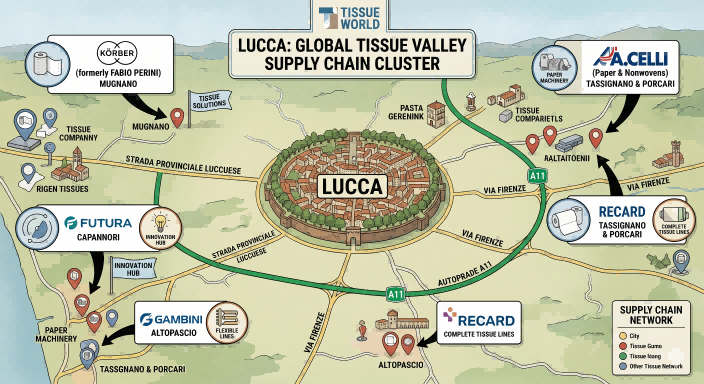
1. Lucca, Italy: The European "Tissue Valley" (Technology Origins & Advanced Automation)
Industrial Heritage
Located in the Tuscany region, Lucca is globally recognized as the "Tissue Valley." Its history is closely tied to the modernization of tissue converting. The region is home to established industry pioneers, such as Fabio Perini, who introduced significant advancements in the rewinding process in the 1960s. Today, Lucca remains a central hub for tissue engineers, featuring a dense network of paper mills, chemical suppliers, and OEM machinery builders.
Advanced Automation & System Integration: Lucca-based manufacturers lead the industry in highly automated, unmanned production systems. Their equipment is designed to minimize manual intervention, utilizing advanced software to monitor and correct tension and embossing variations during operation.
Established Technology Portfolios: Decades of continuous R&D have allowed Italian firms to build extensive patent portfolios, securing their position in the high-end tissue converting segment.
European Environmental Standards: Driven by strict EU regulations, equipment from Lucca typically incorporates low-energy consumption designs and compatibility with biodegradable packaging materials.
Market Positioning
Lucca's machinery is generally engineered for top-tier global paper groups with substantial CAPEX budgets. These buyers prioritize maximum automation, minimal operator dependency, and premium structural design over rapid capital amortization.
2. Green Bay, USA: The North American Industrial Center (Scale & Durability)
Industrial Heritage
Often referred to as the "Toilet Paper Capital of the World," Green Bay, Wisconsin, is central to the North American paper industry. The region's machinery cluster developed alongside major American paper corporations (such as Georgia-Pacific and Kimberly-Clark) to meet the continent's high-volume consumer demands.
Heavy-Duty Structural Engineering: Green Bay machinery prioritizes extreme durability. These machines utilize robust metallurgy and heavy-duty components designed to withstand the stress of continuous, high-volume production cycles over decades.
Large-Scale Processing Capabilities: North American market specifications require large roll diameters and wide jumbo roll processing. Green Bay engineers specialize in building wide-format, continuous rewinders capable of processing standard rolls at a massive scale.
Market Positioning
Green Bay manufacturers are closely aligned with the North American market and major South American paper conglomerates. Their equipment is suited for mature markets requiring large-scale assembly lines where sheer continuous throughput and mechanical resilience are the primary operational objectives.
3. Foshan, China: The Asian Manufacturing Nexus (Supply Chain Efficiency & Agility)
Industrial Heritage
Located in the Pearl River Delta, Foshan's emergence as a global tissue machinery hub reflects the broader evolution of Chinese manufacturing. Initially focused on domestic paper mills, the hub has shifted toward independent R&D and technological optimization. Today, Foshan manufacturers hold practical patents in areas like closed-loop servo control, mechanical tail sealing, and aerodynamic folding systems.
Comprehensive Supply Chain Integration: Foshan benefits from a highly concentrated manufacturing ecosystem. The close proximity of CNC machining facilities and global electrical component suppliers (such as Siemens) enables highly efficient manufacturing and assembly cycles.
Agile Customization: Foshan engineers focus on modular and adaptable engineering. They readily modify embossing technologies or rewinding kinematics to suit specific raw materials. For instance, DCY developed the CJ-C-A Series Automatic V-Fold Production Line to process fragile fibers efficiently, and introduced Glue-Free Tail Sealing Technology to eliminate the ongoing operational costs associated with chemical adhesives.
https://youtu.be/Kcbo4nb3t5k
Responsive Delivery & Support: Operating without the extended lead times typical of legacy Western manufacturers, Foshan provides competitive delivery schedules and deploys dedicated implementation teams for international installations.
Market Positioning
Foshan has become highly competitive in terms of Return on Investment (ROI). After securing a strong presence in Southeast Asia, Latin America, and the Middle East, Foshan machinery is increasingly being adopted in the mid-to-high-end markets of North America and Europe by plant directors seeking advanced servo-automation at a more accessible capital cost.
4. Comparative Analysis: Which Hub Should You Choose?
To provide an objective framework for your 2026 procurement strategy, the following matrix compares the core characteristics of the world's top 3 tissue converting machinery manufacturing hubs.
5. Conclusion: The Future of the Global Supply Chain
The world's top 3 tissue converting machinery manufacturing hubs each offer specific, structural advantages. The decision of where to source equipment should align with your factory's growth stage, operating budget, and market demographic.
However, the industry is shifting. As technological capabilities globalize, competition extends beyond standalone mechanical speed. Procurement focuses are moving toward "Complete Turnkey Solutions," "Implementation Efficiency," and calculating precise "Overall Equipment Effectiveness (OEE)." The Foshan manufacturing cluster, represented by enterprises like DeChangYu (DCY), is adapting to this shift. By leveraging supply chain efficiency and steady technological advancements, Foshan provides the operational agility and cost-effectiveness required in modern converting facilities.
Evaluate the Foshan alternative for your facility. Connect with the engineering team at the DeChangYu Dealership & Contact page today to discuss how our turnkey tissue converting solutions align with your 2026 production goals.







 English
 Español
 العربية
 Português do Brasil
 Русский