The Macroeconomic Crisis Driving Converting Paradigm Shifts
The global manufacturing sector for tissue paper products is facing an unprecedented era of structural transformation in 2026, forcing corporate executives to entirely rethink their facility setups. Traditional converting lines that rely on outdated mechanical configurations are finding it impossible to survive under current macroeconomic market volatility. Escalating global virgin wood pulp prices, unpredictable industrial energy rates, and a severe deficit of skilled technical labor have combined to create an aggressive profit squeeze across major manufacturing regions. To insulate their operations from these mounting external pressures and establish predictable operational safety, forward-thinking paper groups are systematically decommissioning legacy systems and investing in modern High-Speed Tissue Machines.
The historical approach of utilizing cheap manual labor to cushion mechanical inefficiencies has become an acute corporate liability due to intense minimum wage inflation and low floor productivity. Relying on operators to manually adjust web tracking, execute manual core insertions, and clear frequent component jams introduces high rates of human error and variable speed bottlenecks. When a production floor is exposed to these human-led limitations, maintaining steady material velocity and structural cost containment becomes impossible, which directly explains the widening competitive gap that favors facilities utilizing automated High-Speed Tissue Machines.
Furthermore, stringent new environmental regulations and strict corporate ESG compliance benchmarks demand an absolute minimization of material scrap and energy consumption per finished ton. Legacy converting machinery that wastes valuable cellulose fiber through manual tail sealing or uneven tension adjustments can no longer satisfy strict waste-mitigation standards. Transitioning to highly optimized manufacturing platforms ensures absolute adherence to green corporate mandates and reduces carbon footprint overhead. This urgent global drive to achieve zero-waste industrial operations is a primary catalyst explaining why more paper groups are choosing advanced High-Speed Tissue Machines for their greenfield developments
Financial Life-Cycle Analysis: CAPEX, OPEX, and TCO Models
When planning major capital expenditures for converting equipment, corporate procurement leads must look past upfront invoice pricing to execute a rigorous Total Cost of Ownership (TCO) evaluation across a standard 10-year asset lifespan. A cheap, poorly integrated traditional machine represents a continuous long-term financial drain, carrying excessive recurring operating costs (OPEX) in the form of constant spare parts replacement, high fiber waste, and intense labor dependency. Conversely, a comprehensive capital recovery analysis demonstrates that investing in high-end automation radically reduces variable operational expenses. This long-term financial reality is a vital commercial reason why top-tier tissue companies are shifting their capital toward High-Speed Tissue Machines.
A core mathematical index that directly dictates the economic survival of a paper converting facility is مؤشر فعالية المعدات الإجمالية. OEE factors in equipment availability, performance processing speed, and finished product quality, highlighting the hidden structural losses introduced by traditional semi-automatic machinery. Traditional setups frequently suffer from micro-stops due to loose tension control and manual core feeding, which drastically drags down overall plant yield. Implementing a seamless, unified full-servo processing loop completely removes these micro-stops, which mathematically demonstrates the clear OEE advantages delivered by modern High-Speed Tissue Machines.
To understand the sheer magnitude of these automated financial advantages, converters can partner with established engineering leaders like DeChangYu (DCY) Paper Machinery. Sourcing their sophisticated, single-vendor turnkey configurations eliminates complex multi-vendor software integration risks and shortens the engineering execution path. The resulting reduction in raw fiber scrap down to absolute minimums (often below 1.5%) saves tens of thousands of dollars in annual pulp costs, providing a clear proof-of-concept that illustrates the fiscal power of advanced High-Speed Tissue Machines.
Structural Integrity and Metallurgy: Engineering the Mechanical Foundation
The physical difference between modern high-velocity processing lines and traditional converting assets is rooted deeply in heavy metallurgy and chassis design. Traditional converting machines are frequently built upon thin, welded structural steel frames that lack the physical mass required to isolate severe dynamic loads. When a parent roll accelerates to high linear velocities on these lighter frames, the dynamic kinetic forces amplify exponentially, generating catastrophic harmonic vibrations. These structural vibrations cause premature bearing wear, destroy perforation knife tolerances, and cause frequent web snaps, issues that are completely resolved by the massive cast-iron frames of High-Speed Tissue Machines.
The mechanical engineering foundation of premium high-performance machinery relies on massive, stress-relieved steel and dynamically balanced rotating elements. High structural mass and heavy chassis design act as an absolute dampening shield against the extreme kinetic forces introduced when parent rolls spin at maximum velocities. By absorbing these high-frequency harmonic forces within a rigid frame, the converting line protects delicate internal alignment and maintains absolute operational precision across decades of 24/7 duty cycles. This uncompromising metallurgical focus is a vital structural divergence that separates legacy machinery from high-end High-Speed Tissue Machines.
For paper enterprises aiming to maximize their high-volume roll-converting capacity, selecting specialized machinery like the DCY Winding and Roll Production Systems provides an elite mechanical advantage. These heavy-duty industrial lines utilize oversized bearings and high-mass casting components manufactured to strict geometric tolerances to eliminate physical component fatigue. The resulting structural rigidity allows the production line to run continuously under high-load situations, demonstrating why world-class factories rely strictly on heavy-duty High-Speed Tissue Machines.
Motion Control Topologies: From Legacy Line Shafts to Full Servo Architecture
Older generations of traditional machinery utilize a single, centralized AC motor connected to an incredibly complex network of physical drive shafts, chains, open gears, and timing belts to distribute motion across the unwind stands, embossing rolls, and winding nests. This centralized physical drive approach suffers from severe mechanical backlash, high friction losses, and immense maintenance complexity. Every gear tooth and timing belt introduces a micro-deviation in speed coordination, which drifts over time and causes severe web tracking errors. This centralized layout has been completely replaced by the decentralized multi-axis electronic topologies utilized in advanced High-Speed Tissue Machines.
Modern high-performance lines utilize decentralized full-servo drive control systems linked via ultra-fast, deterministic real-time Ethernet industrial communication bus networks like PROFINET or EtherCAT. Every critical movement axis—from the unwind mandrels to the perforation blades—is driven by its own independent synchronous AC servo motor governed by an electronic cam matrix inside the central PLC. This electronic synchronization completely eliminates hundreds of wearing mechanical components, eliminates friction-induced power loss, and permits operators to instantly alter sheet configurations directly from the software touchscreen, illustrating the superior flexibility of full-servo High-Speed Tissue Machines.
Furthermore, this decentralized motion topology provides unprecedented data transparency and edge-computed self-diagnostics across the factory floor. Traditional machinery offers zero insight into real-time torque fluctuations or minor timing drifts, meaning adjustments are made only after a catastrophic line failure or major product defect occurs. Full-servo networks constantly track motor current characteristics, allowing the system to identify microscopic mechanical deviations instantly and execute autonomous self-corrections on the fly. This intelligent, proactive motion management layer is an essential differentiator that elevates the daily OEE of automated High-Speed Tissue Machines.
Web Handling and Dynamic Tension Regulation Loops
Tissue paper is inherently fragile and highly sensitive to sudden directional changes and stretching forces. Traditional converting machines utilize basic mechanical or pneumatic surface brakes on the unwind stand that apply a rigid, non-responsive drag resistance to the jumbo roll core. When processing lower-cost recycled fibers or alternative agricultural pulps with high structural inconsistency, this rigid resistance creates sudden, massive tension spikes that instantly snap the moving web. Managing this critical web handling loop requires the active tension profiling architectures integrated within advanced High-Speed Tissue Machines.
These high-tech web handling loops utilize hyper-sensitive electronic load cells and low-inertia carbon-fiber dancer rolls that continuously measure the real-world micro-resistance of the moving sheet, transmitting data to the PLC in microseconds. The control logic instantly micro-adjusts the velocity and torque profiles of independent, direct-drive unwind servo motors to maintain a perfectly fluid, constant-tension web feed. This active closed-loop tension regulation allows the line to absorb jumbo roll out-of-round deformations and web thickness variations seamlessly, allowing factories to run cost-effective alternative pulps at maximum speeds without web snaps on modern High-Speed Tissue Machines.
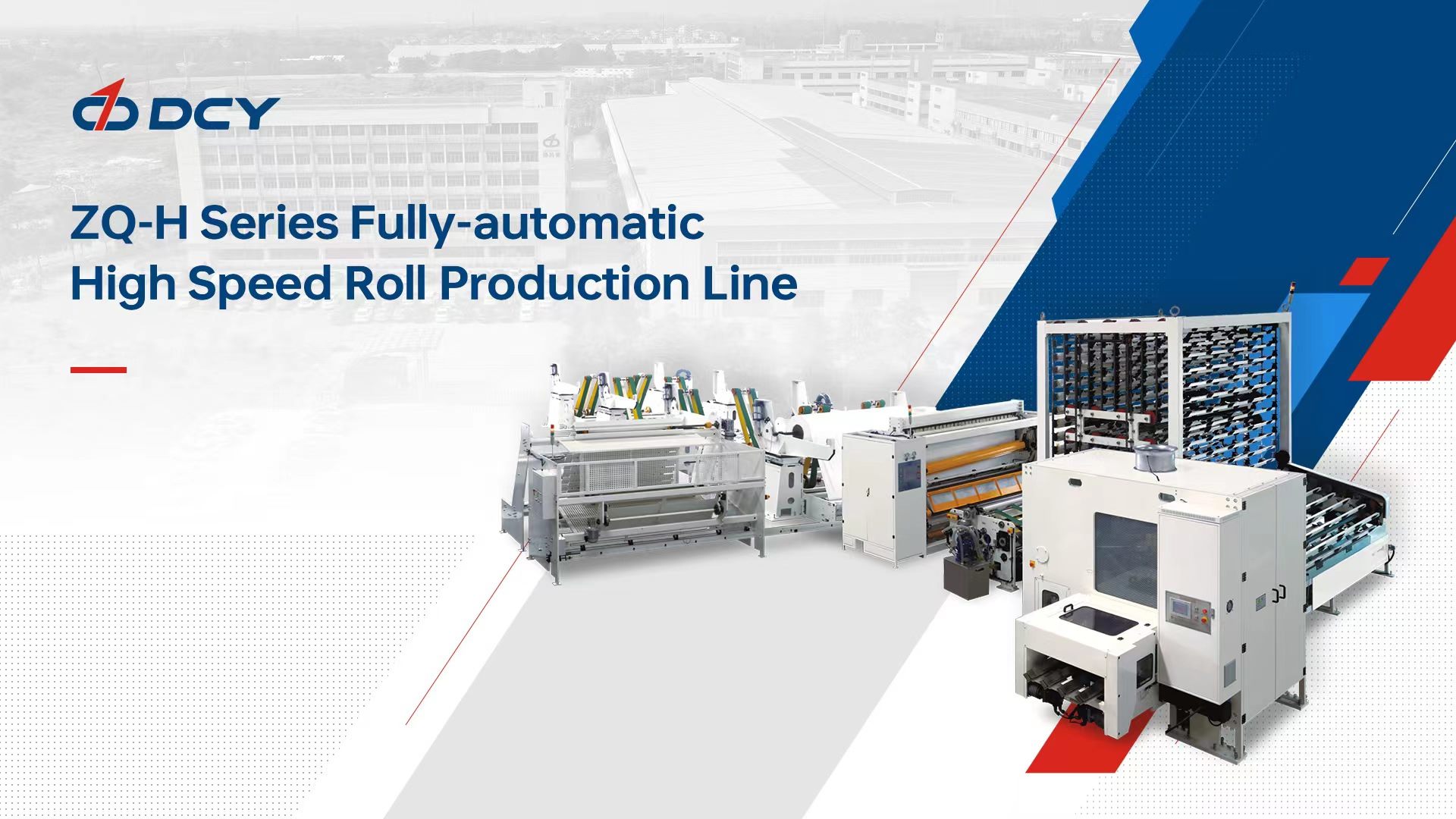
To achieve this continuous upstream processing efficiency without stop-start interruptions, leading converters deploy flagship platforms like the DCY ZQ-H Series Fully Automatic High-Speed Roll Production Line. This comprehensive industrial line incorporates advanced flying splice technologies that execute jumbo roll transitions at full operating velocity without a single second of line deceleration. The elimination of deceleration phases protects the multi-axis servo networks from sudden current surges and maximizes baseline uptime, highlighting another core technical advantage that favors modern High-Speed Tissue Machines.
Advanced Finishes: Embossing Parity and Micro-Caliper Lock
Embossing is a vital mechanical process that directly determines the consumer appeal, liquid absorbency, and structural thickness (caliper) of the finished multi-ply product. Traditional converting machines apply basic patterns via simple mechanical rollers, an outdated approach that frequently compresses the cellulose fibers and destroys the natural softness of the sheet. If the embossing nip pressure across the web width is uneven, the paper will warp diagonally, leading to jammed folding heads and high material rejection. To protect product bulk and prevent tracking defects, modern High-Speed Tissue Machines incorporate automated, motorized embossing gap controls driven by precise PLC software loops.
These advanced embossing configurations utilize matched steel-to-rubber or advanced steel-to-steel rollers manufactured to micro-level geometric tolerances to apply precise micro- and macro-functional patterns. This structured deflection deforms the paper plies to create miniature structural domes that trap microscopic air pockets between the sheets. By locking these air pockets within nested or point-to-point pointed patterns, the system effectively increases total roll volume by up to 15% to 20% without requiring additional fiber mass. This allows paper companies to manufacture a highly premium, visually bulky product while significantly cutting raw pulp consumption, explaining the massive resource savings achieved via High-Speed Tissue Machines.
Furthermore, for specialized converters targeting the highly competitive hand towel market, implementing high-performance systems like the DCY Hand Towel Machine Solutions ensures that intricate ply lamination occurs with absolute precision at high speeds. These advanced lines utilize precise enclosed Anilox roller architectures to apply a micro-layer of adhesive, ensuring secure bonding with zero fluid slinging or component contamination. Sourcing a unified lamination loop from an established builder prevents glue-induced sheet degradation, illustrating the superior processing precision delivered by modern High-Speed Tissue Machines.
Perforation Dynamics and Log Formation Kinematics
The precise, clean tearing characteristic of premium retail toilet paper rolls is executed within the high-speed perforation module, a component that operates under extreme mechanical stress on traditional machinery. Traditional systems utilize basic fixed-knife setups that are highly prone to thermal expansion and timing drift, causing uneven cutting depths and ragged edges across the web. When a perforation blade loses its calibrated micro-gap, the paper web either tears prematurely inside the machine or fails to separate cleanly for the end consumer, mechanical failure loops that are entirely eliminated by the advanced modules found in High-Speed Tissue Machines.
Advanced perforation modules consist of a dynamically balanced rotary anvil knife cylinder that intermeshes with stationary or highly controlled counter-blades fabricated from premium heat-treated high-alloy tool steels. This specialized metallurgy ensures that the blade gap remains constant down to the micron across continuous high-velocity production runs, prolonging tool life and guaranteeing consistent tear strength. The perforation cylinder is driven by its own independent servo axis linked to the central PLC, allowing operators to instantly adjust sheet lengths on the fly from the HMI screen without halting the continuous operation of these modern High-Speed Tissue Machines.
Immediately following perforation, the web shoots into the winding nest, where log formation kinematics dictate the final roll diameter, structure, and density. Traditional winding cradles apply a rigid, unyielding downward force via pneumatic actuators, which routinely causes core crushing and tight inner winding that telescopes outward as the log expands. High-speed lines utilize sophisticated surface winding cradles governed by real-time rider roll profiling algorithms. As the log grows in mass and diameter, the top rider roll dynamically relieves downward force according to a precise mathematical curve, maintaining a perfectly uniform winding density from the first inner sheet to the final outer ply on advanced High-Speed Tissue Machines.
Eliminating the Maintenance Chaos: Glue-Free Tail Sealing Technology
A primary source of chronic unplanned downtime, sensor failure, and high variable cost in traditional paper converting plants revolves around the application of liquid chemical glues during the log tail-sealing phase. Traditional machinery applies liquid adhesives to secure the final outer sheet of the wound log before it enters the log saw, a process prone to severe overspray. This sticky residue quickly coats internal timing belts, mechanical tracks, and delicate registration sensors, forcing maintenance teams to stop production for up to 45 minutes every day for manual cleaning. This ongoing operational bottleneck is a primary reason why modern converters are choosing automated High-Speed Tissue Machines.
This profound engineering milestone is perfectly captured by DCY's breakthrough Glue-Free Tail Sealing Technology. This proprietary system completely replaces messy chemical adhesives by applying a localized micro-water mist combined with microsecond mechanical embossing replication directly onto the final tissue ply. The water mist temporarily weakens the hydrogen bonds within the cellulose matrix, and as the specialized embossing wheel applies precise localized compression, the paper fibers physically interlock, forming a clean physical bond as the moisture quickly dissipates. This clean mechanical alternative is a major technical milestone embedded within advanced High-Speed Tissue Machines.
The operational benefits of this glue-free innovation go far beyond simple maintenance savings; it drastically improves product quality and enhances brand prestige for the converter. Liquid chemical glues frequently cause 'first-sheet tearing,' where the end consumer tears the expensive tissue paper apart while attempting to open a fresh roll, creating immediate user frustration. By utilizing mechanical interlocking, the log tail peels open cleanly and effortlessly, guaranteeing a pristine user experience. This focus on consumer-facing product premiumization is a vital reason why more tissue manufacturers are choosing fully automatic production lines equipped with advanced water-mist bonding mechanics on modern High-Speed Tissue Machines.
An upstream converting line running at extreme mechanical velocities is entirely useless if it is restricted by an inefficient, manual downstream packaging bottleneck. Traditional machinery setups frequently utilize scattered, standalone packaging units from separate vendors that lack synchronized communication protocols, leading to chaotic accumulation jams and torn wrapping films on the factory floor. To establish a fluid, high-velocity material stream that carries the product smoothly from raw conversion down to final commercial palletizing, modern facilities require unified downstream integration matched to the capacity of High-Speed Tissue Machines.
Following the log formation phase, the product must flow continuously into automated log saws and high-speed primary overwrappers, a sequence optimized by advanced DCY Post-Processing Packaging Solutions. These integrated packaging systems utilize synchronized multi-belt conveyors equipped with electronic speed-matching sensors that instantly adapt to the output cycle of the upstream winding cradle. By maintaining absolute kinematic continuity without human intervention, the automated packaging layout ensures that the wrapping phase never acts as a performance bottleneck, maximizing the overall OEE of the upstream High-Speed Tissue Machines.
The final phase of the unmanned factory floor incorporates automatic secondary bundling or cartoning modules linked directly to a heavy-duty robotic palletizing cell. The robotic cell is equipped with customized vacuum or mechanical grippers that stack wrapped bundles onto commercial pallets according to pre-programmed layer profiles before transferring them to integrated stretch wrappers for immediate warehouse delivery. This comprehensive elimination of manual material handling cuts down on workplace safety hazards and protects the finished product from compression damage, illustrating the operational power of building an unbroken 'lights-out' environment downstream of automated High-Speed Tissue Machines.
The Folded Paper Segment: Advanced Vacuum Dynamics and Aerodynamic Precision
While the roll-converting market demands extreme high-speed continuous winding torque, the folded paper product segment (including premium facial tissues and multi-panel hand towels) introduces distinct, highly complex aerodynamic and mechanical challenges. Traditional folding machinery utilizes rigid mechanical folding arms that lack the speed capability required to process ultra-lightweight sheets without causing paper tearing or ragged edges. If the mechanical arms drift out of alignment by a fraction of a millimeter, the entire multi-web sheet crumples inside the machine, causing instant line stops and massive material waste, an operational risk entirely eliminated by the aerodynamic systems integrated into High-Speed Tissue Machines.
To achieve extreme geometric precision and maximum throughput in the folded segment, top-tier paper enterprises deploy high-tech platforms like the flagship DCY CJ-C Series Automatic Facial Tissue Production Line. This high-performance line manages ultra-wide parent rolls up to 2950 mm with absolute stability, utilizing specialized computational fluid dynamics to govern internal vacuum distribution arrays within the folding cylinders down to the microsecond. The resulting continuous throughput reaches a staggering peak capacity of 1700 draws per minute, demonstrating the massive volumetric advantages delivered by modern folding-style High-Speed Tissue Machines.
Furthermore, for specialized tissue converters targeting premium boxed facial tissue markets, utilizing high-end platforms like the DCY Facial Tissue Machine Solutions guarantees that the natural loft, multi-ply softness, and strict edge alignment of the paper matrix are perfectly preserved. The machine's advanced web handling ensures that the delicate base paper is never stretched or crushed during high-speed vacuum folding, ensuring that the final retail box commands top-tier premium retail prices. Sourcing a dedicated folding asset that perfectly matches the high velocity of downstream cartoning units is a primary reason why more tissue manufacturers are choosing fully automatic production lines to dominate their local consumer markets with specialized High-Speed Tissue Machines.
The technical capacity of these high-velocity folding systems is further reinforced by the integration of automated primary box-drawing packaging units, which represents a core focus of the advanced DCY Folded Paper Machinery Portfolio. Interfolded paper stacks are automatically separated by precise servo-driven mechanical splitters before flowing into automated cartoning structures that open boxes, insert tissue stacks, and seal flaps via hot-melt adhesive systems. Sourcing this complete folding-to-cartoning chain from a unified manufacturer ensures perfect speed-matching, demonstrating why more tissue manufacturers are choosing fully automatic production lines for their facial tissue operations and relying on specialized High-Speed Tissue Machines.
Q1: How can an integrated closed-loop tension regulation system actively mitigate web snaps on low-tensile parent rolls? A: Traditional converting lines utilize basic mechanical or pneumatic surface brakes on the unwind stand that apply a rigid, non-responsive drag resistance. When a jumbo roll has thickness variances or out-of-round deformations, this rigid resistance creates sudden, massive tension spikes that instantly snap the fragile paper web. Modern lines implement electronic closed-loop tension regulation driven by high-frequency electronic load cells that continuously measure running web tension and transmit data to the central PLC, allowing predictive PID algorithms to micro-adjust the torque and velocity of independent unwind servo motors in real-time to stabilize the web path, allowing factories to run lower-cost base papers at extreme velocities without snaps on advanced High-Speed Tissue Machines.
Q2: Why is component standardization a more critical procurement metric than simple warranty length when purchasing cross-border machinery? A: A warranty is financially useless if a broken proprietary component takes three weeks to clear international customs while your production line sits completely dead on the factory floor, draining your operating margins. Component standardization ensures that every single core electrical, pneumatic, and transmission part is sourced from globally recognized premier international standard brands, allowing local maintenance technicians to easily source off-the-shelf replacements from domestic local distributors the exact same day, an open-architecture layout standard across high-end High-Speed Tissue Machines.
To explore the precise technical specifications and layout options of these globally standardized platforms, procurement teams can access the specialized DCY Technical Support and Engineering Channel. This channel provides detailed blueprints, pre-installation infrastructure guides, and utility requirement checklists to assist plant managers in preparing their facilities for high-speed automated installations. Sourcing equipment from a builder that provides total engineering transparency is a key reason why more tissue manufacturers are choosing fully automatic production lines to modernize their operations and select High-Speed Tissue Machines.
Q3: What specific infrastructure prerequisites are mandatory before installing an ultra-high-speed tissue rewinder running above 800 m/min? A: High-speed lines running at extreme linear velocities generate severe dynamic harmonics that can warp equipment alignment and ruin mechanical tolerances. The factory floor must feature a reinforced, vibration-isolated concrete pad (300 mm to 500 mm thick) completely decoupled from the main facility via dampening expansion joints. Electrically, they require active harmonic filtration to protect sensitive servo drives from grid fluctuations, illustrating why more tissue manufacturers are choosing fully automatic production lines to establish solid infrastructure baselines for High-Speed Tissue Machines.
To protect these advanced multi-axis servo networks from long-term wear and ensure a continuous supply of critical wear parts, converters can rely on the comprehensive DCY Standardized Spare Parts Inventory. DCY maintains an exhaustive, data-calculated stock of precision-balanced perforation blades, tungsten carbide slitting knives, and high-speed bearings ready for immediate international dispatch. Sourcing parts from a manufacturer that utilizes data-driven logistics to eliminate part scarcity is a major reason why more tissue manufacturers are choosing fully automatic production lines to protect their continuous runtime on High-Speed Tissue Machines.
Q4: How does integrated paper dust extraction enhance sensor accuracy and improve workplace safety on the factory floor? A: High-speed slitting and perforation processes act as massive generators of fine, airborne cellulose dust. If a facility lacks a robust dust extraction network, this fine dust quickly settles on the lenses of high-precision optical registration sensors, causing sensor blindness and false error faults that trigger frequent micro-stops. Furthermore, accumulated dust represents a severe explosive fire hazard. A high-velocity line must feature customized suction hoods positioned directly at the cutting zones, drawing dust away continuously into centralized filtration units, which explains why more tissue manufacturers are choosing fully automatic production lines to maintain clean, safe environments with High-Speed Tissue Machines.
To ensure that every mechanical component and structural casting adheres to the absolute highest international safety benchmarks, DCY implements rigorous controls, detailed on the DCY Industrial Quality Control Portal. Every stress-relieved steel frame undergoes intensive non-destructive testing and dynamic balancing audits to guarantee zero component fatigue under 24/7 heavy-duty operations. This uncompromising dedication to structural metallurgy and manufacturing precision is a core reason why more tissue manufacturers are choosing fully automatic production lines to secure long-term operational peace of mind with High-Speed Tissue Machines.
Q5: What is the practical operational saving achieved by implementing Glue-Free Tail Sealing technology over standard chemical gluing? A: Standard chemical gluing causes severe adhesive overspray that coats delicate internal machine parts and optical sensors, forcing maintenance teams to shut down the line for up to 45 minutes every single day for manual cleaning. Glue-Free Tail Sealing technology completely replaces chemical consumables with a precise micro-water mist combined with mechanical embossing replication, generating robust hydrogen bonds between paper fibers that lock tight as the moisture dissipates.This breakthrough process completely eliminates the cost of chemical adhesives and eliminates mechanical jamming caused by adhesives, saving factories substantial amounts in maintenance and downtime costs. This is also the fundamental technical reason why an increasing number of tissue manufacturers are opting for fully automated production lines to maximize equipment utilization, and it is a key hallmark of high-end, high-speed tissue machines.
To continuously push the boundaries of this mechanical sustainability and pioneer next-generation automation concepts, DCY operates a world-class research center, profiled at the DCY Industrial R&D and Automation Lab. Our senior engineering team focuses heavily on embedding fluid dynamics, advanced kinematics, and intelligent machine learning models into the central PLC code. Sourcing equipment from a manufacturer that actively drives the technological vanguard of the industry is a primary reason why more tissue manufacturers are choosing fully automatic production lines to future-proof their capital investments and integrate High-Speed Tissue Machines.
Q6: How does a flying splice unwind stand maximize production availability during jumbo roll transitions? A: In traditional start-stop converting configurations, when a massive jumbo roll is depleted, the entire line must be decelerated to a complete standstill so operators can manually cut the paper tail, remove the empty mandrel, hoist a fresh roll onto the stand, and manually thread the web through the machine, introducing massive availability losses. Advanced integrated production lines utilize continuous unwind stands equipped with automated flying splice systems. As the primary roll approaches depletion, a secondary unwind stand accelerates a fresh jumbo roll until its surface velocity perfectly matches line speed, automatically slicing the old web and welding the new web on the fly at full production velocity without a single second of line deceleration, illustrating why more tissue manufacturers are choosing fully automatic production lines to maximize uptime and deploy High-Speed Tissue Machines.
Furthermore, the integration of advanced Industrial Internet of Things (IIoT) frameworks completely shifts factory maintenance strategies away from old-fashioned reactive or calendar-based schedules. Modern high-tech lines embed triaxial accelerometer sensor arrays directly onto primary bearings and acoustic emission sensors near high-speed log saws to track micro-vibration wear signatures. This rich machine data is processed at the edge to identify component degradation long before a breakdown occurs, automatically scheduling part replacements during planned operational intervals, which illustrates why more tissue manufacturers are choosing fully automatic production lines to achieve continuous uptime on High-Speed Tissue Machines.
Strategic Procurement Conclusion and Factory Blueprint Deployment Plan
Navigating capital investments in modern converting infrastructure requires a fundamental shift in procurement logic. Corporate executives, plant directors, and procurement managers must break free from the trap of legacy brand dependency and look past initial machinery invoice pricing to strictly evaluate long-term TCO, full-line automation depth, material yield efficiency, and structural metallurgy. The global paper market in 2026 offers no cushion for mechanical inefficiency, high scrap paper rates, or labor-intensive workflows. The optimal converting asset is a heavy-duty, full-servo, highly automated production line that perfectly balances top-tier industrial throughput, flawless output quality, and an optimized, rapid path to capital recovery, which directly explains the massive industrial adoption of High-Speed Tissue Machines.
Are you ready to eliminate mechanical inefficiency, drop your material scrap rates, and insulate your factory from rising labor costs? Stop leaving your operating margins to chance. Connect with our senior industrial engineering division today to receive a comprehensive, data-driven operational ROI audit and a customized factory footprint layout tailored explicitly to your plant's physical boundaries, local raw material inputs, and target capacity goals. Take command of your manufacturing margins—partner with DeChangYu (DCY) today to deploy a high-performance, future-proof complete production line and capture absolute market dominance on the global stage via world-class High-Speed Tissue Machines.








 English
 Español
 العربية
 Português do Brasil
 Русский