Choosing a tissue paper machine based on production capacity sounds straightforward until a buyer starts comparing quotations. One supplier may quote meters per minute, another may quote tons per day, another may quote rolls per minute, and another may only mention packs per minute. The numbers look impressive, but they do not always answer the most important business question: how much saleable tissue can your factory produce every shift with your paper, your operators, your packaging format, and your market demand?
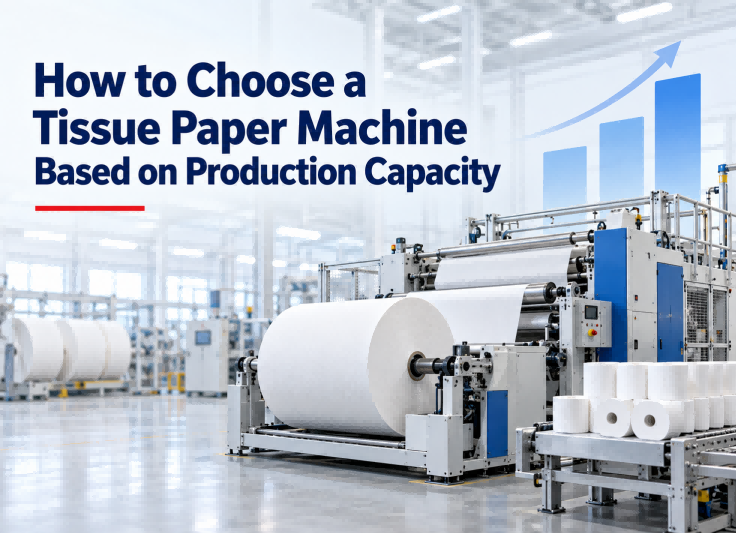
How to Choose a Tissue Paper Machine Based on Production Capacity
This is why production capacity should never be judged only by maximum machine speed. In tissue converting, real output depends on jumbo roll width, GSM, ply count, finished product size, embossing depth, perforation pitch, rewinding stability, folding accuracy, log saw output, packaging flow, operator skill, maintenance discipline, and the number of hours the line can run without interruption. A fast tissue paper machine can still become a low-output investment if one downstream section cannot keep pace. A moderate-speed line can be more profitable if it runs steadily, wastes less paper, and matches the factory's sales volume.
This guide explains how to choose a tissue paper machine based on practical production capacity. It is written for factory owners, production managers, procurement teams, and tissue converters who need to compare equipment for toilet paper, kitchen towel, JRT, facial tissue, hand towel, napkin, slitting, cutting, and packaging-related production. It also shows how DCY's معدات تحويل المناديل and integrated line planning can help buyers avoid mismatched capacity across the full production process.
Quick Answer: How Do You Choose Capacity for a Tissue Paper Machine?
Choose a tissue paper machine by starting from your target finished product and monthly sales demand, then convert that demand into required output per hour or per shift. Add a realistic efficiency factor for downtime, changeover, paper variation, sampling, cleaning, maintenance, and packaging losses. Then compare machines by stable operating speed, not only maximum speed. Finally, check whether upstream unwinding, converting, cutting, folding, wrapping, case packing, labor, power supply, and workshop space can support the same output.
A good capacity decision should answer five questions clearly. What product will you produce? How much do you need per day or per month? How many shifts will you run? What level of automation fits your labor cost and technical team? Which part of the line will become the bottleneck? If the answer is unclear, the buyer is not ready to select a final machine model.
Why Production Capacity Matters in Tissue Converting
Production capacity controls more than output. It affects working capital, raw material purchasing, warehouse size, labor planning, electricity consumption, spare parts planning, and delivery promises to customers. For B2B tissue producers, a tissue paper machine is not only a mechanical asset. It is the backbone of customer reliability. If the line cannot deliver stable output, the sales team cannot promise volume to retailers, distributors, hotels, hospitals, or private-label customers.
There are two common mistakes. The first is undercapacity. A factory buys a low-output line because the initial investment is smaller, then discovers that the line cannot supply peak-season orders. Operators work overtime, maintenance is rushed, and quality becomes unstable. The second mistake is overcapacity. A factory buys a top-speed line before sales channels are mature, so the machine runs below its efficient operating range, inventory grows, cash flow tightens, and operators struggle with unnecessary complexity.
The right answer is not the biggest tissue paper machine available. The right answer is a line that delivers repeatable, saleable output at a cost structure your business can support, with enough room for planned growth. This is where experienced engineering support matters. DCY's solution proposal process can help buyers align product format, capacity, automation, installation, and future expansion before equipment selection becomes locked.
Start With Product Type Before Machine Speed
Different tissue products measure capacity differently. A toilet roll line may be discussed in meters per minute, logs per minute, cuts per minute, rolls per minute, or tons per day. A facial tissue line may be measured in sheets per minute, pumps per minute, logs per minute, or packs per minute. A slitting rewinder may be quoted in meters per minute or finished roll diameter. A packaging machine may be measured in packs per minute. Comparing these numbers directly can mislead buyers.
Before selecting a tissue paper machine, define the product family first. For toilet paper and kitchen towel, key specifications include roll width, roll diameter, core diameter, sheet length, perforation pitch, number of sheets, ply count, embossing pattern, tail sealing method, and packaging quantity. For facial tissue, define unfolded sheet size, folded size, ply count, GSM, sheets per pack, stack height, soft pack or box pack format, and whether bottom-pull tissue is required. For hand towel, define fold type, dispenser compatibility, absorbency target, and pack height.
Understand The Three Capacity Numbers Suppliers May Quote
A serious buyer should ask every supplier to separate three capacity figures: theoretical maximum speed, stable running speed, and expected finished output per shift. These are not the same. A tissue paper machine may reach a high top speed in a demonstration, but normal production includes reel changes, paper breaks, web threading, blade replacement, cleaning, embossing adjustment, SKU changeover, operator response time, and packaging interruptions.
Capacity Number
What It Means
Why It Matters
Theoretical maximum speed
The highest rated machine speed under ideal conditions.
Useful for technical comparison, but not enough for investment planning.
Stable running speed
The speed the machine can maintain with acceptable quality using normal materials.
Better for estimating daily output and operator workload.
Saleable output per shift
Finished product that meets quality and packaging requirements after downtime and waste.
The most important number for business planning and customer delivery.
When a supplier quotes a tissue paper machine, ask what paper grade, GSM, product size, embossing pattern, operator count, and packaging method were used to calculate the capacity. If these conditions are not defined, the capacity number is incomplete. A quote that says 'high speed' but does not define finished output can create expensive confusion after installation.
A Simple Capacity Calculation Framework
A practical capacity calculation starts with market demand and works backward. Suppose a factory expects to sell a certain number of rolls, packs, or tons per month. That demand must be divided by working days and shifts, then adjusted for scrap, sampling, planned downtime, and unplanned stops. This approach is stronger than choosing a tissue paper machine only because its brochure speed looks attractive.
A useful planning formula is: required hourly output = target monthly demand divided by working days, divided by shifts, divided by effective production hours per shift, then multiplied by a safety factor. Many factories apply a safety factor for waste and interruptions. The exact factor depends on material quality, operator skill, product complexity, maintenance condition, and packaging reliability.
For example, a factory that needs 300 tons per month and runs 25 working days must produce 12 tons per day. If it runs two shifts of 8 hours, the gross target is 0.75 tons per hour before considering downtime. If the factory expects 80 percent practical efficiency, the line must be capable of about 0.94 tons per hour of stable capacity to meet the target. This type of calculation helps buyers choose the right production class without relying on guesswork.
The same logic applies to facial tissue packs, toilet rolls, kitchen towel logs, or JRT products. The unit changes, but the thinking remains the same: define the target product, define the available hours, apply realistic efficiency, and then match the whole production line.
Capacity Levels: Small, Medium, High, and Fully Integrated Lines
Not every factory needs the same capacity class. A startup testing local distribution may need a balanced line that protects cash flow and supports a limited SKU range. A regional supplier with confirmed supermarket and distributor orders may need higher automation and stronger packaging integration. A large export-oriented group may need multiple high-speed lines with matched upstream and downstream equipment.
Capacity Class
Typical Buyer
Best-Fit Machine Strategy
Main Risk If Mismatched
Small to entry-level
New factories, local wholesalers, limited SKUs
Simple, reliable converting equipment with room to upgrade packaging later
Buying too much capacity before sales channels are stable
Medium capacity
Growing tissue converters and regional brands
Semi-automatic or automatic lines with stable output and flexible changeover
Undersizing downstream cutting or wrapping
High capacity
Established factories with repeat orders and multiple shifts
Fully automatic lines with matched rewinding, cutting, folding, packing, and service planning
Ignoring technical training and maintenance discipline
Integrated large-scale
Export suppliers and leading tissue producers
Full-line engineering, automation, wide-width machines, strong quality control, and spare parts planning
Treating individual machines as separate purchases instead of one production system
DCY's strength is especially relevant for medium, high-capacity, and integrated projects because the company works across roll solutions, fold solutions, jumbo reel solutions, complementary equipment, smart packaging, and palletizing-related systems. Buyers can review DCY's tissue converting line equipment و types of tissue converting equipment articles to understand how a complete converting line is structured.
Match Capacity To The Full Line, Not One Machine
One of the most common capacity problems is a mismatched line. A buyer may select a powerful rewinder, then pair it with a slower log saw cutter or a manual packaging section. The result is accumulation, stop-start operation, labor stress, and lower actual output. A tissue paper machine should be selected as part of a production flow, not as a disconnected machine.
For roll products, the flow may include jumbo roll unwinding, embossing, perforating, rewinding, tail sealing, log accumulation, cutting, wrapping, bundling, case packing, and palletizing. For facial tissue, the flow may include unwinding, embossing, folding, counting, stacking, compression, cutting, soft pack wrapping or carton packing, and case packing. Each stage must absorb the output of the previous stage.
DCY's fully automatic tissue paper cutting machine related product category, tissue cutting machines guide, and آلة تغليف المناديل guide are useful supporting resources because cutting and packaging often determine actual finished output. A fast rewinder does not create real capacity if finished rolls or folded packs cannot be cut and wrapped at the same rhythm.
How Different Product Lines Affect Capacity
Toilet Paper and Kitchen Towel Capacity
For toilet paper and kitchen towel, capacity is affected by jumbo roll width, rewinding speed, finished roll diameter, core diameter, perforation pitch, embossing type, tail sealing method, and log saw performance. DCY's ZQ-H600 high-speed rewinder is used in a 600 fully automatic high-speed toilet roll, JRT, and kitchen towel production line. Company materials list maximum jumbo roll widths of 2850 or 3650 mm and production speed up to 500 m/min with core under suitable configuration.
A buyer selecting a tissue paper machine for roll products should not compare speed alone. Larger roll diameter, premium embossing, more sheets per roll, glue-free tail sealing, or different packaging quantities all change output. For related reading, DCY's tissue roll machines, toilet roll vs jumbo roll converting line, and toilet roll rewinder applications pages help explain roll-product decisions.
Facial Tissue and Folded Tissue Capacity
For facial tissue, capacity depends on sheets per minute, number of lanes, folded size, stack height, paper GSM, ply count, folding stability, counting accuracy, and packaging speed. DCY's CJ-C interfolder family includes configurations with maximum jumbo roll widths of 1500, 2050, 2950, and 3700 mm. Company materials list production speed up to 1700 sheets per minute and 13 to 15 logs per minute under suitable conditions. The CJ-C-A series is focused on automatic V fold facial tissue production, with catalog data showing 1000 to 1200 pumps per minute and 13 to 15 pieces per minute.
For slitting and rewinding, capacity is usually linked to web speed, raw paper width, finished roll diameter, minimum slitting width, side trimming, blade system, tension control, and dust removal. DCY's FC-IV high-speed slitting rewinder has catalog data showing raw paper widths of 2850 or 3700 mm, production speed of 1000 to 1200 m/min, and finished product diameter options up to 1800 mm, 2300 mm, or custom specification. The FC-II slitting rewinder is a lower speed configuration, with catalog data showing 250 to 300 m/min.
This comparison shows why capacity class matters. A buyer handling wide jumbo rolls or preparing material for high-volume converting will need a different machine than a smaller workshop. DCY's FC series slitting rewinder, سلسلة FC مع طلاء و converting process pages can support this section with deeper internal links.
Automation Level and Labor Cost
Automation changes real capacity because it changes how consistently the line can run. A semi-automatic tissue paper machine may be suitable in markets where labor cost is lower, technical maintenance is simple, and production targets are moderate. A fully automatic line is usually better where labor is expensive, hygiene requirements are strict, output volume is high, and the factory needs one operator to supervise more equipment.
However, automation is not only about reducing labor. It also requires better technician training, stronger spare parts planning, stable power supply, and a disciplined maintenance system. A factory should not buy a highly automated machine if it cannot support the controls, sensors, servo systems, PLC, HMI, and changeover procedures. DCY can work with Siemens PLC systems and can also support Inovance according to project requirements, which helps buyers match control systems with local service familiarity.
The practical capacity question is: which automation level will produce the highest stable output in your factory, with your people? In high labor cost regions, fully automatic solutions can make sense. In labor-abundant markets, a staged approach may be better: start with a reliable converting line, then add higher-speed packaging, palletizing, or smart handling when sales volume supports it.
Raw Material, GSM, Ply Count, and Waste
Raw paper quality can change the real capacity of a tissue paper machine. Paper with unstable GSM, weak tensile strength, high dust, moisture variation, or inconsistent softness can cause web breaks, edge tracking problems, poor perforation, folding defects, and packaging instability. A machine that runs smoothly with ideal paper may not perform the same with local recycled stock, bamboo fiber, or lightweight tissue grades.
Buyers should ask for testing based on their expected paper specification. For facial tissue, DCY materials list 2 to 3 layers with single-layer 11 to 18 g/m2, or 3 to 5 layers with single-layer 11 to 15 g/m2 for certain interfolder configurations. For hand towel, the listed range includes 2 layers with single-layer 17 to 22 g/m2, or single-layer 28 to 40 g/m2. These numbers illustrate why material compatibility must be part of capacity planning.
Waste is also capacity. If two machines have the same headline speed but one creates fewer breaks, cleaner trimming, more accurate cutting, and fewer rejected packs, the lower-waste line produces more saleable output. For this reason, buyers should ask suppliers about start-up scrap, web break frequency, trimming loss, blade maintenance, embossing changeover, and packing reject rates.
Workshop Layout, Utilities, and Installation Capacity
A tissue paper machine cannot reach its expected capacity if the workshop is not prepared. Capacity planning should include machine footprint, operator access, raw material staging, finished goods flow, scrap handling, compressed air, electrical power, dust collection, ventilation, crane or forklift access, spare parts storage, and maintenance clearance. A wide-width production line may deliver higher output, but it also needs more floor space and stronger logistics inside the factory.
For overseas buyers, voltage and frequency should be confirmed early. Many Chinese machines are designed around 380V and 50Hz unless customized. Factories in countries with 220V, 60Hz, or other local standards need proper electrical planning. Packaging, air compressors, conveyors, and peripheral machines should be checked at the same time. DCY's implementation support, توصيل الطلبات و after-sale warranty pages are good internal links around installation and service concerns.
Buying Guide: Step-by-Step Capacity Selection
Step
Decision
What to Check
1
Define the finished product
Toilet roll, kitchen towel, JRT, facial tissue, hand towel, napkin, or jumbo roll. Include sizes, ply, GSM, pack format, and quality target.
2
Calculate market demand
Estimate monthly demand by channel, then convert it into daily, shift, and hourly output.
3
Apply realistic efficiency
Account for downtime, paper variation, cleaning, changeover, maintenance, sampling, and packaging rejects.
4
Choose capacity class
Select small, medium, high, or integrated line capacity based on confirmed demand and growth plan.
5
Match every line section
Unwinder, rewinder, folder, cutter, wrapper, conveyor, case packer, and palletizing capacity should be aligned.
6
Verify automation fit
Choose fully automatic or semi-automatic based on labor cost, technical team, budget, and quality requirement.
This approach turns the buying process from a vague speed comparison into a technical and commercial decision. It also makes supplier discussions clearer. Instead of asking 'How fast is this machine?', the buyer can ask 'What stable saleable output can this line produce for my product specification, working schedule, and packaging plan?'
Questions to Ask Suppliers Before Ordering
What product specification is the quoted capacity based on?
Is the output number theoretical maximum speed, stable running speed, or finished output per shift?
How much efficiency loss should we expect from paper change, roll change, cleaning, and SKU changeover?
How many operators are required per shift at the recommended capacity?
Can the downstream cutting, wrapping, and packing sections match the converting output?
What happens to output when we change roll diameter, GSM, ply count, embossing pattern, or pack format?
Can you test our raw paper or a similar material before final confirmation?
What PLC, HMI, inverter, servo, and electrical components are used?
What spare parts are recommended for the first year of operation?
What installation, commissioning, training, and after-sales response can be provided?
These questions are practical, but they reveal whether the supplier understands real production. A strong supplier will discuss the whole line, not only the speed of a single machine. Buyers can also read DCY's tissue production line buying questions و paper converting with DCY for broader procurement guidance.
Common Capacity Selection Mistakes
Many mistakes in tissue paper machine procurement happen before the buyer ever visits a factory or receives a proforma invoice. The problem usually begins with an unclear definition of capacity. If the buyer asks only for the fastest model, suppliers may compete on headline numbers instead of building a line that fits real business conditions. A good procurement process should slow down long enough to define the product, expected sales volume, available labor, working hours, and packaging requirements.
The first mistake is confusing rolls, packs, sheets, meters, and tons. A toilet roll machine quoted in meters per minute cannot be compared directly with a facial tissue machine quoted in sheets per minute or a wrapper quoted in packs per minute. Buyers should convert all options into a common business unit such as finished packs per shift, finished rolls per day, or tons per month. This makes it easier to see whether the proposed tissue paper machine actually supports the sales plan.
The second mistake is ignoring SKU complexity. A factory that produces only one standard toilet roll can run longer batches and achieve higher efficiency. A factory that changes between different roll diameters, embossing patterns, sheet counts, private-label packs, and packaging quantities will lose more time to changeover. In that case, recipe storage, easy mechanical adjustment, fast-change unwinding, good HMI design, and operator training may matter more than the absolute top speed of the machine.
The third mistake is forgetting quality losses. Production capacity is only valuable when the product can be sold. Rolls with unstable diameter, weak perforation, poor tail sealing, loose packaging, crushed facial tissue stacks, inaccurate sheet count, or damaged edges should not be counted as useful output. A lower-speed line with better web control, cutting accuracy, and packaging consistency may create more saleable tissue than a faster line that produces more rejects.
The fourth mistake is underestimating the first six months after installation. New operators need time to learn threading, web tension adjustment, blade replacement, embossing cleaning, emergency stops, alarm handling, and preventive maintenance. If the first production plan assumes full rated capacity from the first week, delivery schedules may become stressful. A better plan includes a ramp-up period, spare parts preparation, technician training, and clear communication with sales teams about when full capacity will be realistic.
The fifth mistake is separating the purchasing decision from service planning. A tissue paper machine is a long-term industrial asset. If the supplier cannot provide documentation, remote guidance, spare parts, commissioning support, or maintenance advice, real capacity may fall sharply after the first mechanical issue. For international buyers, service planning should include spare parts lead time, technician dispatch conditions, online support, language of manuals, electrical documentation, and training materials.
Choosing Capacity by Business Scenario
A good capacity decision depends on the business model. The same machine may be too large for one buyer, too small for another, and exactly right for a third. Instead of asking for a universal best machine, buyers should identify their business scenario and then choose a capacity class that supports that scenario.
For a startup factory, the main goal is usually to prove demand without overloading cash flow. The right tissue paper machine should be reliable, easy to operate, and flexible enough to produce the first set of SKUs. A startup should avoid buying a very large high-speed line unless it already has confirmed distribution contracts, trained operators, and sufficient working capital for raw paper, packaging material, spare parts, and inventory. A staged investment can be healthier: begin with core converting capacity, then add faster packaging or additional automation once sales volume becomes predictable.
For a growing regional converter, the priority shifts toward stable output and SKU flexibility. The factory may already have wholesalers, supermarkets, hotels, or private-label customers. At this stage, capacity should be high enough to support repeat orders while still allowing changeover between product formats. The buyer should focus on machine uptime, operator efficiency, fast changeover, packaging compatibility, and spare parts availability. This is where a semi-automatic line may no longer be enough, but the factory may not yet need the largest integrated production system.
For a high-volume brand owner, capacity planning is about unit cost, consistency, and scheduling control. The factory may run multiple shifts and serve large retail or export customers. A fully automatic tissue paper machine or complete production line can reduce labor per ton, improve hygiene, and stabilize product quality. However, high-volume production also requires stricter maintenance discipline, better warehouse coordination, stronger quality control, and matched downstream equipment. If the packing section is undersized, the whole production plan will suffer.
For an export-oriented OEM or private-label supplier, capacity must also support product variation. Export customers may request different roll counts, embossing patterns, sheet lengths, pack sizes, carton quantities, and labeling requirements. In this scenario, flexible machine adjustment and packaging integration become crucial. The best capacity is not only the highest tonnage; it is the ability to deliver different products on schedule while keeping waste, downtime, and changeover loss under control.
For an established tissue group replacing older equipment, capacity planning should compare the new line with real historical data. The buyer should review current bottlenecks, rejected-product reasons, maintenance logs, labor hours, and actual output by SKU. The new machine should solve the known production constraint rather than simply adding speed in the wrong place. If the old line is limited by cutting, wrapping, or manual handling, a faster rewinder alone may not improve real output.
How to Discuss Capacity With a Supplier
When speaking with suppliers, buyers should move the conversation from 'What is your maximum speed?' to 'Can you model my actual production requirement?' A useful supplier discussion includes product drawings or samples, target output, paper specification, packaging format, local power supply, operator plan, workshop layout, expected shifts, and future expansion goals. The supplier should then recommend a configuration and explain the capacity assumptions behind it.
A professional capacity proposal should state the product specification, recommended machine model, stable operating speed, expected output per shift, required operator count, major optional modules, downstream equipment requirements, installation requirements, and service plan. If the proposal only lists a machine name and a top speed, it is not enough for a serious B2B project.
DCY's role should be positioned around this deeper consultation. Because DCY has experience in roll solutions, fold solutions, jumbo reel solutions, complementary equipment, smart packaging, and overseas service, the company can help buyers compare different capacity paths. One buyer may need a high-speed toilet roll line with automatic cutting and wrapping. Another may need a facial tissue production line with stable folding and stack control. Another may need a slitting rewinder to prepare jumbo rolls for multiple downstream machines. The capacity conversation should be customized to each factory, not forced into one standard answer.
Why DCY Is a Strong Partner for Capacity-Based Machine Selection
DCY is well suited to capacity-based planning because the company is not limited to one machine category. Foshan De ChangYu Paper Machinery Manufacture Co., Ltd. has been active since 1987 and focuses on tissue converting machinery and intelligent equipment solutions for daily-use paper production. The company integrates R&D, production, sales, and service, with large-scale workshop capacity, around 400 experienced employees, more than 160 export countries and regions, and a strong patent base.
For buyers choosing a tissue paper machine, this background matters because capacity planning requires engineering experience across different product lines. DCY provides roll solutions, fold solutions, jumbo reel solutions, complementary equipment, smart packaging, and palletizing-related solutions. The company can help match high-speed rewinding with log cutting, facial tissue folding with packaging, slitting with downstream converting, and automation level with labor economics.
DCY also supports customization. Buyers can select large-width equipment, high-speed lines, full automatic or semi-automatic configurations, Siemens or Inovance control options, glue-free tail sealing, embossing modules, tension control, side trimming, fast-change unwinding, and other modules depending on product and capacity requirements. This is important because two factories with the same sales target may still need different machine configurations.
The strongest ranking pages on this topic tend to explain realistic capacity instead of only listing machine features. Alibaba's buyer guides emphasize matching output goals, automation level, material compatibility, and supplier verification. NRC's capacity guide highlights the difference between theoretical machine speed, stable running speed, and finished output per shift. Packaging-focused guides also point out that downstream wrapping capacity can limit real throughput. These themes should be reflected in the DCY article because they match buyer intent and provide useful AI-search-ready answers.
What is the most important capacity number when choosing a tissue paper machine?
The most important number is saleable output per shift or per day, not theoretical maximum speed. Saleable output accounts for product quality, downtime, waste, changeover, and packaging limitations.
Should a startup buy a high-capacity tissue paper machine?
Not always. A startup should choose capacity based on confirmed demand, available working capital, operator skill, and growth plan. A reliable medium-capacity line may be better than an oversized line that stays underused.
How much extra capacity should I plan for?
Many factories plan a buffer above current demand, but the right amount depends on market growth, seasonality, maintenance schedule, and sales certainty. The buffer should protect growth without creating excessive idle equipment.
Why does packaging affect machine capacity?
Packaging can become the bottleneck. If wrapping, bundling, or case packing is slower than converting, the upstream machine must stop or slow down, reducing real output.
Is fully automatic always better than semi-automatic?
No. Fully automatic lines are strong for high labor cost and high-volume factories, but they require stronger technical support and higher investment. Semi-automatic lines can be practical where labor is available and output targets are moderate.
How do GSM and ply count affect capacity?
Higher GSM, more plies, deeper embossing, and larger roll or pack sizes usually reduce practical output because more paper is processed per unit and machine stability requirements increase.
What product information should I prepare before asking for a quotation?
Prepare finished product type, size, GSM, ply count, sheet length, roll diameter, pack quantity, target monthly output, working hours, factory power supply, available space, and automation preference.
Why choose DCY for capacity planning?
DCY has broad tissue converting equipment coverage, long industry experience, customization capability, patent-supported R&D, export experience, and service support. This helps buyers align capacity across the whole production line.
Conclusion: Choose Stable Output, Not Just Bigger Numbers
The best tissue paper machine is not always the fastest machine in a catalog. It is the machine or production line that can deliver stable, saleable output for your target product, working schedule, labor model, raw paper supply, and packaging system. Capacity should be calculated from real market demand, adjusted for efficiency losses, and matched across every section of the line.
For buyers planning a new factory or upgrading an existing line, DCY can help evaluate product specifications, output goals, automation level, workshop layout, and downstream packaging requirements. Share your target product, monthly demand, raw paper specification, available factory space, and preferred automation level with DCY to receive a practical solution proposal based on real production capacity rather than headline speed alone.




 English
 Español
 العربية
 Português do Brasil
 Русский