What Is Included in a Complete Tissue Paper Production Line
Demand for tissue products can grow faster than a factory's ability to convert, pack and dispatch them reliably. A converter may buy a fast rewinder or interfolder, yet still miss delivery targets because the cutter, wrapper, transfer conveyor or core supply cannot keep pace. Another buyer may ask for a complete tissue paper production line while suppliers quote two entirely different projects: one quote starts with pulp and a paper machine, while another starts with purchased parent reels. That difference changes the equipment scope, building services, staffing, commissioning plan and capital requirement.
What Is Included in a Complete Tissue Paper Production Line?
This guide explains what a complete tissue paper production line includes when the business objective is to convert jumbo parent rolls into toilet tissue, kitchen towel, jumbo roll tissue, facial tissue, hand towels or napkins. It also identifies the upstream papermaking equipment that is outside a normal converting project. The aim is to help factory owners, production managers and procurement teams prepare a technically complete request for quotation, compare line configurations on equal terms and prevent hidden bottlenecks after installation.
Quick Answer
A complete tissue paper production line for converting normally includes parent-reel handling and unwinding, web tension control, embossing or lamination, product-forming equipment, cutting, counting or accumulation, primary packaging, bundle or case packing, conveyors, inspection, dust removal, electrical controls, safety systems and commissioning support. Roll products use a rewinder, core supply and log saw. Folded products use an interfolder or folder, stack control and a tissue log saw or sheet-cutting system. The line should be balanced from the parent reel to the saleable pack, with utilities, spare parts, training and acceptance criteria included in the project scope.
In short, the main converting sequence is parent reel feeding, converting, cutting, packing and pallet-ready dispatch. A genuinely complete line is defined by the finished product and the handover point, not by the number of machines shown in a quotation. For an overview of the category before reviewing individual stations, see DCY's tissue converting line equipment guide.
First Define What Complete Means
The phrase complete tissue paper production line has two common meanings. A tissue mill uses pulp preparation, cleaning, screening, stock approach flow, a forming section, pressing, a Yankee dryer and hood, creping, reeling and sometimes a rewinder to manufacture parent reels. A tissue converter purchases or receives those parent reels and turns them into consumer or away-from-home products. The converting route uses very different machinery, floor space and process knowledge.
DCY specialises in tissue post-processing and converting equipment. Its project boundary therefore usually begins with a jumbo tissue roll and can extend through converting, cutting, smart packaging and palletising. This is the scope most buyers mean when they search for a toilet paper line, facial tissue line or hand towel line. The broader complete guide to tissue machines helps distinguish papermaking machinery from downstream equipment.
This distinction should appear on the first page of every inquiry. State whether parent reels will be purchased, produced in the same mill or supplied from another site. Then define the required finished SKU, pack format and dispatch condition. If the requested handover point is 'retail-ready cases on pallets', the supplier must account for packaging and material flow. If it is only 'finished logs at the rewinder discharge', log cutting, wrapping and end-of-line equipment remain the buyer's responsibility.
Rewinder for rolls or interfolder for folded tissue
Logs or folded webs with controlled count and dimensions
Cutting and flow
Log saw, stack cutter, accumulator and conveyors
Consumer-size units delivered without starving the packer
Primary packaging
Roll wrapper, soft-pack wrapper or box packer
Sealed and coded retail or away-from-home pack
Secondary packaging
Bundler, case packer, case sealer and palletiser
Shipping unit ready for warehouse handling
Control and assurance
PLC, drives, sensors, inspection, guarding and dust extraction
Repeatable output, traceability and safe operation
This chain follows the same system boundary used by established suppliers that describe integrated tissue lines from the parent reel to palletising. For example, BW Converting complete lines presents converting, packaging and end-of-line equipment as one connected operation. That system view is useful because the fastest individual machine does not determine saleable output. The lowest sustainable rate among all connected stations does.
Parent Reel Receiving and Feeding
Parent Reel Specifications
Every complete tissue paper production line begins with a written parent-reel specification. Confirm reel width, maximum diameter, core inside diameter, total weight, number of plies, basis weight per ply, moisture, tensile characteristics, caliper and splice quality. These values determine whether reels fit the unwind stands and whether the web can accelerate without breaks, wrinkles or telescoping. A line designed around 2,850 mm reels may need different lifting equipment, shaft design and aisle space from one designed around 3,650 mm reels.
The receiving area also needs a safe method to unload, inspect, identify and stage reels. Typical equipment includes a crane, clamp truck, reel trolley or hydraulic loading device. The layout must prevent transport routes from crossing operator work areas unnecessarily. Reel labels should connect the supplier lot, paper grade and production order so quality problems can be traced to a source roll instead of being treated as an unexplained machine fault.
Unwind Stands and Web Tension
Unwind stands hold one or more parent reels and feed each ply into the process. Brakes, dancer rollers, load cells or closed-loop drive control regulate tension as reel diameter falls. Stable tension protects fold registration, perforation length, embossing alignment and finished roll firmness. Thin facial tissue needs especially gentle control because excessive draw can stretch or tear the web, while insufficient control can create wrinkles and tracking errors.
Buyers should ask how reel loading is performed, whether automatic tension control is included, how a splice is handled and how long a normal reel change takes. A fast main machine can lose much of its rated capacity if it stops for every reel change. Optional fast-change unwinding, reel preparation and buffer strategies should be evaluated against the actual run length of each SKU. The article on why tissue conversion machines matter explains how upstream stability affects every downstream operation.
Optional Parent Reel Preparation
Some plants receive reels in the exact width and grade needed by each converting line. Others need to slit wide parent reels, remove damaged edges, combine orders or apply a coating before conversion. In those factories, parent-reel preparation is part of the production system even if it sits in a separate bay. Omitting it from the capacity plan can create reel queues and force converters to wait for material.
A high-speed slitting rewinder trims and rewinds parent tissue into widths required by downstream equipment. DCY's FC series slitting rewinder is relevant where a factory needs controlled slitting, edge trimming and large finished reel diameters. The FC-IV configuration in DCY materials supports raw-paper widths up to 2,850 or 3,700 mm and production speeds of 1,000 to 1,200 m/min, subject to the selected specification and operating conditions. Those figures should be matched to reel handling, winding quality and planned downstream demand rather than used as a stand-alone purchase criterion.
Coated or specially treated grades may require an FC series with coating or a separate tissue lotion machine. Printing may be applied to tissue for branded or decorative products using an FC series toilet paper printing machine. The guide to toilet paper printing machines explains additional print and customisation considerations. Each value-adding process changes drying, tension, register, cleaning and quality-control requirements. It also affects which side of the web enters the rewinder or folder, so process order must be agreed before the line layout is frozen.
Roll Product Converting Route
Toilet rolls, kitchen towels and jumbo roll tissue share a basic route, but they do not use one universal recipe. Core diameter, finished roll diameter, sheet count, perforation pitch, embossing pattern, ply bonding and pack arrangement vary by market. The complete guide to tissue roll machines provides more detail on the equipment category, while the line-level sequence below shows how the stations depend on one another.
Embossing and Ply Bonding
Embossing rollers create a controlled pattern that can add bulk, improve visual identity and influence absorbency. Multi-ply products may use mechanical nesting, edge embossing, glue lamination or glue-free bonding depending on product design. The selected toilet paper embosser must match web width, operating speed, paper stretch and required pattern depth. A beautiful sample produced slowly is not enough; the buyer should approve samples at a representative production condition and define acceptable delamination, pinholes and edge alignment.
Glue systems add adhesive preparation, dosing, cleaning and consumption controls. Glue-free technology can remove those tasks for suitable product structures. The choice should be based on ply adhesion, softness, embossing definition, raw-paper behaviour and end-use performance. It should not be reduced to a generic claim that one method is always superior. DCY can configure glue or glue-free lamination in relevant lines, which allows the product specification to drive the process.
Perforation and Rewinding
The rewinder perforates the moving web and winds it into a long log at the specified diameter, firmness and sheet count. Automatic core feeding, web break and transfer, tail sealing and log discharge determine cycle time. Servo control helps synchronise high-speed motion, but the mechanical condition of blades, rolls, vacuum systems and web paths remains essential. Valmet X Series converting lines illustrates how established roll-line suppliers combine unwinders, embossing options and rewinders in modular systems with stated line speeds and log output.
For high-volume roll production, the ZQ-H high-speed roll production line is designed for toilet roll, kitchen towel and JRT products. Published DCY specifications state a raw-paper width of 2,850 to 3,650 mm and a design speed up to 500 m/min, with other specifications available by agreement. The line uses independent drives and Siemens SIMOTION in the described perforation control system. Siemens identifies Siemens SIMOTION motion control as a production-machine automation platform, while also publishing its lifecycle transition. Buyers should therefore confirm the exact current control architecture, spare-parts plan and migration path in the final technical agreement.
A medium-scale or different product mix may be better served by the ZQ-III automatic roll production line. The correct decision depends on sustainable output, format range, changeover frequency, paper grade and downstream packing capacity. Comparing nameplate speed alone can lead to an oversized rewinder that spends much of its shift waiting for the log saw or wrapper.
Core Making and Core Supply
Cored products need a continuous supply of straight, strong and correctly sized paper tubes. A core maker feeds board, applies adhesive, forms the tube and cuts it to length. The ZX high-speed toilet paper core machine can be planned as an inline or nearby supporting station. DCY reference data for the ZX-V lists a forming speed of 90 to 100 m/min, two to three paper layers and core diameters of 40 to 50 mm. Actual core demand must be calculated from roll output, planned scrap and changeovers.
The core area also needs curing or storage space, glue handling, quality checks and a route to the rewinder hopper. If cores are purchased instead, procurement lead time and incoming inspection become part of production continuity. Coreless rolls remove the core supply process but require a rewinding system designed for coreless start and stable roll formation.
Tail Sealing and Log Cutting
After rewinding, the loose tail must be secured so the log survives cutting and packaging. Conventional tail gluing is common, while a non-glue tail sealer can produce a sealed tail without adhesive for compatible products. The choice affects appearance, consumables, cleaning and downstream opening behaviour. Tail position and bond consistency should be included in sample approval.
A log saw divides each long log into consumer rolls. Blade condition, sharpening, product clamping, cut length control and dust extraction affect roll faces and reject rates. DCY's DH-VI reference configuration uses four lanes, reaches 160 cuts per minute and supports cutting lengths from 50 to 300 mm, subject to the final machine specification. Trim and end pieces need a defined collection route. For buyers comparing large-format and retail roll equipment, the guide to a toilet roll versus jumbo roll converting line clarifies differences in diameter, cutting and handling.
Folded Tissue Converting Route
Facial tissue, hand towels and napkins replace the rewinding stage with folding and stack formation. Their output is counted in sheets, logs, stacks or packs rather than rolls. A complete tissue paper production line for folded products must control the web gently, form accurate folds, separate or cut the product cleanly and transfer unstable stacks into packaging without disturbing the count.
Facial Tissue Interfolding
An interfolder draws multiple tissue webs through embossing and slitting sections, cuts or separates sheets and interleaves them so the next sheet presents itself when one is pulled from the pack. V-fold and related interfold formats require accurate vacuum, timing and web tension. The facial tissue paper machine guide explains the selection factors in detail.
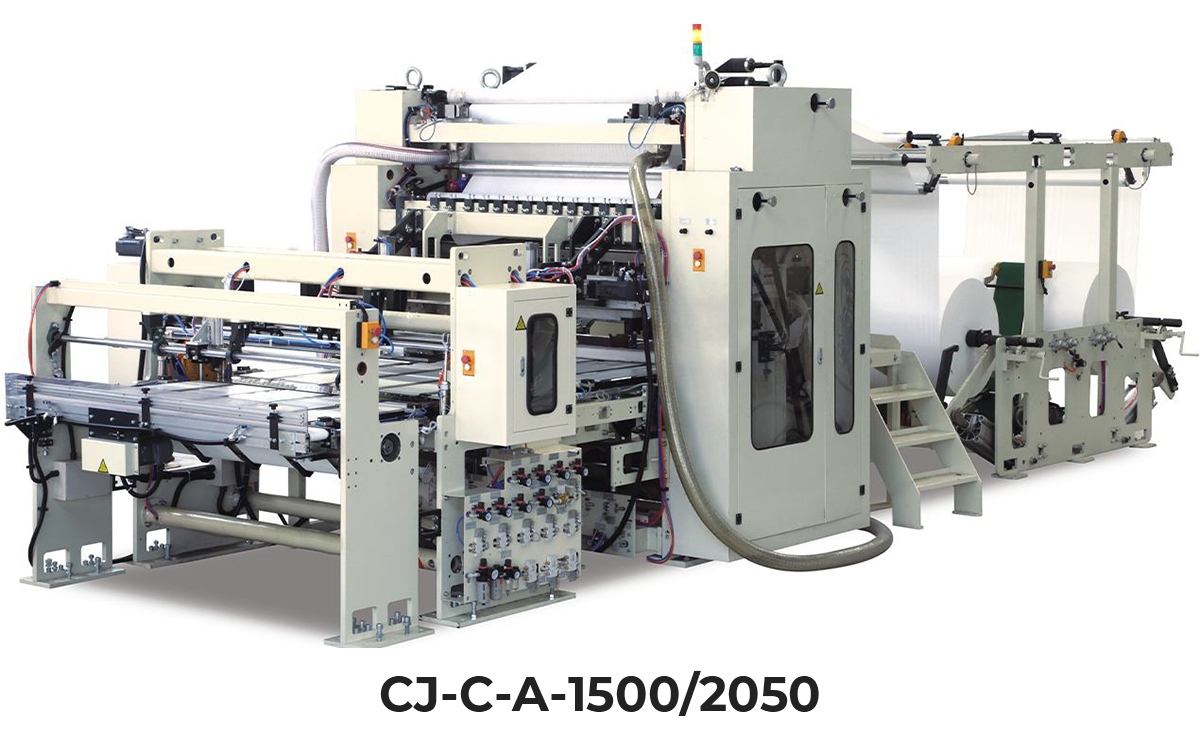
DCY's CJ-C automatic facial tissue production line combines folding, cutting, stacking and packaging capability in a fully automatic configuration. Published specifications list raw-paper widths from 1,500 to 3,650 mm and design speed up to 170 m/min or 1,700 sheets per minute. Available functions include side trimming, edge embossing and a first-pull half fold. The final line still needs a confirmed pack format, cutting arrangement and packaging rate; an interfolder alone is not a complete finished-product system.
For V-fold products and specific output arrangements, the CJ-C-A automatic V fold facial tissue production line supports optional half fold, flip, bottom-pull configuration, tension control, side trimming and embossing or lamination choices. Buyers should test the intended base paper at the required sheet size and pack count because fold stability can change with basis weight, ply count, softness and moisture.
Hand Towels and Napkins
Away-from-home hand towels commonly use V, N, M or Z-style folds selected to fit dispensers and support one-at-a-time dispensing. The CJN-C automatic hand towel production line is intended for folded hand towel production, with the exact fold, sheet size, ply structure, embossing and packaging configuration agreed for the project. Strength and absorbency requirements are usually higher than for facial tissue, so paper grade and fold trials matter.
Napkin lines may include printing, embossing, longitudinal and cross folding, counting and wrapping. Quarter-fold, dispenser, cocktail and luncheon napkins require different tooling and dimensions. The guia de compra de máquina de guardanapo can help buyers define fold style, print colours, sheet size and pack format before asking for a line quotation. A supplier cannot size a napkin line accurately from the word 'napkin' alone.
Cutting Counting and Stack Transfer
Folded webs often leave the interfolder as long logs that must be cut into pack-width stacks. The cutter must hold soft material without crushing it, remove dust and keep the stack square. Counting systems and reject logic must protect the declared sheet count. Accumulators or conveyors decouple the folder from the cutter and wrapper long enough to absorb short disturbances. Without this buffer, one film splice or box-feeding interruption can stop the entire upstream line.
Packaging and End of Line Equipment
Packaging is part of production capacity, not an accessory added after the converting machine is selected. A tissue packaging line may include a single-roll wrapper, multi-roll wrapper, facial tissue soft-pack machine, carton or box packer, bundler, case erector, case packer, case sealer, checkweigher, label printer, conveyors and robotic palletiser. The exact chain depends on the unit sold to the customer and the unit handled in the warehouse.
Primary packaging protects the tissue, carries consumer information and creates the shelf-ready format. Secondary packaging groups products for logistics. The packaging film or carton specification influences sealing temperature, friction, static, print registration and machine speed. A detailed tissue wrapping machine guide should be reviewed alongside the converting specification, especially when the line will run several pack arrays.
End-of-line conveyors need enough accumulation to keep short packer stops from starving or blocking other machines. Product orientation, lane merging and reject access must be designed into the layout. If cases will be palletised automatically, define case dimensions, case weight, pallet pattern, pallet type, label position, stretch-wrapping requirement and forklift approach. The complete line should end at a measurable handover point, such as a labelled closed case or a wrapped pallet.
Integrated suppliers increasingly describe the system from parent reel to pallet. Valmet tissue converting overview lists rewinding, embossing, laminating, folding, packaging and quality control as typical converting functions. This supports a practical procurement lesson: equipment scope should follow the material flow until the product reaches the condition your warehouse actually receives.
Controls Drives and Production Data
A complete tissue paper production line requires a control philosophy for the whole process. Individual PLCs can operate each machine, but the line also needs coordinated start, stop, speed reference, starvation and blockage logic. Sensors must detect product gaps, reel depletion, web breaks, jams, guard status and accumulation level. Drives and servo axes control web transport, perforation timing, folding rolls, saw infeed, wrapping jaws and conveyors.
DCY can configure control systems with Siemens or Inovance components according to project requirements. The final bill of materials should name the PLC, HMI, servo drives, motors, safety controller, network protocol and critical sensors. It should also state which components may be substituted and how approval will be obtained. This detail matters for maintenance capability, regional parts availability and long-term support.
Useful production data include run speed, good output, rejects, downtime reason, parent-reel lot, recipe, alarm history and changeover time. A line-level dashboard can help managers distinguish a paper problem from a mechanical stop or packaging constraint. Data collection should serve defined decisions; collecting hundreds of tags without naming owners or responses rarely improves output.
Quality Control Safety and Housekeeping
Quality Checks Across the Line
Quality control should identify defects near the process that creates them. Incoming reels can be checked for width, diameter, damage, basis weight and moisture. Rewinding checks may include roll diameter, firmness, sheet count, perforation strength and tail position. Folded-product checks may cover sheet dimensions, fold alignment, count, embossing and dispensing behaviour. Packaging checks include seal integrity, coding, pack dimensions, count and visual appearance.
A sampling plan should define frequency, method, tolerance and disposition of nonconforming product. Cameras, checkweighers and diameter sensors can automate some inspections, but reference samples and trained operators remain useful. Quality records should link finished packs to the machine recipe and parent reel lot wherever practical.
Machine Safety and Dust Control
Rewinders, folders, saws, conveyors and wrappers contain nip points, blades, rotating shafts and powered transmission components. Line design should include fixed and interlocked guards, emergency stops, safe access, lockout provisions and risk assessment. ISO 12100 machinery safety sets out general principles for machinery risk assessment and risk reduction. Local law and destination-market requirements still govern the delivered project.
OSHA machine guarding guidance identifies the point of operation, power transmission and operating controls as fundamental machine areas requiring safeguarding consideration. Although regulations vary by country, this framework helps buyers ask practical questions about cutting stations, belts, gears and operator intervention. The final safety validation should cover normal production, reel loading, web threading, jam clearing, blade change, cleaning and maintenance.
Tissue dust affects product cleanliness, sensors, electrical enclosures, bearings and fire risk. Extraction should be located near slitting, perforation and sawing sources, with collection capacity based on the line and paper grade. Good housekeeping also requires accessible cleaning points, smooth product-contact surfaces and a waste-removal route that does not cross packed-product flow.
Utilities Factory Layout and Environmental Conditions
A machinery quotation is incomplete if the factory cannot supply the required electrical power, compressed air, vacuum, extraction, water, drainage or network connection. Buyers should request a utility schedule showing connected load, typical consumption, pressure, flow, connection size and quality requirement for every station. Voltage, frequency and earthing must match the destination site.
The layout should show machine footprints, working envelopes, control cabinets, operator positions, doors, columns, crane coverage, reel staging, packaging-material storage, waste collection and maintenance removal paths. Ceiling height and floor loading can be decisive for jumbo reel handling and palletising. Allow space for safe blade replacement and roller removal, not merely enough space for the machine frame.
Ambient temperature and humidity influence tissue moisture, static, web behaviour and packaging film. Dust extraction and ventilation should be coordinated with the building system. For overseas projects, shipping splits, container access and reassembly sequence should be reviewed before civil work is finalised. DCY's fazer um pedido and implementation support services are relevant when planning shipment, installation and commissioning responsibilities.
Capacity Must Be Balanced Across Every Station
The rated speed of the main machine is only one input. Sustainable saleable output depends on product dimensions, paper properties, changeovers, stops, rejects and the capacity of every downstream station. A complete tissue paper production line should be sized with a common unit such as finished rolls per minute, packs per minute, cases per hour or tonnes of good product per shift.
For roll products, convert rewinder speed into logs per minute and then into cut rolls using log length and roll width. Compare that value with log-saw cycles, wrapper pack arrays and bundler output. For facial tissue, translate interfolder sheets per minute and lane count into logs or packs per minute using sheets per pack and cutting format. Then apply realistic operating efficiency rather than assuming nameplate speed for every scheduled minute.
A buffer can absorb short differences, but it cannot correct a permanent capacity mismatch. If a rewinder sustainably supplies 30 logs per minute while the cutting and packing system handles 22, inventory will accumulate until the line slows or stops. The buying team should request a capacity table for each SKU, including the assumed efficiency and the slowest station. DCY's article on tissue production line buying questions provides a broader checklist for technical discussions.
Fully Automatic and Semi Automatic Configurations
Decision factor
Fully automatic line
Semi automatic line
Material transfer
Connected conveyors and automatic handling
Manual transfer may be used between stations
Labour dependence
Lower direct handling at stable volume
More operators and greater dependence on work method
Output consistency
Usually more repeatable when well maintained
Can vary with operator pace and staffing
Changeover flexibility
Recipe driven but may need planned tooling
Often practical for small batches and varied manual work
Best fit
High labour-cost regions, export volume, stable SKUs
Lower labour-cost regions, start-ups, pilot or mixed small orders
Planning risk
Integration and service capability
Hidden labour, hygiene and work-in-process handling
Automation should match the business model. A high-labour-cost factory producing a stable retail range often benefits from automatic transfer, wrapping, bundling and palletising. A start-up serving local distributors may prefer a semi-automatic line that protects cash and allows operators to handle varied formats. The tradeoff should be calculated through good packs per labour hour, changeover loss, hygiene risk and expansion options.
Semi-automatic does not mean incomplete. It means that defined tasks are manual. The quotation should state those tasks, expected staffing, lifting requirements, work-in-process storage and maximum manual handling rate. Fully automatic also does not mean unattended. Operators still load materials, monitor quality, respond to alarms, perform cleaning and maintain the system.
Configurations for Common Product Strategies
High Volume Toilet Roll and Kitchen Towel
A high-volume complete tissue paper production line for rolls may include two or more unwind stands, embossing and lamination, automatic perforating and rewinding, inline core feeding, tail sealing, an accumulator, multi-lane log saw, roll conveying, primary wrapper, bundler or case packer and palletiser. It suits stable, high-demand SKUs where labour reduction and continuous flow justify integration. Large width and high speed must be supported by reel logistics and packaging capacity.
Flexible Roll Production for Regional Markets
A flexible line may use a rewinder with several recipes, a separate core maker, one log saw and semi-automatic or modular packaging. This arrangement can handle toilet rolls, kitchen towels and selected JRT formats with planned change parts. It suits factories that need more SKU variety and cannot dedicate a line to each product. The supplier should identify which changes require tools, how long they take and which formats cannot share a station.
Facial Tissue for Soft Packs and Boxes
A facial tissue complete tissue paper production line includes multi-ply unwinding, tension control, optional embossing or lamination, interfolding, log accumulation, cutting, stack transfer and either soft-pack wrapping or box filling. A factory producing both formats may share the interfolder and cutter but needs diverging packaging routes or controlled changeovers. First-pull folding, printed film register, box dimensions and opening design should be validated with actual packaging materials.
Away From Home Hand Towel and JRT
Away-from-home customers prioritise dispenser fit, strength, reliability and case efficiency. A hand towel route needs the specified V, N, M or Z fold and packaging compatible with distributor cases. JRT uses a roll route with larger finished diameters, heavier handling and different log-saw and wrapper requirements. Combining both product families in one factory can share parent-reel receiving, maintenance and warehousing, but not the core converting machine.
What to Put in the Request for Quotation
A useful RFQ starts with finished products, not a generic machine name. Send drawings or samples for every priority SKU. State unfolded and folded sheet sizes, roll width and diameter, core diameter, ply count, basis weight, perforation pitch, embossing design, sheets or metres per unit, units per pack, packs per bundle or case, packaging material and required output. Include parent-reel dimensions and paper grades.
Also provide annual demand, shift pattern, expected efficiency, labour conditions, available floor plan, utility standards, destination voltage, safety requirements, language, data connection and future products. Ask the supplier to return a process flow, equipment list, layout, capacity by SKU, utility schedule, staffing estimate, exclusions, spare-parts list, installation plan, training plan and acceptance test.
DCY's solution proposal process can translate product requirements into a line configuration. The Confirmação de pedido stage should then freeze specifications, interfaces, responsibilities and approved drawings. This written baseline is essential when several machines, packaging suppliers or local contractors contribute to one project.
Acceptance Testing and Ramp Up
Factory acceptance testing should use agreed materials or a clearly documented equivalent. Test representative high-volume and difficult SKUs, not only the easiest product. Record sustained good output, waste, changeover time, count accuracy, dimensions, seal quality, alarm response and safety functions. Clarify whether output is measured at the rewinder, cutter, primary packer or closed case because each point gives a different result.
Site acceptance testing confirms performance after transport, installation and connection to local utilities. The ramp-up plan should define operator and maintenance training, production support, spare parts, remote access and escalation contacts. An after-sale warranty should state coverage, response process and exclusions clearly. Performance normally improves as paper settings, recipes and operator routines are stabilised, so the contract should distinguish acceptance conditions from longer-term optimisation targets.
A supplier's manufacturing depth and service experience reduce integration risk. Information about Dechangyu describes DCY's R&D, manufacturing and global service background. For markets served through local partners, dealership opportunities may also support regional technical and commercial coverage.
Commonly Omitted Items
Reel unloading, lifting devices, shafts, chucks and staging space.
Packaging-material feeding, coding, labels, cases, pallets and stretch wrapping.
Dust extraction, trim removal, waste baling and fire-risk controls.
Change parts, product recipes, reference samples and format drawings.
Air compressors, vacuum pumps, electrical distribution, network drops and earthing.
Conveyors, accumulators, reject lanes and access platforms between quoted machines.
Blade tools, sharpening equipment, lubrication supplies and initial consumables.
Installation labour, travel, accommodation, translation and operator training.
Critical spare parts, remote support, maintenance documentation and software backups.
Performance definitions, approved test paper and responsibility for third-party interfaces.
These omissions explain why two quotations for a complete tissue paper production line can differ greatly without either price being directly comparable. Build a scope matrix with every station and support item, mark who supplies it and identify the handover interface. A clear matrix is more useful than asking each supplier whether its offer is 'turnkey'.
How DCY Builds an Integrated Converting Solution
DCY develops roll, folding, slitting, complementary, packaging and palletising solutions for tissue converters. The company's materials trace its establishment to 1987 and describe a manufacturing base of about 100,000 square metres, about 400 experienced employees, more than 30 engineers and more than 60 national patents. DCY also reports exports to more than 160 countries and regions. These facts are relevant because a complete tissue paper production line requires mechanical engineering, controls, manufacturing, installation and service coordination rather than a single machine transaction.
The equipment can be configured for large working widths, high speed and fully automatic or semi-automatic operation. Siemens or Inovance controls can be selected according to the agreed project. Optional technology includes embossing, glue or glue-free lamination, glue-free tail sealing, coating, printing, tension control and automatic handling. Product trials and a written technical specification remain necessary because paper, packaging and local operating conditions differ.
DCY has supplied equipment to major tissue producers and international markets. Customer references should be discussed for a comparable product, capacity and region, with confidentiality and logo permissions respected. The article on tissue converting machinery companies gives wider supplier context for buyers conducting due diligence. The better decision is the supplier and configuration that can demonstrate the required product on a balanced line and support it through ramp-up.
Frequently Asked Questions
What is the minimum equipment for a toilet paper line
At minimum, a toilet paper converting line needs parent-reel unwinding, embossing if required, perforating and rewinding, log cutting and a method to pack the finished rolls. Cored products also need purchased cores or a core-making system. A commercially complete line usually adds automatic transfer, tail sealing, wrappers, bundling or case packing, dust removal and quality checks.
Does a complete line include a tissue paper mill
Not always. In converting projects, the line begins with purchased parent reels. A tissue mill begins with fibre or pulp and includes stock preparation, forming, Yankee drying, creping and reeling. State the raw-material starting point in the inquiry so suppliers quote the same scope.
Which machine is the main machine in a tissue converting line
For toilet roll and kitchen towel, the rewinder is the main forming machine. For facial tissue and folded hand towels, the interfolder is central. However, saleable capacity depends on the cutter, packer and material-handling system as well, so the complete line must be evaluated as one process.
Can one line make toilet paper kitchen towel and JRT
Some roll lines can produce more than one of these product families, but change parts and downstream machines may differ. Confirm finished diameter, width, core size, perforation, embossing, log-saw range and packaging for every SKU. Multipurpose capability should be demonstrated in the technical offer.
Can one folding machine make facial tissue and hand towels
Certain platforms can be configured for related folded products, but paper strength, basis weight, fold geometry, sheet size and packaging differ. A supplier should confirm the exact products and required tooling. Do not assume that a shared machine name guarantees acceptable output for both.
How many operators does a line require
Staffing depends on automation, reel loading, packaging-material changes, quality sampling, palletising and maintenance practices. Ask for an operator map by station and shift. Fully automatic transfer reduces direct handling, while semi-automatic lines may need operators between cutting and packing.
How should line capacity be compared
Compare sustainable good output for the same SKU and handover point. Request the assumed paper, pack format, operating efficiency, waste and test duration. Convert every station to one common unit and identify the bottleneck. Nameplate metres per minute alone cannot describe finished-pack capacity.
What utilities are normally required
Typical requirements include electrical power, compressed air, vacuum, dust extraction, ventilation and network connections. Some coating, gluing or cleaning processes may add water or drainage requirements. The supplier should issue a station-by-station utility schedule before installation.
What quality checks should be automated
Useful automated checks can include roll diameter, pack weight, count confirmation, print registration, seal inspection, code verification and metal detection where required. Automation should target frequent or costly defects. Manual sampling remains important for softness, dispensing, appearance and other product attributes.
What documents should be delivered with the line
Request approved layouts, electrical and pneumatic drawings, utility lists, manuals, parts lists, maintenance schedules, safety documentation, software backups, product recipes, training records and acceptance reports. Documents should use an agreed language and reflect the final as-built machine.
How long does installation and ramp up take
The schedule varies with line size, shipping splits, civil readiness, local utilities, packaging trials and operator experience. Ask for separate dates for delivery, mechanical installation, electrical connection, dry commissioning, material trials, acceptance and production support. Site readiness often controls the critical path.
How can a buyer avoid missing equipment in a quotation
Define the starting material, finished SKU and final handover condition. Then request a process flow and responsibility matrix that covers every transfer, utility, quality check and support item. Compare exclusions line by line. Generic terms such as complete or turnkey should always be converted into a written equipment and services list.
Plan the Line Around the Finished Pack
The most reliable way to specify a complete tissue paper production line is to work backward from the finished pack. Define what the customer buys, how the warehouse handles it and how many good units the factory must ship per shift. A complete tissue paper production line should then use packaging, cutting, forming and reel-feeding systems that can sustain that output together.
DCY can review your product samples, parent-reel specification, capacity target, factory drawing, labour conditions and automation preference to prepare a matched converting solution. A useful first inquiry includes the priority SKUs, required packs per minute, available utilities and destination country. That information allows the engineering discussion to focus on line balance, product quality and a clear project boundary.






 English
 Español
 العربية
 Português do Brasil
 Русский