Global tissue converters face a difficult mix of pressures. Retailers want cleaner roll edges, stable diameter, soft hand feel and reliable sheet count. Away from home distributors want large volumes delivered on time. Factory managers must produce those rolls while controlling web breaks, labour dependency, waste, energy use and downtime. In that setting, the ZQ-H high-speed roll production line and similar roll converting systems are judged by how steadily they turn parent reels into saleable toilet rolls, not by brochure speed alone.
Toilet Paper Rewinding Machine Everything You Need to Know
A toilet paper rewinding machine is the central converting unit that unwinds jumbo tissue reels, controls web tension, embosses or laminates the tissue when required, perforates the web, rewinds it around a paper core or coreless forming system, seals the tail and discharges a long log for cutting. It does not make base tissue from pulp. It converts already manufactured jumbo rolls into toilet paper logs that can then be cut, wrapped, bundled and palletised.
This guide explains the machine from a buyer's point of view. It covers the working process, main components, performance factors, automation choices, product applications, technical specifications, common problems, supplier questions and factory planning details. It also shows where DCY Dechangyu fits when a producer needs a high speed, wide width, customised roll converting solution supported by engineering, installation and after sales service.
Quick Answer
A toilet paper rewinding machine takes one or more jumbo tissue reels and rewinds the paper into long toilet paper logs with a controlled diameter, sheet length, roll firmness and tail finish. The standard process is jumbo roll unwinding, tension control, optional embossing or lamination, perforation, core feeding or coreless winding, rewinding, tail sealing and log discharge. A log saw then cuts the logs into retail rolls, and packaging equipment prepares the rolls for sale.
For B2B buyers, the most important selection factors are working width, design speed, stable running speed, finished roll diameter, ply range, perforation pitch, core or coreless capability, embossing method, tail sealing method, controls, safety, spare parts, installation support and the way the rewinder connects with cutting and packing. A high specification rewinder has limited value if the log saw, wrapper or manual handling process cannot absorb its output.
A practical buying decision starts with the finished product. Confirm roll width, diameter, sheet count, plies, tissue grammage, embossing pattern, core diameter, pack format and target output per shift. Then the supplier can size the rewinder, core maker, log saw, wrapper, conveyors and utilities as one balanced route.
What The Machine Does
The phrase toilet paper rewinding machine can describe a standalone rewinder or the rewinding section inside a complete toilet roll production line. In either case, its main job is to create a stable log. A log is a long wound cylinder across the machine width. If the machine is 2850 mm wide, the log may later be cut into many individual rolls according to the target roll width. That is why rewinding quality affects every downstream process.
The machine handles several technical actions at the same time. It must pull delicate tissue from the parent roll without tearing it, keep each ply aligned, apply embossing pressure without crushing the sheet, create clean perforation lines, control winding density from the core to the outside of the roll, change cores at the correct cycle point and seal the tail so the log stays neat during transfer and cutting.
A good article on tissue roll machines should make one point clear for buyers: the rewinder is not a simple winding shaft. It is a coordinated web handling system. The frame, unwind brakes, servo drives, perforation blade, rider roll, core magazine, HMI recipes, sensors and tail sealer all decide whether the final roll feels premium, cuts cleanly and packs without deformation.
Main Process Flow
Stage
What Happens
Why It Matters
Jumbo roll loading
Parent reels are loaded onto unwind stands.
Checks raw paper width, diameter, ply arrangement and roll condition.
Web tension control
Brakes, dancers, load cells or servo systems stabilise each paper web.
Reduces wrinkles, web breaks and uneven roll density.
Embossing or lamination
Rollers create texture or bond plies, with glue or glue free options.
Improves softness, bulk, appearance and brand differentiation.
Perforation
A blade system creates tear lines at a controlled pitch.
Controls sheet length, tear quality and consumer experience.
Core feeding and rewinding
The web winds around a paper core or coreless forming system.
Determines roll diameter, firmness, sheet count and log stability.
Tail sealing
The loose tail is sealed by glue, tip sealing or non glue technology.
Prevents loose tails, contamination and cutting or packing jams.
Log discharge
The finished log exits toward accumulation or cutting.
Must match log saw capacity, conveyor height and safety layout.
This flow is also useful when comparing supplier quotations. Some offers include only the toilet paper rewinding machine body. Others include unwind stands, embossing modules, a tail sealer, core system, log saw, wrapper, conveyors and electrical integration. Buyers should ask for a written scope table, because a missing conveyor or core maker can create practical bottlenecks after installation.
In a complete roll route, the toilet paper rewinding machine sits before tissue cutting machines and before the toilet paper wrapping machine. The surrounding machines do not need to be from the same series in every factory, but their speeds, log dimensions, safety controls and communication signals should be coordinated before layout approval.
Unwinding And Tension Control
Unwinding looks simple until the line reaches industrial speed. A parent reel may be more than two metres wide and heavy enough to store considerable rotational inertia. As the reel diameter decreases, the torque needed to maintain steady web tension changes continuously. If control response is slow, the web can become slack, wrinkle before embossing or snap when the draw section accelerates.
A high quality unwinding system uses stable stands, accurate braking or servo control, web guide correction, emergency stop logic and clear threading access. For two ply or three ply products, each web should have independent tension adjustment. A weaker ply cannot simply follow a stronger ply without creating stretch differences that later show up as poor perforation or uneven softness.
Modern B2B buyers should ask whether the rewinder uses open loop brake settings or closed loop tension feedback. They should also ask how recipes store tension parameters for different paper grades. A factory running virgin pulp, recycled pulp, kitchen towel and private label toilet tissue will need more adjustment range than a factory producing one standard roll all year.
This is where industrial automation matters. Siemens SIMATIC Motion Control describes scalable control for motion tasks, and that principle is relevant to tissue converting because multiple driven sections must remain synchronised. DCY machines can be configured with Siemens or Inovance PLC control according to project requirements, helping buyers match international component preference, local service capability and factory standardisation.
Embossing And Lamination Choices
Embossing changes both the appearance and the functional feel of toilet paper. A pattern can make the roll look more premium, increase perceived bulk, improve softness and help bond multiple plies. The simplest systems use full embossing. More advanced configurations may use edge embossing, point to point embossing, point to flat embossing, glue lamination or glue free bonding, depending on paper grade and brand positioning.
A buyer should decide what the product must communicate in the market. Economy rolls may prioritise stable winding and simple texture. Premium household rolls may need high definition pattern clarity and good ply bonding without a stiff hand feel. Kitchen towel variants need absorbency and strength. JRT or commercial rolls may place more emphasis on stable diameter and long running efficiency.
DCY's toilet paper embosser pages and catalog materials highlight high definition embossing, pattern options and automation. In practical selection, the buyer should ask for sample rolls using the actual paper grade, because embossing depth that looks excellent on one tissue may weaken another. The pressure system, roller hardness, engraved pattern, line speed and web moisture all influence the final result.
For producers planning branded or seasonal products, printing and embossing can work together. The FC series toilet paper printing machine belongs in the discussion when a buyer wants coloured patterns, private label differentiation or promotional tissue. Printing should be considered early because it affects web path, drying, registration, ink selection and cleaning routines.
Perforation And Sheet Control
Perforation determines how the user tears each sheet. If perforation is too weak, sheets separate during winding, cutting or consumer handling. If it is too strong, consumers pull multiple sheets or tear ragged edges. The issue is technical but visible to the end user, which makes it an important quality signal for retail and away from home brands.
Key perforation questions include the pitch range, blade count, blade shaft precision, adjustment method, blade change time and stability at running speed. DCY's ZQ-H specifications list perforating pitch options of 80 to 140 mm with six blades and 160 to 280 mm with three blades, while the machine design speed reaches 0 to 500 m per minute. Those ranges help buyers understand whether one line can cover several regional SKU requirements.
The machine frame also matters. At high speed, vibration can show up as uneven perforation clarity or unstable winding. A rigid wallboard structure, high precision blade shaft and stable servo control help the perforation line stay clean. DCY states that the ZQ-H uses high precision NC machined large diameter blade shafts and a Siemens SIMOTION system for precise perforation and roll tightness control.
For SEO and AI search, perforation deserves more than a one line feature list. Searchers often ask why rolls tear badly, why sheet length changes during production or why the machine creates loose paper dust near the blade. A useful guide explains the blade, paper grade, tension and speed relationship in terms plant managers recognise.
Core Feeding And Coreless Rewinding
A toilet paper rewinding machine may produce cored toilet rolls, coreless toilet rolls or both. Cored rolls use a cardboard tube as the winding base. Coreless rolls use a forming method that creates a stable centre without a disposable tube. The choice depends on market habits, dispenser design, sustainability goals, product diameter and downstream packaging.
For cored products, core quality strongly affects rewinding and cutting. Weak cores can crush under rider roll pressure or during log sawing. Cores with inconsistent diameter can cause eccentric rolls, vibration or poor tail sealing. A factory that purchases cores from outside suppliers still needs incoming inspection for diameter, wall thickness, moisture and crush resistance.
DCY's ZX high-speed toilet paper core machine supports integrated core supply for roll lines. Catalog data lists a forming speed of 90 to 100 m per minute, 2 to 3 paper core layers and a 40 to 50 mm paper core diameter range. Pairing the core process with the rewinder helps stabilise dimensions and reduces dependence on purchased cores when the factory reaches higher output.
For coreless products, ask how the machine starts the roll, controls the centre opening and avoids wrinkles at the beginning of winding. DCY's ZQ-H page states that a constant vacuum system can start coreless rewinding faster and with fewer wrinkles. That is a meaningful detail because the first layers decide whether the roll will stay round after discharge.
Tail Sealing Options
Tail sealing holds the loose end of the log after rewinding. Traditional systems use glue. Glue can work well when controlled, but it introduces consumables, cleaning routines, nozzle maintenance and the risk of glue marks or sheet adhesion. In humid markets or factories with inconsistent maintenance, tail sealing becomes a common source of complaints.
A non-glue tail sealer changes that discussion. DCY materials position glue free tail sealing as a patented differentiator that avoids glue contamination and reduces cleaning time. The value is especially clear for high speed roll lines, where a clogged nozzle or messy tail can stop the flow into the log saw and wrapper.
A buyer should ask for sample logs and check tail appearance after cutting. The seal should hold during conveyor transfer and cutting, but the consumer should still be able to open the roll cleanly. The seal also should not interfere with the first few usable sheets. For premium products, that small user experience detail can decide whether a roll feels well made.
Tail sealing is often treated as an accessory. In reality, it sits at a sensitive point in the process. If the tail is loose, the log can unwrap during transfer. If the tail is over sealed, the first sheets tear. If glue spreads, cutting and packing become dirty. This is why the supplier's experience with actual high speed production matters.
Automation Levels
Level
Best Fit
Typical Scope
Main Planning Point
Semi automatic
Lower labour markets, new converters, flexible small batch work
Manual loading, simpler transfer, manual or semi automatic cutting and packing
Lower technical barrier but higher labour dependency
Automatic rewinder only
Factories replacing an older core machine while keeping existing cutters
Automated unwinding, perforating, rewinding, core feeding and discharge
Output may be limited by old log saws or wrappers
Fully automatic roll line
High labour cost regions and large tissue producers
Integrated rewinder, log transfer, log saw, wrapper, conveyors and safety control
Requires stronger planning, utilities and operator training
Custom high speed line
Premium producers, multi SKU factories and export focused plants
Wide width, high speed, advanced embossing, glue free tail sealing and recipe control
Needs supplier engineering review before quotation
Automation should be selected from factory economics rather than from prestige. In high labour cost regions, full automation can reduce manual transfer, repeated lifting and inconsistent handling. In lower labour cost regions, a semi automatic configuration may be reasonable at the beginning, especially when the market has not yet stabilised pack formats and demand.
The ZQ-III automatic roll production line can support producers that need an automatic toilet paper rewinding machine without immediately jumping to the most advanced high speed specification. The correct line depends on required working width, speed, paper grade, core choice, roll range and planned connection to cutting and packing.
For large factories that supply national brands or supermarket chains, automation also protects consistency. The operator should not need to manually adjust basic parameters for every batch. Recipes, HMI prompts, fault records and sensor checks reduce variation between shifts. Siemens SIMATIC HMI pages describe the importance of operator visualisation for industrial processes, which aligns with what tissue factories need from daily production control.
Capacity And Line Balance
Capacity is one of the most misunderstood parts of buying a toilet paper rewinding machine. A supplier may state design speed in metres per minute, but the factory cares about finished rolls per shift, saleable packs per day and stable output after waste and changeovers. The two numbers are related, but they are not identical.
The first calculation starts with web width and finished roll width. A wider machine produces more rolls across each log. The second calculation uses running speed, sheet length and sheet count. The third calculation subtracts changeover time, jumbo roll replacement, blade service, cleaning, waste removal and planned maintenance. A realistic capacity estimate should state assumptions, not just a maximum speed.
The log saw and wrapper must be sized with the rewinder. DCY's DH-VI four lane log saw data from company materials lists 160 cuts per minute, finished product outer diameter of 90 to 150 mm and cutting length of 50 to 300 mm. If a high speed rewinder feeds a low capacity cutter, the line will accumulate logs and force stops.
A useful RFQ should therefore ask for line level output, not only rewinder output. It should also separate design speed, recommended stable running speed, guaranteed finished product range and expected operator count. Strong suppliers will explain the assumptions behind capacity rather than treating one speed figure as a complete answer.
Important Specifications
Especificação
What It Controls
Buyer Check
Working width
Shows how much web the machine processes per cycle.
Match jumbo reel supply and target roll width.
Velocidade de projeto
Maximum engineered machine speed under suitable conditions.
Ask for normal production speed with your paper grade.
Finished roll diameter
Controls retail roll size and dispenser compatibility.
Confirm minimum and maximum range for all SKUs.
Core diameter
Affects winding start, roll appearance and dispenser fit.
Check cored and coreless requirements separately.
Passo de perfuração
Sets sheet length and consumer tear behaviour.
Compare blade options and adjustment range.
Embossing type
Affects softness, bulk, ply bonding and pattern clarity.
Request samples using actual tissue.
Tail sealing method
Controls log stability and first sheet opening.
Compare glue, tip type and glue free options.
Control system
Coordinates speed, tension, recipe and diagnostics.
Confirm Siemens, Inovance or preferred platform.
Safety design
Protects operators around moving rolls and blades.
Check guarding, access doors, interlocks and stops.
Service scope
Determines installation, training and long term support.
Clarify spare parts, commissioning and warranty.
DCY's ZQ-H data gives buyers a concrete reference point. The machine can be configured for max raw paper width of 2850 to 3650 mm, raw paper outer diameter of 1500 to 3000 mm and design speed of 0 to 500 m per minute. It supports roll and JRT applications, independent servo driven units, precise web breaking at the perforation line and multipurpose production.
Specifications should be confirmed against the product portfolio, not selected in isolation. A factory producing small household rolls, premium embossed rolls, kitchen towel and JRT needs more flexibility than a factory producing one economy toilet roll. Wider machines and higher speeds are valuable when the downstream route, operators and maintenance system are ready for them.
Applications By Product Type
Standard household toilet rolls are the most common application. These products need stable sheet count, neat perforation, consistent diameter and reliable packing. The machine should change cores smoothly, control roll firmness and discharge logs in a way that supports clean cutting. For supermarket supply, consistency across batches matters more than occasional peak speed.
Premium embossed toilet rolls require closer attention to embossing pattern, ply bonding, softness and roll appearance. A producer may use high definition embossing, edge embossing or glue free lamination to create differentiation. The article tissue rewinder for embossed paper can support readers who need deeper context on soft or patterned products.
Kitchen towels use stronger paper, larger sheet length and often larger roll diameter. The rewinder must handle different tension and embossing pressure without damaging absorbency. Some factories want one line that can switch between toilet rolls and kitchen towel. In that case, changeover design, recipe storage and perforation range become important.
JRT and commercial rolls serve offices, hotels, airports, factories and public facilities. These products often require larger diameters and stable winding density. DCY's ZQ-H page says the line can also produce JRT products, which is useful for converters serving both retail and away from home channels. The comparison article toilet roll vs jumbo roll converting line can help buyers understand the difference between consumer rolls and larger commercial formats.
Private label and contract manufacturing create a different requirement. The factory may handle many brands, roll counts, wrapping formats and embossing patterns. toilet roll rewinder applications is a useful cluster article for this topic, and this guide should connect to it because application context often decides which equipment specification is practical.
Comparison With Related Machines
Machine
Main Function
Relation To Toilet Roll Production
Toilet roll rewinder
Creates long toilet paper logs from jumbo tissue reels.
Core equipment for roll converting.
Log saw cutter
Cuts logs into individual rolls.
Needed after rewinding before packaging.
Slitting rewinder
Slits and rewinds jumbo rolls or parent reels into narrower rolls.
Used upstream or for different jumbo reel products.
Facial tissue interfolder
Folds sheets into interleaved stacks.
Used for folded tissue, not roll products.
Packing machine
Wraps single rolls or multi roll packs.
Needed to create market ready products.
Core maker
Produces cardboard cores for roll winding.
Supports stable roll shape and cutting quality.
A toilet paper rewinding machine is sometimes confused with a toilet paper making machine. In strict technical language, a rewinder is a converting machine. It does not pulp fibre, form tissue sheets or dry base paper. It receives jumbo tissue rolls and converts them into logs. Upstream tissue making machines belong to a different capital and utility category.
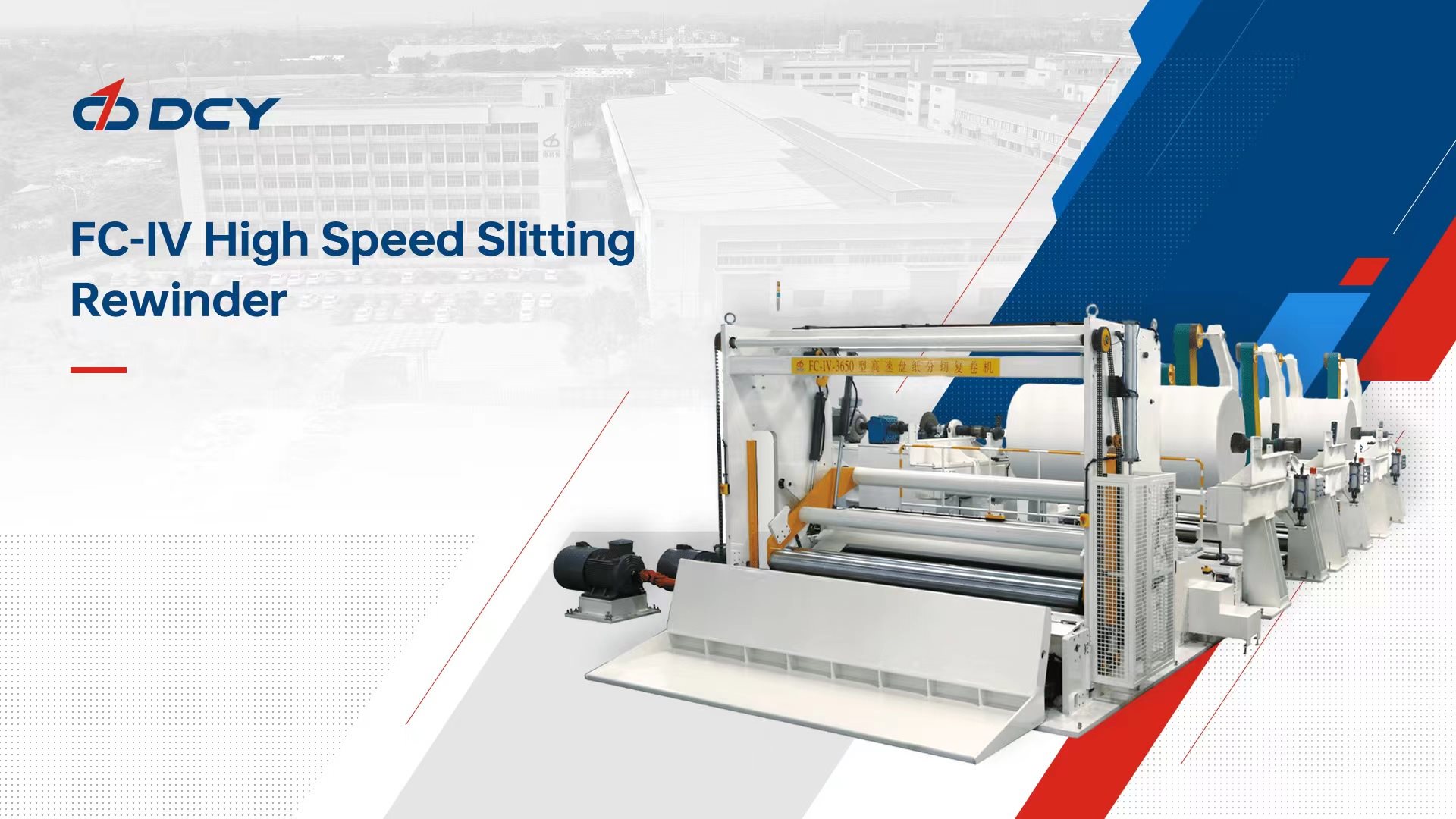
It is also different from a FC series slitting rewinder. A slitting rewinder handles jumbo reel processing, rewinding or width conversion at very high speed. Company memory lists FC-IV speed at 1000 to 1200 m per minute and raw paper width of 2850 or 3700 mm. That equipment is important in the broader converting plant, but it does not replace the toilet roll rewinding section.
The article toilet paper machine types should link to this guide after publication because buyers often search broad terms first. Once they understand the difference between rewinder, cutter, wrapper and core maker, they can evaluate each quotation more accurately.
Quality Problems The Right Machine Should Reduce
Web breaks waste time and raw material. They usually come from poor jumbo roll quality, unstable tension, web edge damage, worn rollers, misaligned guides or sudden speed changes. The machine should help operators detect problems quickly and recover with minimal paper accumulation.
Loose rolls or overly tight rolls usually point to winding profile problems. If the centre is too soft, the roll can deform. If the outer layers are too tight, softness drops and perforation may tear poorly. A well tuned system controls rider roll pressure, torque, speed differential and recipe curves throughout the winding cycle.
Bad perforation creates end user complaints. Ragged tears, weak bridges or variable sheet length can come from dull blades, vibration, wrong pitch setup or poor tension before the blade. High precision blade shafts and stable servo synchronisation help protect perforation clarity at speed.
Messy tail sealing can contaminate logs, clog downstream conveyors and create poor opening performance. Glue based systems require cleaning discipline. Glue free systems reduce that maintenance burden when properly engineered. DCY's blog on converting process can support a broader explanation of how tail sealing fits with slitting, lamination and cutting.
Cutting deformation often starts before the cutter. Poor winding density, weak cores or inconsistent log diameter make it hard for the log saw to produce clean individual rolls. That is why the rewinder, core maker and cutter should be evaluated as a connected process rather than separate machines bought only by specification sheet.
Factory Planning Before Purchase
Before asking for a formal quotation, prepare a short production brief. It should include target products, tissue grammage, number of plies, jumbo roll width and diameter, roll diameter, roll width, core diameter, sheet length, expected shift output, packaging format, available workshop dimensions, local voltage, compressed air supply and planned operator count.
The solution proposal stage should turn that brief into a recommended line layout. A good proposal will define the machine scope, product range, output assumptions, utilities, installation footprint, loading plan, commissioning steps and training needs. It should also clarify what is excluded from supply, such as air compressors, glue system consumables, packing film, dust collection ducts or spare blade sets if those are not included.
Order details should then be frozen through Confirmação de pedido. This matters because small product changes can affect mechanical design. A change in roll diameter, pack format or discharge direction after manufacturing starts may require mechanical redesign. Confirm drawings, electrical standards, language on HMI screens and accepted component brands before production.
For overseas projects, fazer um pedido planning is also part of the buying decision. A wide high speed line may require container planning, lifting equipment, installation sequence and clear responsibility for local utilities. The fastest way to lose time is to receive the machine before the site has power, air, foundation space and trained operators ready.
Implementation support becomes especially important for first time converters and large upgrades. Installation is not only physical assembly. The supplier must align the machine, commission drives and sensors, test safety functions, verify recipes, produce qualified samples and train operators. A rewinder that is installed poorly can appear to have quality problems that actually come from alignment, tension setup or operator practice.
Supplier Evaluation Checklist
Checkpoint
Question To Ask
Product fit
Can the supplier run your paper grade, ply count, roll diameter and core requirement?
Line experience
Has the supplier delivered roll converting projects similar to your width and capacity?
Controls
Are PLC, HMI, servo drives and safety systems aligned with your maintenance capability?
Samples
Can the supplier produce sample rolls with your real paper or an equivalent paper?
Customisation
Can the line support embossing, printing, glue free tail sealing or JRT if required?
Service
What training, remote support, spare parts and warranty process are included?
Documentation
Are manuals, electrical drawings, pneumatic drawings and parts lists supplied in usable language?
Quality system
Does the supplier have a documented quality system and final acceptance process?
A supplier for a toilet paper rewinding machine should be evaluated on engineering depth, not only response speed. Ask how the machine handles web tension during acceleration and deceleration, how perforation blades are adjusted, how tail sealing is stabilised, how recipes are stored and how operators diagnose faults.
For reference, Valmet tissue converting overview and BW Converting complete tissue lines both show that global tissue suppliers present roll converting as part of a larger integrated process with packaging and services. That is the right way for buyers to think. Even when purchasing a standalone rewinder, the surrounding process decides whether the investment performs well.
DCY brings a long operating history to this discussion. Company materials state that Dechangyu was established in 1987, operates about 100000 square metres of manufacturing space, has about 400 employees, more than 30 professional engineers and more than 60 national patents. Its products are exported to more than 160 countries and regions, and the company has served major tissue producers across China and overseas markets.
Public blog claims should still stay precise. Instead of saying a supplier is the best in every possible situation, state the evidence that matters to a buyer: patents, wide width lines, high speed roll converting experience, Siemens or Inovance control options, custom engineering, installation support and references from established tissue producers.
Safety Maintenance And Compliance
A roll converting line contains rotating shafts, nip points, blades, pneumatic movements, conveyors, electrical cabinets and paper dust. Safety design should be discussed at the same level as production speed. Guards, interlocked access doors, emergency stops, lockout procedures, blade change procedures and dust extraction all affect daily operation.
OSHA machine guarding standards are a useful external reference for buyers who want to understand the general safety logic around machinery hazards. Local standards vary by country, but the principle is consistent: operators should not be exposed to moving parts, cutting hazards or uncontrolled machine start up during normal work or maintenance.
Maintenance planning should cover daily cleaning, weekly inspection, lubrication, blade condition, pneumatic filters, sensor cleaning, belt tension, embossing roller inspection, tail sealing area cleaning and spare parts inventory. Paper dust is not only a housekeeping issue. It can interfere with sensors, accelerate wear and affect operator comfort.
Quality management also matters because B2B equipment projects involve design, production, inspection, shipment, installation and service. ISO 9001 quality management is widely recognised as a framework for consistent processes and customer requirements. DCY company materials state ISO 9001:2015 certification and CE certification, which support buyer confidence when evaluating overseas machinery supply.
After-sale warranty should be tied to practical response. Buyers should ask how faults are reported, which spare parts are stocked, whether remote support is available, how warranty terms apply to consumables and how training is handled when operators change. Equipment reliability depends on both the machine and the service system around it.
How DCY Can Configure The Right Rewinding Solution
DCY Dechangyu is best positioned when a buyer needs a customised toilet paper rewinding machine or roll converting solution rather than an off the shelf machine with limited adjustment. The company's product range covers roll solutions, folding solutions, jumbo reel solutions, complementary equipment, smart packaging and palletising. That range allows a factory to discuss the whole tissue route, from rewinding to cutting, wrapping and handling.
For high speed toilet roll and kitchen towel production, the ZQ-H high-speed roll production line is the natural internal product link. It supports 2850 to 3650 mm raw paper width, up to 500 m per minute design speed, independent servo driven units, core and coreless production considerations and JRT compatibility. For many buyers, that combination addresses the three big production questions: width, speed and product flexibility.
The DCY advantage should be explained through use cases. In a high labour cost region such as the United States, Australia, Korea or Japan, a buyer may prefer full automation, automatic transfer, packaging integration and stronger diagnostics. In a lower labour cost or early stage market, a semi automatic or staged investment may be more suitable. DCY can design around both situations because its catalogue covers production lines and complementary equipment.
The company also has credibility through customer cooperation. User supplied company context mentions partnerships with leading Chinese tissue producers such as C and S, Hengan, Vinda and APP, plus international cooperation involving P and G, Kimberly Clark, ABC and customers across Vietnam, the Middle East, Korea, Japan and other markets. Use logos and customer names publicly only where DCY has permission to do so, but these references support the internal confidence behind the article.
Do not select a machine from maximum speed alone. Stable output depends on raw paper quality, operator skill, recipe setup, cutting capacity, packaging capacity and changeover time. A lower published speed with better uptime can produce more saleable rolls than a faster machine that stops often.
Do not ignore working width. A narrow rewinder may be acceptable for a starter line, but a factory with larger customer contracts may outgrow it quickly. A wider machine requires more space, stronger jumbo reel logistics and matched downstream equipment, so it should be planned as a line decision.
Do not treat embossing as decoration only. Embossing affects softness, bulk, ply bonding, sheet strength and brand identity. Ask for real samples, not only photos. Also confirm whether the pattern can be changed and what tooling time or roller cost is involved.
Do not leave packaging until the end. The finished product that customers buy is a packed roll or multipack. A rewinder that produces good logs still needs a cutting and wrapping route that protects hygiene, pack appearance and warehouse handling. The related toilet paper wrapping machine guide should be used when packaging format becomes the next decision.
Do not forget service. For overseas buyers, time zone support, spare parts, documentation, remote diagnosis and local operator training can decide how fast the line reaches stable production. A factory should compare suppliers by project support, not only by equipment specification.
Frequently Asked Questions
What is a toilet paper rewinding machine
A toilet paper rewinding machine is a tissue converting machine that unwinds jumbo tissue reels and rewinds them into long toilet paper logs. It normally includes web tension control, embossing or lamination options, perforation, core feeding, winding control, tail sealing and log discharge.
Does the machine make paper from pulp
No. It converts parent tissue reels into finished logs. Pulping, sheet forming, drying and creping are upstream tissue making processes. Buyers should separate tissue making equipment from tissue converting equipment when planning investment and factory utilities.
What is the difference between a rewinder and a full toilet paper production line
A rewinder creates logs. A full line may include the rewinder, core maker, log saw, wrapper, conveyors, bundling, case packing and palletising. Ask the supplier for an itemised scope so every included and excluded machine is clear.
Can one rewinder make toilet rolls and kitchen towels
Yes, many machines can be configured for both, but the supplier must confirm roll diameter, sheet length, paper strength, embossing requirements and packaging format. Changeover time and recipe control become important when one line serves several products.
Can the same machine produce coreless rolls
Some machines can support coreless production with the right forming and starting system. Confirm the coreless diameter range, winding start quality, centre opening, discharge method and sample roll appearance before purchase.
What speed should buyers compare
Compare normal running speed under your product specification, not only design speed. Ask for output per shift, waste assumptions, changeover time and downstream equipment capacity. Design speed is useful, but line balance decides practical output.
Why does roll firmness change during production
Roll firmness can change because of tension variation, rider roll pressure, servo tuning, paper grammage variation or worn mechanical parts. Recipe based winding profiles and closed loop control help stabilise density from core to outer layer.
Is glue free tail sealing worth considering
Glue free tail sealing is valuable when the factory wants to reduce glue contamination, nozzle cleaning and messy tails. It should be tested with the target paper and roll diameter to confirm opening quality and log stability.
Which PLC brand is suitable
Many buyers prefer internationally familiar platforms such as Siemens. Others use strong local brands such as Inovance for service availability and cost control. The best choice depends on plant standards, engineer familiarity and spare part access.
What information should be sent before requesting a quotation
Send jumbo roll width and diameter, paper grammage, ply count, finished roll width and diameter, core diameter, sheet length, embossing requirement, tail sealing preference, pack format, target output, workshop size, power standard and automation expectation.
How much space does the line need
Space depends on working width, unwind stands, log transfer, log saw, packing machines, conveyors, maintenance aisles and safety guarding. A formal layout drawing should be approved before order confirmation.
How can DCY help with overseas installation
DCY can support project planning, order confirmation, delivery coordination, installation, commissioning, operator training and after sales service. The exact scope should be written into the proposal so both sides understand responsibilities.
Conclusão
A toilet paper rewinding machine is the heart of toilet roll converting because it controls the web before the product becomes visible to the customer. When the rewinder runs well, the factory gets stable logs, cleaner cutting, neater packaging and fewer quality complaints. When it is poorly selected or poorly integrated, the whole production route feels unstable.
The strongest buying process starts with the finished roll and works backward. Define the SKU, paper grade, output target, automation level and packaging route first. Then evaluate working width, speed, embossing, perforation, core system, tail sealing, controls, safety, service and line balance. This approach helps buyers compare equipment with engineering logic instead of relying on one headline specification.
For factories planning a new toilet roll line or upgrading an older rewinder, DCY Dechangyu can review production requirements and recommend a suitable configuration, from rewinding and core making to cutting, wrapping and palletising. Share your product specifications, target output and workshop conditions with DCY to receive a practical solution proposal for your next roll converting project.






 English
 Español
 العربية
 Português do Brasil
 Русский