Best Toilet Paper Rewinding Machine Manufacturers in China
A retailer orders a 200-sheet bathroom roll in a twelve-roll pack. Which Chinese rewinder manufacturer should receive the enquiry? The answer changes if the same retailer wants a coreless roll, if your mill supplies 3,650 mm parent reels, or if you already own a saw that handles only one log diameter. Each detail changes which machine can make the order profitably.
Five Chinese manufacturers worth shortlisting are Baosuo, Dechangyu (DCY), Huaxun, Wangda and Xinyun. Baosuo publishes separate winding speeds for cored and coreless products. DCY documents a wide-web line. Huaxun specifies a rewinder and log storage system for a defined parent reel size. Wangda describes a line through multipack wrapping, while Xinyun publishes useful product dimensions for a rewinder that can feed separate cutting and packing equipment.
Which manufacturer fits your project
Best Toilet Paper Rewinding Machine Manufacturers in China
Manufacturer and model
When to include it in your enquiry
First detail to verify
Baosuo YD-PL250C
You plan to sell cored and coreless rolls on the same line.
Output and changeover time in each mode.
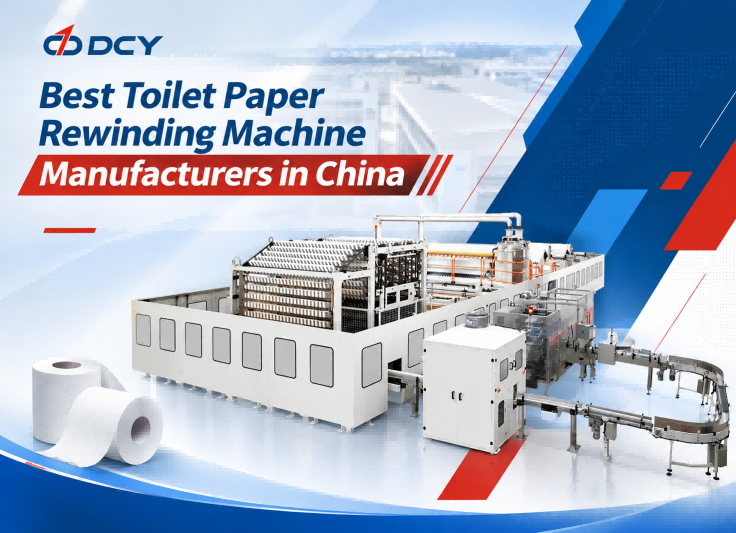
DCY ZQ-H
You buy wide parent reels and need high-volume roll conversion.
Usable web width and saw capacity on the shortest roll.
Huaxun HX-2100H
You use 2,100 mm reels and want to buffer logs before cutting.
Usable storage and downstream recovery rate.
Wangda WD-TP-PL1092-3200II
You want one proposal from rewinding through multipack wrapping.
Guaranteed good packs per minute on each pack pattern.
Xinyun XY-TQ-B
You need to match a rewinder to an existing cutter or several roll sizes.
Discharge height, log dimensions and transfer timing.
How we selected these companies. DCY publishes this guide and manufactures one of the lines covered. Each company has public technical documentation for an identifiable toilet roll rewinder or converting line. The shortlist is arranged alphabetically. Each profile pairs the manufacturer's published specifications with a buying decision and a test you can request. Performance figures come from the manufacturers. The five machines have not undergone a common independent production trial.
Baosuo for combined cored and coreless production
bs
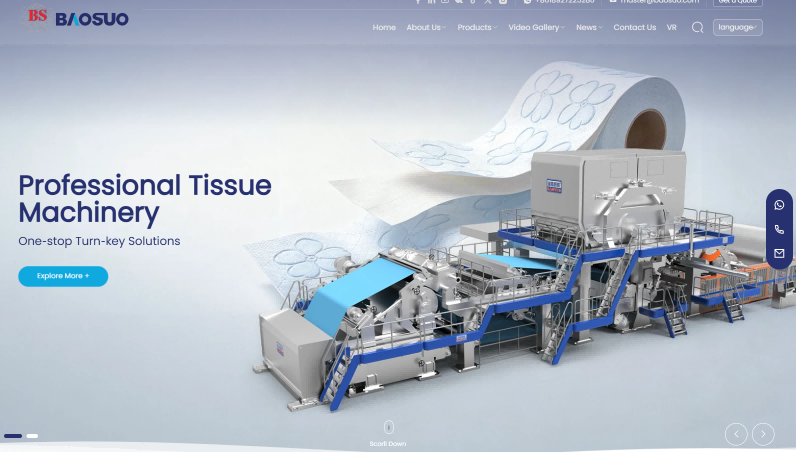
Baosuo's YD-PL250C gives a buyer two numbers to work with. The manufacturer lists stable production speeds up to 250 m/min for cored rolls and 180 m/min for coreless rolls. It also describes vacuum-assisted coreless winding, automatic web break detection and edge embossing. For a converter supplying both formats, the separate ratings make it possible to build a first production schedule around the actual order mix. Baosuo toilet roll machine specifications
Suppose a contract requires equal lengths of web in the two formats. At the published upper rates, 18,000 metres would take 72 minutes to rewind with a core and 100 minutes without one. That extra 28 minutes matters when assigning shifts. Changeovers, reel changes and packing losses would add to both estimates. Ask Baosuo to quote a demonstrated rate for each grade, including the time needed to switch formats and release the first acceptable pack.
For the coreless trial, take samples from the beginning and end of each run and inspect the centre after cutting and after packing. Check whether the first sheets release as intended and whether the roll fits the customer's holder. On the cored version, repeat the trial with the tubes you intend to purchase locally. Record core rejects separately from web breaks so you can tell whether paper handling or tube quality limits the run.
DCY for wide parent reels and integrated roll conversion
Dechangyu's ZQ-H series is a candidate for factories buying wide reels or expanding an existing roll operation. DCY lists maximum raw paper widths of 2,850 to 3,650 mm across configurations and a design speed of up to 500 m/min. The series uses independent drives and servo-controlled web separation at the perforation. Buyers can use these specifications to select a starting configuration for toilet rolls, kitchen towels or jumbo toilet rolls. DCY ZQ-H roll production line
The width choice deserves as much attention as speed. At 100 mm per finished roll, 3,600 mm of usable log length gives 36 full roll positions. At 105 mm it gives 34, with 30 mm left over before any further loss. Obtain a cutting plan showing available length after end trim and allowances for the cutting process. A few millimetres of roll width can change the number of accepted units from every log across a full year's production.
For a quotation, identify the exact reel width and weight, the number of unwind stands, the embossing pattern and the planned pack counts. Ask DCY to run the shortest roll in the range through cutting and wrapping. At the same web speed, shorter roll lengths increase the number of log transfers and cuts required per minute. The resulting pack count gives the buyer a basis for sizing the rest of the line.
Huaxun for a defined reel size and log buffer
Huaxun specifies its HX-2100H for parent reels 2,100 mm wide and 1,400 mm in diameter, with a published rewinding range of 150 to 200 m/min. Its technical sheet describes an 80-log storage rack and a saw rated at 80 to 100 cuts per minute with two rolls per cutting cycle. The manufacturer identifies storage, cutting and embossing equipment as configurable. Request a priced equipment list for the exact arrangement. Huaxun HX-2100H technical parameters
The rack is particularly relevant if your saw stops briefly for blade changes or the wrapper pauses to replace film. At eight incoming logs per minute, 40 empty positions can absorb five minutes of production during a complete downstream stop. The available time depends on how full the rack was when the stop began. After restart, the downstream machines need spare capacity to clear the accumulated logs.
Ask Huaxun to demonstrate a controlled downstream pause with your intended log diameter. Record the time until the rewinder must slow, whether soft logs retain their shape in storage, and how long the saw needs to return the rack to its normal level. This test gives the production manager a practical buffer setting and the warehouse team a sample from the most demanding transfer condition.
Wangda for a project that ends at the wrapped multipack
Wangda's WD-TP-PL1092-3200II is worth considering when several machines will come from one supplier. Wangda describes a rewinder and perforator, log accumulator, automatic log saw and multipack wrapper. Its page lists rewinding speeds up to 200 m/min and accumulator options of 100, 150 or 200 logs. The published equipment sequence gives buyers a clear basis for assigning responsibility for the transfers from one section to the next. Wangda automatic toilet roll production line
Start the commercial discussion with the packs your customers actually order. At 240 rolls per minute, four-roll packs need 60 successful wrapping cycles per minute. Twelve-roll packs need 20. The smaller pack imposes a higher cycle rate, while the larger pack may require more grouping, different guides and a wider film. Ask for both formats on the same capacity sheet, including film specification, roll orientation and staffing.
For a turnkey project, write the delivery boundary on the layout. Mark the discharge point for accepted packs, how rejected packs leave the line and who supplies conveyors to case packing. During the trial, include a pack-size change and count all conforming packs produced over the full interval. The result captures how well the machines operate together when the factory changes from one customer order to another.
Xinyun for a rewinder feeding separate finishing equipment
Fujian Xinyun Machinery Development publishes detailed dimensions for its XY-TQ-B. Its table gives a parent reel width range of 1,200 to 2,800 mm, a nominal parent reel diameter of 1,200 mm, finished roll diameters of 70 to 280 mm and a stated speed of 180 to 230 m/min. Xinyun describes automatic core feeding, log discharge and tail gluing. It also identifies cored and coreless winding and says the rewinder can work with separate cutting and packing machines. Xinyun XY-TQ-B product data
That combination makes the XY-TQ-B worth investigating when an existing saw or wrapper will stay in service. Send drawings of the current infeed, including elevation, direction of travel, supported log length and allowable log diameter. Ask both equipment suppliers to approve the transfer drawing. Specify what happens to a finished log when the saw stops and how the rewinder receives permission to discharge again.
Xinyun also publishes different perforation pitch ranges for two- and four-blade setups. If you make short-sheet bathroom rolls and longer-sheet towels, ask which blades and change parts cover your approved samples. During the trial, measure several consecutive sheet lengths, record the time to switch pitch and inspect the first logs after restart. Confirm the selected unwind width, diameter range and winding mode together on the purchase specification.
How to compare five speed quotations on one order
Use a finished product that accounts for a meaningful share of sales. Consider a hypothetical two-ply roll containing 200 finished sheets at a 100 mm perforation pitch. Each roll contains 20 m of wound web. If the usable log yields 20 retail rolls and the rewinder sustains 200 m/min, the ideal winding rate is ten logs per minute, equivalent to 200 rolls per minute. Both plies travel together, so the wound length is still 20 m.
Now include the finishing equipment. If the saw can deliver 180 rolls per minute and the wrapper sustains 14 twelve-roll packs per minute, the wrapper limits output to 168 rolls per minute while the line runs. With 420 productive minutes in an eight-hour shift and a 98% acceptance rate at the wrapper discharge, the illustration yields about 5,762 accepted packs. These figures assume the machines can sustain the stated rates on this product and that the 14-pack rate is measured before final rejects.
This calculation gives purchasing a precise follow-up for each machine builder. Have the supplier replace each assumption with a proposed value, specify the counting point and identify which losses the value already includes. When an offer quotes good packs per scheduled shift, applying another downtime or reject factor would count the same losses twice.
What to put in the request for quotation
Provide an approved roll, a sealed pack and samples of the tissue and tubes you expect to buy. A photograph communicates surface appearance. A paper sample gives the supplier a chance to see how the web stretches, how the perforation behaves and whether the tail adhesive holds on the embossed surface. Include the lightest grade and the least forgiving package as well as the usual product.
Item to specify
What suppliers need to return
Parent reels
Usable width, maximum reel weight, diameter, core bore, ply arrangement and loading method for the selected stands.
Finished roll
Target length, cut width, diameter tolerance, core dimensions, sheet pitch, firmness and tail release for each grade.
Embossing and bonding
Pattern sample, ply attachment method, included tooling and change time for a second design.
Cutting and packing
Accepted rolls and packs per minute, trim allowance, wrapper format limits and reject handling.
Utilities and layout
Installed and typical running loads, air consumption at stated pressure, full footprint and access for reel and blade changes.
Service and handover
Commissioning scope, training language, spare part lead times, warranty start date and named responsibility for line interfaces.
Two details often change the price comparison. First, clarify whether the supplier will deliver an operational line at your site or ship machinery for local installation. Freight, rigging, electrical work, commissioning travel and accommodation can fall to different parties. Second, ask for a separate price for each new product format. A second embossing roll set, core-handling parts and wrapper tooling can change the economics of a private-label contract. Equipment scope of a complete tissue converting line
Compare offers in cost per thousand accepted rolls at the same product length and weight. Include annual equipment and financing costs on a consistent basis, operators, utilities, maintenance, cores, adhesive, film and the tissue consumed. To see the effect of yield alone, assume two lines must each deliver 100 tonnes of accepted tissue. At 95% material yield the first needs 105.26 tonnes of input. At 97% the second needs 103.09 tonnes. Multiply the 2.17-tonne difference by your delivered paper price and examine whether the expected saving survives a change in product mix.
For service, ask for the part number and dispatch location of one perforation blade set, one saw blade and one critical drive. Ask who maintains the machine recipes, how a replacement drive receives its parameters and what training the shift technician receives. Those answers let you budget initial spares and estimate the duration of a stoppage on equipment installed outside China.
How to verify the preferred manufacturer before ordering
Arrange the factory acceptance test around an order you expect to sell. Agree who supplies paper, cores and film, how long each run lasts, where the team counts accepted packs and how it records stops. Use the same inspection sheet for every candidate. A continuous video showing reel identity, control settings and pack discharge can support remote review when a buyer cannot attend in person.
Run the main product first. Record incoming reel identification and actual test duration. Sample rolls across the log width and at intervals during the run. Check sheet count, perforation pitch, roll width, finished diameter and tail release. A roll can meet its diameter target through looser winding while containing less paper, so verify length or count independently. Retain labelled rolls and packs from the trial as references for commissioning.
Change to the difficult format. Choose the format most likely to interrupt production. It might be a soft three-ply roll that compresses in the wrapper, a short roll that taxes the log saw or a coreless roll that must hold its centre opening. Measure from the last accepted pack of the first format to the first sustained run of accepted packs of the next. Count discarded paper, tubes and film during the interval.
Repeat the checks after installation. Define which results the supplier must reproduce with site utilities, local materials and trained operators. Agree how long a failed item may remain open, who supplies corrective parts and which tests will be repeated. Identify the legal entity responsible for the warranty and the equipment serial numbers it covers. For a line involving more than one machine builder, give the buyer one contact responsible for diagnosing transfer faults.
Which manufacturers should receive your enquiry
For a private-label order split between cored and coreless bathroom rolls, start with Baosuo and Xinyun. Baosuo provides separate rate assumptions for the two modes. Xinyun gives you a dimensional range and details of the rewinder discharge that you can check against an existing saw. Run both offers against the same coreless centre specification and order mix.
If your mill supplies reels around 3.6 m wide, start with the DCY ZQ-H and request a cutting diagram for your retail roll widths. If your existing reel supply is 2.1 m wide and interruptions at cutting are the main source of downtime, the Huaxun HX-2100H and its specified buffer deserve a trial. For a greenfield factory whose first delivery commitment is wrapped multipacks, Wangda's published line scope offers a starting point for a whole-line tender.
The purchasing decision comes down to the order your factory can ship. Give shortlisted suppliers the same paper, finished roll, pack pattern and shift target. Ask each to return a signed product specification, a line layout and a trial result in accepted packs. For a DCY evaluation, those same materials can accompany a project enquiry. Request a converting line proposal from DCY




 English
 Español
 العربية
 Português do Brasil
 Русский