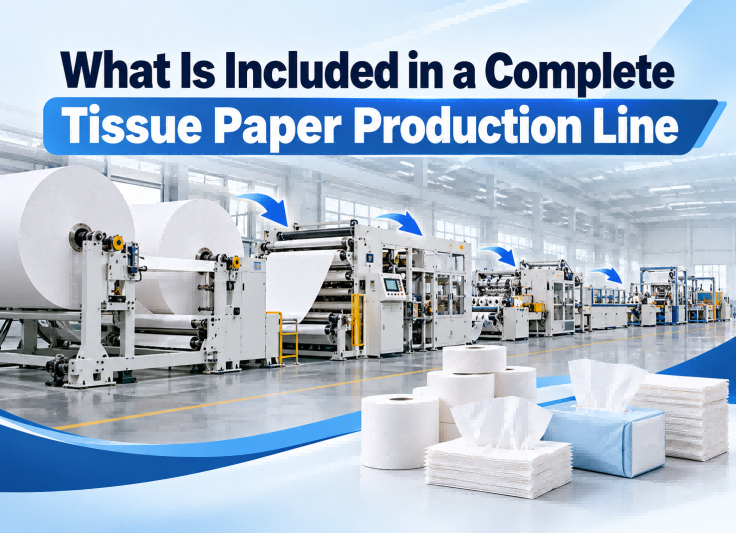
What Is Included in a Complete Tissue Paper Production Line
A buyer who asks for a complete tissue paper production line is often trying to avoid hidden gaps. The factory may need toilet rolls, kitchen towels, jumbo rolls, facial tissues, hand towels, napkins or mixed formats. The purchasing team wants one project scope, one layout logic and one accountable supplier. Yet the phrase can mean very different things. One supplier may include pulp preparation and a tissue paper machine. Another may start from purchased parent reels and include only converting equipment. A third may stop before packaging, leaving the buyer to solve wrapping, carton packing and palletising later.
What Is Included in a Complete Tissue Paper Production Line
That ambiguity creates real production problems. A fast rewinder without a matching log saw can starve the wrapper. A good interfolder without stable packaging can produce neat tissue logs that still pile up before shipment. A semi automatic line may be practical in a low labour cost market, while a fully automatic line may be essential where operator cost, hygiene control and shift consistency matter more. The buyer therefore needs a clear definition of what is included, what is optional and what should be excluded from the supplier quote.
DCY Dechangyu Paper Machinery focuses on tissue converting and post processing solutions, not upstream pulping or parent reel papermaking. Founded in 1987, DCY has a 100000 square meter manufacturing base, about 400 employees, more than 30 engineers, more than 60 national patents, ISO 9001 and CE certification, and export experience across more than 160 countries and regions. This article explains the equipment normally included when a B2B buyer asks for a complete tissue paper production line for converting parent reels into saleable tissue products.
Quick Answer
A complete tissue paper production line for converting normally includes parent roll handling, unwinding, web tension control, embossing or lamination, rewinding or folding, cutting, counting, accumulation, primary packaging, secondary packing, conveying, inspection, dust removal, electrical controls, safety systems, spare parts, operator training and commissioning support. Roll products require a rewinder, core supply, tail sealing, log saw, roll wrapper and end of line handling. Folded products require an interfolder or folder, stack control, tissue log saw or sheet cutting system, wrapping or boxing, carton packing and warehouse ready discharge.
The most important point is scope. A complete tissue paper production line is complete only when it reaches the buyer's agreed handover point. If the handover point is wrapped retail packs, secondary packaging and palletising may still be outside the scope. If the handover point is pallet ready cartons, the supplier must account for wrapper, case packing, conveying, palletising, controls and utility interfaces. Good procurement starts by defining the finished product and tracing the material flow backward to the parent reel.
What Competitor Pages Usually Cover
The pages ranking for this topic usually succeed because they answer the scope question early. DCY's existing article on this subject ranks because it defines the difference between upstream tissue making and downstream converting, then explains the sequence from parent reel handling to pallet ready output. Competitor articles often list core stages such as raw material preparation, sheet formation, converting, packaging and quality inspection, but many mix papermaking equipment with converting equipment in the same article.
Large international suppliers tend to describe the whole value chain. The Valmet tissue making technology overview explains tissue making from stock preparation through tissue machine lines, converting, packaging, services and automation. Its Valmet tissue converting overview also defines tissue converting as transforming parent reels into finished products such as toilet tissue, paper towels, facial tissue and napkins, with typical functions including rewinding, embossing, laminating, folding, packaging and quality control.
Packaging specialists and converting line resellers add another useful lesson: a line is not really complete if it ends before end of line handling. A listed CT Paper complete toilet and kitchen roll converting line includes unwinding, printing, embossing, laminating, rewinding, tail sealing, core making, log sawing, wrapping, bundling, palletising and stretch wrapping. That example shows why buyers should ask whether the quote ends at converted logs, wrapped packs, cartons or pallets.
Related searches also show what buyers worry about: what machinery is needed, what is the difference between tissue making and tissue converting, whether packaging is included, how to choose between fully automatic and semi automatic lines, and how the line changes for toilet roll, kitchen towel, facial tissue or hand towel production. This article answers those search intentions in a structure that procurement teams can use as an RFQ checklist.
First Define The Production Boundary
The phrase complete tissue paper production line has two meanings in the market. In an integrated tissue mill, it may include pulp preparation, cleaning, screening, refining, approach flow, a forming section, a Yankee dryer, creping, reeling and parent roll handling. In a converting factory, it usually begins with purchased or internally supplied jumbo parent rolls and ends with consumer or away from home tissue products. These are very different projects, with different building requirements, utilities, technical staff and investment logic.
A buyer who needs a paper machine should discuss stock preparation, headbox, forming, pressing, drying, creping, reel quality and parent roll logistics. A buyer who already has parent reels should discuss converting, folding, rewinding, cutting, wrapping and palletising. The distinction matters because DCY's strength is downstream converting. Buyers who need background on equipment categories can compare broader tissue machines with DCY's focused guide to tissue converting line equipment.
When preparing an inquiry, state the starting point and the handover point in the first paragraph. For example, a converting inquiry may start with parent rolls of specified width, diameter, core size, ply, basis weight and moisture. It may end with wrapped rolls, boxed facial tissues, cartons on pallets or finished reels for another line. The supplier cannot design a reliable complete tissue paper production line unless these boundaries are written clearly.
Production boundary comparison
Project Type
Typical Starting Point
Typical Included Equipment
Common DCY Relevance
Upstream tissue making
Pulp or fibre furnish
Pulping, screening, forming, Yankee drying, creping and reeling
Core fit for toilet paper, kitchen towel and JRT solutions
Folded tissue line
Jumbo parent tissue roll
Unwinder, interfolder, stack control, cutting, wrapping, boxing and carton handling
Core fit for facial tissue and hand towel solutions
Jumbo reel preparation
Wide parent reel or raw paper roll
Slitting, rewinding, trimming, coating or printing when required
Fit for FC series slitting and coating solutions
The Basic Converting Flow
For most DCY buyers, the complete tissue paper production line begins at parent reel preparation. Operators or automated handling systems bring parent rolls to the unwind area. The line controls web tension, edge position and reel changeover. The tissue web then moves into value adding stages such as embossing, lamination, printing, lotion coating or ply combining. After that, the line forms the product: a toilet roll log, a kitchen towel log, a jumbo roll, a folded facial tissue log, a hand towel stack or a prepared slit reel.
The next stage is cutting and flow control. Roll products usually leave the rewinder as long logs that must be cut into consumer or commercial roll lengths. Folded products may need log saw cutting, sheet separation, stack compression or count control. From there, the product moves into primary packaging, secondary packaging, conveying, case forming, carton packing, palletising and warehouse transfer. The sequence is simple, but each interface can become a bottleneck if the machines are not balanced.
A useful rule is to judge the line by saleable output, not by the top speed of one machine. If the rewinder can produce faster than the wrapper can accept, the line will stop or accumulate products. If the interfolder produces clean logs but the cutter crushes them, quality suffers. If the packaging line changes format slowly, the daily output may disappoint even when machine speed looks impressive. A complete project should therefore specify capacity at the finished pack, carton or pallet stage.
Parent Roll Handling And Unwinding
Parent roll handling is the first practical station in a converting line. It includes roll storage, lifting, loading, core chucking, unwind stands, brake or drive control, splice method, web guiding, tension feedback and operator access. The parent roll specification should include maximum width, outside diameter, core diameter, ply, basis weight, moisture, strength, edge condition and reel hardness. Poor parent roll quality can create breaks, wrinkles, edge waste and unstable tension even when the converting machine is well built.
For roll products, unwinding must feed the rewinder at a stable tension while protecting softness and embossing quality. For folded products, unwinding must allow clean sheet separation, accurate folding and stable stacking. For jumbo reel preparation, unwinding must support slitting accuracy, web spreading and finished reel quality. The Valmet Digital JumboRoll article is useful because it highlights how parent roll data can connect tissue making and converting, showing why parent roll information is not just warehouse paperwork.
A complete tissue paper production line should also define roll change strategy. A small line may use manual loading and simple splicing. A high output line may require fast change unwind stands, automatic tension control and better parent reel logistics. If the parent reel supply cannot match downstream speed, the rest of the line will never reach stable output.
Roll Product Equipment
Toilet paper, kitchen towel and JRT lines share several core stages. The line unwinds one or more webs, controls tension, embosses or laminates when required, perforates the sheet, rewinds it onto a core or coreless structure, seals the tail, transfers the log, cuts the log into finished rolls and sends the rolls to wrapping and packing. This is the product family where many buyers most often use the phrase complete tissue paper production line.
A roll line should not be specified only by rewinder speed. Buyers should confirm parent roll width, finished roll diameter, core diameter, perforation pitch, roll length, ply, embossing pattern, tail sealing method, log length, cutting length, wrapping style, pack count and carton pattern. DCY's article on tissue roll machines and the broader guide to toilet paper machine types can support teams that are still mapping the machine functions inside a roll project.
Folded Tissue Equipment
Facial tissue and hand towel production use a different logic from roll products. Instead of rewinding a web into logs around a core, the line folds the tissue into interfolded or folded stacks. A folded tissue line normally includes parent roll unwinding, tension control, optional embossing or lamination, folding, counting, stack or log control, cutting, compression, wrapping or boxing, carton packing and conveying. The line must protect softness while keeping sheet count and stack shape consistent.
The most important folded tissue specifications are parent roll width, ply, sheet size, fold type, sheet count, stack height, log height before and after pressing, cutting length, packaging style, pack speed and downstream carton requirement. A line that folds accurately but packages slowly is incomplete for a factory that needs retail ready output. A line that packs fast but cannot maintain sheet count will create customer complaints. The complete design must hold both quality and speed.
Slitting Rewinding Printing And Coating
Not every tissue project goes directly from parent roll to consumer pack. Some factories need a slitting rewinder to prepare reels for other converting lines, remove damaged edges, split wide raw rolls, improve reel quality or create jumbo rolls for away from home products. Some brands need printed toilet paper, coated products or lotion treated tissue. These functions should be included only when they match the product strategy.
DCY's FC series slitting rewinder supports jumbo reel and slitting requirements, while the FC series with coating and tissue lotion machine are relevant when coating or lotion treatment is part of the product plan. If printed patterns or branding are required, the FC series toilet paper printing machine can become part of the converting route. These options should be discussed early because they affect floor layout, material flow, drying or curing needs, quality checks and operator training.
The article on conversion machines is useful because it explains why converting equipment matters after parent reels are made. DCY's guide to tissue cutting machines also helps buyers understand how cutting requirements differ between toilet paper, facial tissue, kitchen roll and other formats. In a complete line, slitting, printing, coating and cutting are not isolated add ons. They must fit the downstream process.
Packaging Secondary Packing And Palletising
Packaging is where many incomplete quotations reveal themselves. A supplier may quote the main converting machine but exclude wrapping, bundling, carton packing or palletising. For a small project, that may be acceptable if the buyer already has downstream equipment. For an export oriented factory, packaging is usually part of the expected scope. The buyer should define whether the required output is loose rolls, wrapped packs, cartons, bundles, pallet ready cases or stretch wrapped pallets.
For roll products, DCY's F-T6 automatic roll wrapper and F-T8 automatic roll wrapper can support automatic toilet paper and kitchen towel packaging routes. At the end of the line, the high-speed robotic palletizing system can reduce manual handling and improve warehouse consistency. Packaging lines should be chosen according to product orientation, pack count, film or paper wrapping type, label position, carton size, pallet pattern and warehouse flow.
A complete tissue paper production line should include buffer and accumulation strategy. If a wrapper stops, the rewinder or interfolder should not immediately create scrap. If a palletiser is slower than the carton flow, cases should not block upstream machines. Conveyors, reject stations, inspection access and manual bypasses may look less exciting than the main machine, but they often decide whether the line is stable during real shifts.
Roll wrapper, bundler, case packer, conveyor, palletiser and stretch wrapping
Kitchen towel
Unwinder, stronger embossing, rewinder, perforation, log saw and transfer system
Roll wrapper, multipack system, carton packing and palletising
Facial tissue
Unwinder, interfolder, counting, stack control, pressing and log saw or cutting
Soft pack wrapper or box packer, cartoning and case handling
Hand towel
Unwinder, folding, counting, stacking, cutting and compression
Pack wrapper, carton packing and warehouse discharge
Jumbo reel or JRT
Slitting rewinder, trimming, tension control and reel handling
Finished reel handling, wrapping or downstream transfer
Controls Drives Safety And Data
A line is complete only when the machines work together as one process. Individual machines may have their own controls, but the whole line needs a control philosophy for speed reference, start stop sequence, emergency stop, starvation, blockage, product recipe, alarm display and maintenance access. PLC, HMI, servo drives, sensors, encoders, pneumatic components and safety circuits should be specified with after sales support in mind.
DCY can work with Siemens PLC systems and can also use strong Chinese automation brands such as Inovance when the customer prefers that platform. The correct choice depends on local support, spare parts, factory standards and customer preference. The buyer should ask how recipes are stored, how alarms are displayed, how operators adjust product format, how remote support is handled and how the line recovers from a stop.
Safety belongs in the same discussion. A complete tissue paper production line includes guarding, interlocks, emergency stops, safe access for roll loading, blade changing, wrapping film replacement, jam clearing and maintenance. OSHA's OSHA machine guarding standards provide a useful reference point for why point of operation hazards, power transmission areas and operating controls must be guarded. Local regulations may differ, but the engineering principle is the same: productivity and safety should be designed together.
Utilities Layout And Workshop Preparation
A supplier cannot design the complete system without workshop information. The buyer should provide floor dimensions, ceiling height, foundation condition, door size, forklift route, crane availability, power supply, compressed air, ventilation, dust extraction, drainage, lighting, warehouse route and future expansion area. Tissue equipment is long, and a line that looks correct on a quotation may become difficult to operate if roll loading, packaging material storage and finished goods movement are not considered.
Dust control is especially important in converting. Cutting, perforating, trimming and rewinding can generate dust that affects product cleanliness, machine reliability and operator comfort. A complete scope should also define waste collection, trim handling, reject removal and cleaning access. For high speed projects, the layout should support maintenance teams without forcing them to climb over conveyors or move pallets every time they inspect a sensor.
For overseas buyers, logistics and site readiness are part of line success. DCY's Confirmação de pedido and fazer um pedido service pages are relevant because equipment scope, packing lists, delivery batches, spare parts, site preparation and installation timing must match. A line that arrives before utilities are ready will sit idle. A line that arrives without clear interface drawings will create avoidable delay.
Automation Level And Labour Strategy
A fully automatic line is not automatically the best choice for every factory. In high labour cost regions, automation can reduce manual transfer, improve hygiene, stabilise output and make production less dependent on individual operator skill. In lower labour cost regions, a semi automatic configuration may be more practical for an early stage factory if the product mix is simple and daily volume is moderate. The right line should match capacity, labour cost, product variety and maintenance capability.
For roll products, automation may include automatic core making, automatic web transfer, tail sealing, log accumulation, log saw feeding, roll wrapping, case packing and palletising. For folded products, automation may include automatic counting, compression, wrapping, box packing, cartoning and product transfer. The buyer should ask which stations are fully automatic, which require manual feeding and which can be upgraded later.
DCY's service process can support this decision through a solution proposal, followed by implementation support during installation and commissioning. The after-sale warranty page is also important because a complete line is a long term production asset, not a single machine purchase. Buyers should evaluate the supplier's ability to support operators, maintenance staff and spare parts after the first successful trial.
How To Compare Supplier Quotations
Two quotations for a complete tissue paper production line may look similar but contain very different scopes. One may include only a rewinder and log saw. Another may include core making, tail sealing, wrapping, conveyors and palletising. One may include installation and training. Another may quote those separately. One may specify control brands and spare parts. Another may leave them vague. Buyers should compare the handover point first, then compare machine list, automation level, performance assumptions and support.
A strong quotation should identify product formats, parent roll assumptions, required speed, accepted waste target, power, compressed air, layout, operator number, spare parts, controls, safety scope, delivery schedule, installation responsibility, commissioning method and acceptance criteria. It should also identify exclusions clearly. If packaging film, cartons, air compressor, dust extraction, conveyors or palletising are not included, the buyer should know before ordering.
Company credibility also matters. DCY's background, factory scale, patents, export experience and cooperation with major tissue producers are explained on the about Dechangyu page. Buyers who want regional cooperation can review dealership opportunities. These links do not replace technical evaluation, but they help overseas buyers judge whether the supplier can support a complete project beyond the first shipment.
RFQ checklist for a complete line
RFQ Item
What The Buyer Should Define
Why It Matters
Product scope
Toilet roll, kitchen towel, JRT, facial tissue, hand towel, napkin or mixed formats
The product decides the machine route
Starting point
Parent reel specifications, storage and loading method
Unwinding and tension design depend on reel quality
Handover point
Logs, wrapped packs, cartons or pallets
Determines whether packaging and palletising are included
Automation level
Manual, semi automatic or fully automatic station by station
Affects labour, layout, maintenance and output stability
Controls
PLC, HMI, drives, sensors, safety and remote support preference
Controls decide usability and long term serviceability
Acceptance
Saleable output, product tolerances, training and documentation
Prevents disputes after installation
What Should Not Be Assumed
Do not assume pulp preparation is included unless the supplier clearly says so. Do not assume packaging is included unless wrapper, bundler, case packer, conveyor and palletising scope are listed. Do not assume a quoted speed equals saleable output. Do not assume every line can make every product format. Do not assume a semi automatic line can be upgraded easily unless the layout and controls allow it. Do not assume the supplier will provide utilities or civil work unless the contract states it.
Also avoid asking only for a complete tissue paper production line without product details. A supplier needs dimensions, sheet count, roll diameter, core diameter, ply, basis weight, embossing requirement, pack format, carton requirement, daily output target, labour plan, utility conditions and factory layout. The more complete the buyer's inquiry, the more useful the supplier proposal becomes.
The Soontrue tissue production process and machinery article is an example of why buyers must be careful with terminology. It describes both upstream tissue making stages and downstream converting stages in one article. That can be educational, but a procurement document should separate the two. DCY's role is strongest when the project is a converting and post processing line from jumbo roll to finished product.
Configuration Examples For Different Factories
A startup converter and a multinational tissue group may both ask for a complete tissue paper production line, but they should not receive the same configuration. A startup factory may need a focused product route, simple material flow, practical semi automatic handling and clear upgrade space for future packaging automation. The first goal is to produce saleable tissue consistently, train operators and prove the local market. A large tissue producer may need high speed automation, multiple packaging formats, robotic palletising, recipe control, strict traceability and faster changeovers because downtime across several shifts becomes expensive.
For a toilet roll startup, a practical line may include parent roll unwinding, embossing, perforation, rewinding, a core machine, log saw, basic roll wrapping and manual or semi automatic carton handling. For an established roll factory, the same product category may require high speed rewinding, fast changeover, glue free tail sealing, automatic log transfer, automatic wrapping, bundling, case packing and palletising. The difference is not only machine speed. It is the amount of manual touch, the number of SKUs, the expected shift output and the tolerance for stoppage.
For facial tissue, an entry project may start with an automatic or semi automatic interfolder, cutting and one packaging format. A more advanced project may include multiple parent roll widths, V fold or M fold flexibility, bottom pull tissue options, automatic stack transfer, soft pack and box pack compatibility, carton packing and line data collection. Hand towel projects may emphasize stronger base paper, stable folding, accurate count control and commercial packaging formats. In every case, the complete line should be designed around the product mix that will actually be sold.
Factories that already own some equipment should not automatically replace everything. If an existing wrapper, conveyor or palletising system is reliable and compatible with the new output, it can remain part of the project. If an old downstream machine limits speed or pack quality, keeping it may turn a new line into an expensive bottleneck. The supplier should therefore review existing equipment, control interfaces, mechanical transfer points and layout before confirming whether the old assets can be integrated.
Acceptance Criteria And Handover Documents
A complete tissue paper production line also needs a complete handover process. Before installation, the buyer and supplier should agree what will be tested, which products will be used, how many trial runs are required and what counts as acceptable output. The test should not focus only on whether the machine moves. It should confirm product dimensions, sheet count, roll diameter, cut accuracy, tail seal quality, wrapping appearance, carton condition, pallet pattern, safety functions, alarm messages, operator training and spare parts readiness.
For roll products, acceptance may include stable parent roll unwinding, consistent perforation, roll tightness, finished roll diameter, core position, tail sealing, cut length, wrapping integrity and pack count. For folded tissue, it may include fold accuracy, sheet count, stack height, cutting quality, soft pack or box appearance, reject handling and carton quality. For slitting projects, it may include finished reel diameter, edge quality, slitting width, tension stability and trim removal. Each product type needs acceptance standards that match its process.
The final handover package should include layout drawings, electrical drawings, pneumatic diagrams, machine manuals, spare parts list, lubrication points, recommended maintenance schedule, operator training records, PLC or HMI backup procedure when available, safety checklist, commissioning report and contact path for service. These documents are not paperwork decoration. They allow the buyer's maintenance team to keep the complete tissue paper production line productive after supplier engineers leave the site.
Acceptance checklist by line area
Line Area
Acceptance Evidence
Common Risk If Missing
Unwinding and web control
Stable web path, tension records, clean threading and parent roll compatibility
Web breaks, wrinkles and unstable downstream quality
Converting core
Roll or folded product dimensions, speed ramp and repeatable product quality
A fast demonstration that cannot become stable shift production
Cutting and transfer
Clean cut, accurate count, smooth accumulation and no product crushing
Finished product rejects after good upstream converting
Packaging
Pack appearance, sealing, carton count, label position and format changeover
Products are made but not saleable in the required format
Controls and safety
Alarm response, emergency stops, interlocks, guarding and operator screens
Unsafe operation and slow troubleshooting
Documentation
Manuals, drawings, spare parts, maintenance and training records
The factory depends too much on supplier engineers after handover
Perguntas Frequentes
What machines are included in a complete tissue paper production line
For a converting project, the line can include parent roll handling, unwinding, embossing or lamination, rewinding or folding, cutting, counting, wrapping, carton packing, conveyors, dust removal, controls, safety systems and palletising. The exact list depends on the finished product and handover point.
Does a complete line include pulp making equipment
Not always. If the project starts from pulp, it may include stock preparation and a tissue paper machine. If it starts from purchased jumbo rolls, it is a converting line. DCY mainly serves the converting and post processing scope from parent rolls to finished tissue products.
What is included in a toilet paper production line
A toilet paper line normally includes unwinding, embossing, perforation, rewinding, core supply, tail sealing, log sawing, roll wrapping, bundle or case packing, conveyors and optional palletising. The buyer should also include controls, safety, spare parts, training and commissioning.
What is included in a facial tissue production line
A facial tissue line normally includes parent roll unwinding, web tension control, optional embossing or lamination, interfolding, counting, stack or log control, cutting, compression, soft pack or box packing, carton handling and line controls.
Should packaging be part of the quotation
Packaging should be included when the buyer expects saleable retail packs, cartons or pallet ready goods from the same project. If the buyer already owns packaging equipment, the quote should still define the interface between the converting machine and the existing packaging line.
How does DCY help buyers define the line scope
DCY can review product type, target output, parent roll specifications, factory layout, automation preference, labour conditions and packaging requirements, then recommend a customized converting solution across roll products, folded products, slitting, embossing, coating, packaging and palletising.
What is the most common hidden bottleneck
Packaging and product transfer are common hidden bottlenecks. A main converting machine may run well, but output can still be limited by log saw feeding, wrapping speed, carton packing, conveying, palletising or manual handling. A complete line should be balanced all the way to the agreed handover point.
Conclusão
A complete tissue paper production line is not just a long list of machines. It is a balanced production system that starts at a clearly defined input and ends at a clearly defined finished product. For most DCY buyers, the practical scope begins with jumbo parent rolls and includes converting, cutting, wrapping, packing, controls, safety, training and commissioning. The exact equipment depends on whether the factory is producing toilet rolls, kitchen towels, jumbo rolls, facial tissues, hand towels or specialized products.
The safest way to buy a complete tissue paper production line is to work backward from the finished pack. Define the product, pack, carton, pallet, output target, labour plan and factory layout. Then ask the supplier to show how each machine and interface supports that result. If the handover point is retail packs, include packaging. If the handover point is pallet ready cartons, include palletising. If the project starts from parent reels, separate it from upstream papermaking scope.
DCY Dechangyu supports global tissue converters with customized tissue converting solutions, large width and high speed equipment options, full and semi automatic configurations, Siemens or Inovance control choices, patented technologies and experience serving leading tissue producers in China and overseas markets. For buyers planning a new factory or expanding an existing line, a complete and well defined scope is the first step toward stable production and long term customer delivery.
External Sources Used
External research for this article included Valmet's tissue technology and tissue converting overviews, Soontrue's process and machinery article, CT Paper's complete toilet and kitchen roll converting line listing, Valmet's parent roll data article and OSHA machine guarding standards. These sources were used for industry context, while DCY-specific details came from DCY product and company materials.




 English
 Español
 العربية
 Português do Brasil
 Русский