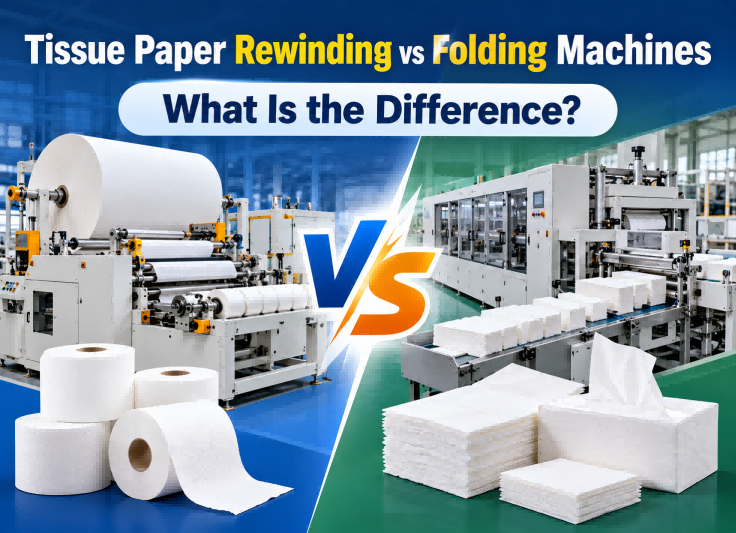
Tissue Paper Rewinding vs Folding Machines What Is the Difference
Global tissue converters are under pressure from two directions at once. Retail buyers want cleaner embossing, tighter roll winding, better sheet appearance, and packaging that reaches shelves without waste. At the same time, factory owners must handle wider parent rolls, more SKUs, higher labor costs in many regions, and stricter expectations for safety and repeatability. In that environment, choosing the wrong converting route can create years of hidden inefficiency. A toilet roll project cannot be solved by a facial tissue folder, and a boxed facial tissue project cannot be solved by a toilet roll rewinder.
Tissue Paper Rewinding vs Folding Machines What Is the Difference
This is why buyers search for tissue paper rewinding vs folding machines before they request a quotation. The difference is not simply the machine shape. It is the product logic. Rewinding machines transform jumbo rolls into logs and then retail rolls such as toilet paper, kitchen towel, and jumbo roll tissue. Folding machines transform jumbo rolls into interfolded or folded sheet products such as facial tissue, hand towel, kitchen towel sheets, and handkerchief tissue. A serious purchase decision should begin with the final product, then move backward through capacity, automation, web width, sheet count, packaging, factory space, and service support.
For DCY, that distinction is part of everyday engineering work. Dechangyu Paper Machinery has served the tissue converting sector since 1987, with a large manufacturing base, an experienced engineering team, many national patents, and projects across China, the United States, Australia, Vietnam, the Middle East, Korea, Japan, and many other markets. The company supplies both roll solutions and fold solutions, so the goal is not to force every buyer into one machine type. The goal is to configure the route that fits the product plan, labor environment, and long term growth path.
Quick Answer
A tissue paper rewinding machine is used when the finished product is roll based. It unwinds parent rolls, controls tension, perforates, embosses when required, rewinds paper around a core or into a coreless log, seals the tail, and sends the log to cutting and roll packing. A tissue paper folding machine is used when the finished product is sheet based. It unwinds parent rolls, slits or guides webs, folds sheets into V fold, M fold, Z fold, C fold, or other patterns, counts stacks, cuts when needed, and prepares stacks for bag or box packaging.
The simplest decision rule is this. Choose rewinding when your commercial target is toilet paper, kitchen towel rolls, industrial rolls, or JRT. Choose folding when your target is facial tissue, hand towels, napkins, folded kitchen towels, or pocket tissue. If your catalog includes both roll products and folded products, plan two converting routes, even if they share parent roll supply, embossing knowledge, operators, warehouse systems, and downstream packing standards.
The practical difference between tissue paper rewinding vs folding machines can be summarized in one sentence: rewinding controls roll diameter, winding tightness, perforation and log quality, while folding controls sheet presentation, fold geometry, stack accuracy and dispensing performance. Both routes can be fully automatic or semi automatic. Both can include embossing, trimming, counting, automatic transfer, safety guarding, and smart packaging. But the converting movement, quality risks, maintenance focus, and buyer specifications are different.
Industry Search Intent
When buyers compare tissue paper rewinding vs folding machines, they are usually trying to avoid three mistakes. The first mistake is asking for a machine name before defining the product. The second is comparing line speed without checking web width, sheet count, roll diameter, package format, and realistic operating efficiency. The third is assuming that any tissue converting equipment can make any tissue SKU. Competitor articles that rank well often win because they answer the basic intent quickly: what the machines do, which products they make, and what equipment is needed around them.
A better B2B answer must go deeper than a short definition. A purchasing manager needs to know whether a rewinder line requires a core machine, accumulator, log saw, tail sealer, roll wrapper and case packing. A factory owner considering facial tissue needs to know whether the folder can handle the desired ply, sheet size, stack height, interfold pattern, first-pull performance, and packaging connection. A technical director wants stable servo control, reliable PLC architecture, width options, accurate tension control, safe guarding, and clear after sales support.
That is the framework used in this guide. It explains the process flow from jumbo roll to finished product, compares the main technical parameters, connects each machine type to real applications, and gives a buying checklist. The focus is not price. For serious B2B equipment decisions, value is usually created through stable output, usable production time, product quality, easier maintenance, and a line configuration that matches labor conditions in the buyer's country.
What a Rewinding Machine Does
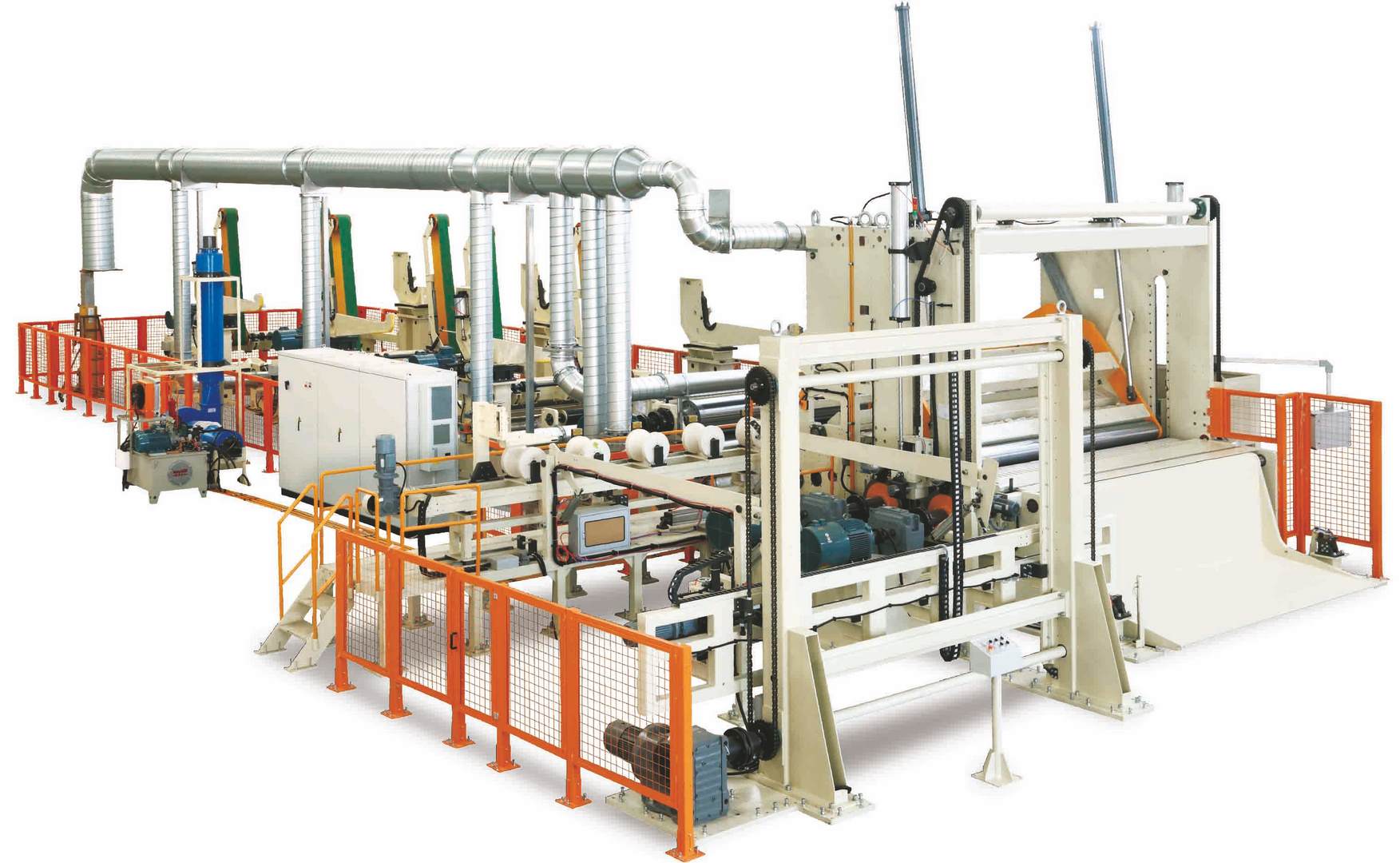
A tissue rewinding machine converts a large parent roll into smaller wound logs. The web is unwound under controlled tension, passed through embossing or perforation units when specified, wound to the target diameter, and prepared for later cutting. In a toilet paper line, the rewound log is usually transferred to a log saw, cut into individual rolls, then wrapped and packed. In a kitchen towel line, the same principle applies, although roll diameter, sheet size, embossing depth, and perforation pitch may differ.
The rewinding route is built around cylindrical geometry. That means the buyer must define finished roll diameter, core diameter, roll width, sheet length, sheets per roll, web width, parent roll diameter, ply, embossing, tail sealing method, and package style. In a practical review of tissue paper rewinding vs folding machines, this is the moment when a roll project separates itself from a folded sheet project. A high speed roll line such as the DCY ZQ-H high-speed roll production line is designed for toilet roll, kitchen towel, and JRT production, with wide raw paper options and servo based control for high volume factories.
For factories that require a different automation level or product range, DCY also supplies the ZQ-III automatic roll production line. The exact configuration depends on production planning. A high labor cost region may prefer more automatic transfer, automatic core feeding, automatic tail sealing, and integrated packaging. A region with lower labor cost may still require reliable rewinding quality but choose a line with more manual handling around secondary operations.
A roll route may include supporting modules. Core production can be handled by the ZX high-speed toilet paper core machine. Surface softness or pattern can be supported through embossing, and some converters add printing or coating for differentiated products. For narrow rolls, jumbo roll slitting, or material preparation, the FC series slitting rewinder can support upstream converting needs. The final choice should follow product specifications rather than a generic machine list.
What a Folding Machine Does
A tissue folding machine converts parent roll webs into counted stacks of folded sheets. Instead of building a cylindrical log, the machine creates a sheet sequence that consumers pull from a box, soft pack, dispenser, or pocket pack. The most common products are facial tissue, hand towels, napkins, folded kitchen towels, and some specialty hygiene sheets. The machine must control sheet cutting, fold shape, layer alignment, stack count, stack transfer, and presentation quality.
The folding route is built around sheet geometry. Buyers must define unfolded sheet size, folded sheet size, ply, fold type, stack count, stack height, pack dimensions, dispensing style, parent roll width, slit width, and downstream packaging format. In the same review of tissue paper rewinding vs folding machines, these sheet details show why a folder must be specified around dispensing and pack appearance. A line such as the DCY CJ-C automatic facial tissue production line is designed for high speed folding, cutting, stacking, and packaging connection, with wide raw paper options and accurate stacking control.
For V fold facial tissue, the CJ-C-A automatic V fold facial tissue line is relevant when the product requires reliable interfolding and smooth dispensing. For institutional washrooms, away from home channels, and food service environments, the CJN-C automatic hand towel production line supports folded hand towel production. These folded products compete on neat stack appearance, sheet pull, absorbency, and dispenser compatibility rather than roll tightness.
A folding line can also include lotion, embossing, trimming, and automatic packaging according to the tissue grade. For premium facial tissue, a tissue lotion machine can support softness positioning. For pattern and bulk, embossing equipment must be chosen carefully so that the finished stack stays neat and the sheet still dispenses smoothly. In folded products, a small web alignment error can become a visible stack defect very quickly.
Side by Side Comparison
Comparison Point
Rewinding Machines
Folding Machines
Typical finished products
Toilet paper rolls, kitchen towel rolls, JRT, industrial rolls
Facial tissue, hand towels, napkins, folded kitchen towels, pocket tissue
Core converting action
Unwind, perforate, emboss, rewind into logs, transfer to cutting
Unwind, slit or guide, fold, count, stack and transfer
Main quality target
Roll diameter, winding tightness, perforation accuracy, tail sealing, cut face
Core making, log saw cutting, roll wrapping, bundling and palletizing
Stack cutting when needed, soft pack or box packing, carton packing and palletizing
Automation decision
Automatic lines reduce core feeding, log transfer and packing labor
Automatic lines reduce counting, stacking, transfer and packing labor
This comparison shows why tissue paper rewinding vs folding machines should not be treated as a small wording difference. The two routes solve different market needs. A rewinder is judged by how consistently it builds a log and protects tissue properties through unwinding, tension control and rewinding. A folder is judged by how accurately it forms sheets and stacks that consumers can pull one by one. Both can be part of a complete tissue converting strategy, but each has its own engineering center.
Both rewinding and folding start from the jumbo roll, also called the parent roll. The parent roll is produced by a tissue paper machine, then transferred to converting. At the converting stage, the goal is to transform wide, heavy parent rolls into sellable products with controlled dimensions and stable quality. This is the bridge between paper making and retail or away from home distribution.
In a rewinding line, the parent roll is loaded to an unwind stand. The web passes through tension control, embossing if required, perforation, core insertion or coreless forming, rewinding, tail cutting, tail sealing, log transfer, log saw cutting, individual roll wrapping, bundling, case packing, and palletizing. DCY can connect roll output with smart packaging such as the F-T6 automatic roll wrapper or the F-T8 automatic roll wrapper depending on product and packing plan.
In a folding line, the parent roll is loaded to an unwind stand and guided into folding lanes. The web may be slit, embossed, trimmed, folded into the selected pattern, counted into stacks, separated, transferred to packaging, placed into boxes or soft packs, cartoned, and palletized. Product presentation is created during the fold and stack steps, so the machine must maintain stable web tracking and accurate sheet timing throughout operation.
For buyers comparing tissue paper rewinding vs folding machines, the question is not which process is more advanced. The question is which process preserves the value of the product being sold. A toilet roll with poor winding will feel loose, oval, or inconsistent on shelf. A facial tissue stack with poor folding will jam, pull multiple sheets, or look uneven in the box. The customer may never know which machine caused the defect, but the brand will feel the result.
Product Applications
Rewinding machines are most suitable for products where roll form is part of the value. Toilet paper is the most obvious example, because consumers expect a defined roll diameter, sheet count, perforation, core quality, and easy tearing. Kitchen towel rolls also rely on controlled winding and perforation, but usually use stronger paper, different embossing, and larger sheet formats. JRT products require larger roll diameters and are often used in commercial washrooms.
Folding machines are most suitable for products where one sheet should present itself after another. Facial tissue depends on soft touch, clean folding, attractive stack appearance, and reliable first pull. Hand towels require dispensing reliability, absorbency, and stack consistency for public or commercial environments. Napkin and handkerchief products may add printing, embossing, quarter folds, or small pack formats. These are different design targets from roll products.
A buyer planning roll products can review the toilet paper machine guide to understand toilet roll equipment types. A buyer planning facial products can use the facial tissue paper machine guide to define facial tissue specifications before requesting a quote. If the product plan includes several SKU families, the comparison of tissue converting equipment types helps separate roll, fold, cut, pack, and auxiliary functions.
Large tissue groups often operate both routes because their market channels require both. Retail shelves may need toilet paper, kitchen towel, facial tissue, and napkins. Hotels, airports, offices, hospitals, and food service channels may need JRT, folded hand towels, and dispenser compatible products. A supplier that understands both converting routes can help a factory plan phased investment and avoid equipment islands that cannot grow with the product mix.
Technical Parameters That Matter
A professional quotation should not begin with a vague request for a tissue machine. For rewinding, the buyer should provide parent roll width, parent roll diameter, basis weight, ply, finished roll width, finished roll diameter, core diameter, sheet length, sheets per roll, embossing pattern, perforation distance, expected operating speed, package type, and available factory layout. When comparing tissue paper rewinding vs folding machines, these inputs keep the conversation measurable. Without these details, capacity claims are easy to misunderstand.
For folding, the buyer should provide parent roll width, parent roll diameter, ply, unfolded sheet size, folded sheet size, fold type, sheets per stack, stacks per minute target, stack height tolerance, box or bag dimensions, desired first pull, lotion or embossing requirements, and downstream packing method. The same nominal speed can produce different output depending on sheet size, fold type and transfer design.
DCY roll equipment demonstrates why width and speed must be read together. The ZQ-H series is designed with wide raw paper options and a high design speed, while supporting toilet roll, kitchen towel and JRT applications. DCY folding equipment shows a different metric logic: the CJ-C series describes both meters per minute and sheets per minute because folded products are measured by stack output as well as web speed.
Component selection also matters. In B2B tissue equipment, buyers often care about PLC stability, servo response, electrical cabinet quality, pneumatic reliability, bearing access, blade change convenience, safety interlocks, and remote service support. DCY can work with Siemens PLC architecture and also supports strong Chinese control brands such as Inovance when the project calls for that configuration. This flexibility matters for maintenance teams and spare parts planning.
Automation and Labor Strategy
Automation should be chosen according to labor cost, skill availability, output target, and quality risk. In high labor cost regions, automatic core feeding, automatic log transfer, automatic packaging, automatic stack transfer, and robotic palletizing can protect consistency while reducing manual handling. In lower labor cost regions, a semi automatic line can sometimes be the practical first step, especially for smaller factories that need reliable output without unnecessary complexity.
For rewinding, automation usually reduces manual intervention around core supply, log handling, tail sealing, log cutting and roll packing. A non-glue tail sealer can support cleaner roll finishing, while an integrated log saw and roll wrapper can reduce handling marks. For folding, automation reduces manual counting, stack transfer, box loading and carton handling. The benefit is not only fewer operators, but fewer opportunities to disturb product geometry.
Robotic palletizing can be important when finished product volume is high or cartons are heavy. DCY supplies a high-speed robotic palletizing system for factories that want more stable end of line handling. This type of integration should be considered early, because line speed without warehouse and pallet flow planning can create a bottleneck after the converting machine.
The best automation plan is not always the most complex one. A buyer comparing tissue paper rewinding vs folding machines should ask where labor actually touches the product, where quality is most often lost, and where downtime is most expensive. Then automation can be applied with purpose. That is especially important for factories that expect to add new SKUs or raise output over several years.
Quality Risks in Rewinding
In rewinding, common quality problems include loose rolls, over tight rolls, telescoping logs, uneven roll diameter, poor perforation tear, web breaks, wrinkling, core deformation, tail lift, dusty cut faces, and unstable log transfer. Some problems are caused by paper properties, but many are related to tension control, winding curve, perforation blade condition, embossing pressure, alignment, or operator settings.
The rewinder must protect softness and bulk while still creating a stable roll. If winding is too tight, the roll may feel hard and reduce perceived tissue quality. If winding is too loose, the roll can deform during packaging and transportation. If perforation is inconsistent, the consumer experience suffers. If tail sealing is unstable, the roll may look messy or open during packing.
The toilet paper embosser can improve appearance and bulk when properly configured, but embossing also changes web behavior. Deep embossing can affect roll diameter, winding tightness and web strength. That is why rewinding line selection must consider paper grade, embossing, perforation and cutting together rather than as separate purchase items.
Log cutting is another critical point. The log saw must produce clean roll faces without crushing the roll. A buyer evaluating a roll route should ask about log transfer stability, blade maintenance, dust control, cutting length range and packaging handoff. The tissue cutting machine guide can help buyers understand why cutting quality matters after rewinding.
Quality Risks in Folding
In folding, quality problems include inaccurate fold position, skewed stacks, wrong sheet count, inconsistent stack height, sheet drag, double pull, poor first pull, wrinkled sheets, edge dust, loose packs and dispenser jams. Since folded products are judged sheet by sheet, small process errors become visible quickly. A consumer may forgive a slightly irregular roll more easily than a facial tissue box that does not dispense properly.
Fold geometry is central. V fold, M fold, Z fold, C fold and quarter fold patterns each create different dispensing behavior and package geometry. The correct choice depends on product category, target pack, dispenser design, and channel. Facial tissue often needs soft sheet presentation and reliable first pull. Hand towels require stronger dispensing control and stack stability in public washrooms.
Stack count accuracy is also critical. If the count is too low, the brand loses trust. If the count is too high, the package may bulge, sealing may become difficult, and downstream packing can slow down. A high quality folding line must coordinate unwinding, folding, cutting, counting and transfer without damaging the sheet or losing alignment.
In this area, comparing tissue paper rewinding vs folding machines reveals a key operational difference. Rewinding defects often appear as roll geometry problems, while folding defects appear as sheet presentation and dispensing problems. The inspection checklist, operator training, spare parts plan and quality reports should be different for the two routes.
When to Choose Rewinding
Choose rewinding when the target SKU is a roll product and the business model depends on high volume roll converting. Typical examples include toilet paper, kitchen towel rolls, JRT, industrial rolls, and some private label roll programs. Rewinding is also the right route when the buyer wants to build capability around roll diameter variety, sheet count variety, different core sizes, and different package quantities.
A strong rewinding project should define the complete line, not only the rewinder. The buyer should specify core making, embossing, perforation, rewinding, tail sealing, log cutting, roll wrapping, bundling, carton packing and palletizing. In a sourcing discussion about tissue paper rewinding vs folding machines, this complete line view prevents buyers from underestimating the downstream equipment. DCY can support this conversation through solution proposal work, where product requirements and factory conditions are translated into a practical configuration.
Rewinding is especially attractive for factories that serve supermarkets, wholesalers, away from home suppliers, hotels, office buildings and institutional channels. The same factory may produce economy toilet rolls, premium embossed rolls, kitchen towel, or JRT with different setup parameters. A robust machine must therefore support changeover discipline, repeatable settings and stable operation across SKU families.
Buyers should not select rewinding only because it sounds faster. A fast line that cannot match packaging, warehouse flow or operator skill will not deliver real output. The better question is whether the rewinding route can produce the roll range your market sells, at the quality level your customers expect, with a service system that keeps the machine productive after installation.
When to Choose Folding
Choose folding when the target SKU is a counted sheet product. Facial tissue, hand towels, napkins, folded kitchen towels and pocket tissue are all natural folding applications. Folding is also the right route when customer value depends on sheet feel, fold neatness, pack appearance, dispensing reliability and accurate stack count. The machine must be selected around the pack and dispensing experience, not only web speed.
A folding project should define fold type, sheet size, ply, count, pack dimensions, transfer method, carton packing and any lotion or embossing requirements. For premium facial tissue, the pack must open cleanly and the first sheet must present correctly. For hand towels, the stack must work with dispensers and withstand commercial usage. In tissue paper rewinding vs folding machines evaluation, these details change machine configuration.
Folding is especially important for branded products where shelf appearance communicates quality. A neat stack in a soft pack or box gives consumers confidence before they touch the product. In away from home channels, consistent dispensing reduces waste and complaints. A well chosen folder therefore protects both factory efficiency and brand reputation.
A buyer comparing tissue paper rewinding vs folding machines should choose folding when the product is sold as sheets and the consumer interaction is pull, wipe and dispose rather than tear from a roll. This simple test prevents many early specification errors.
Can One Factory Use Both
Yes. Many medium and large tissue converters use both rewinding and folding lines. The two routes can share parent roll sourcing, quality control principles, electrical maintenance skills, compressed air systems, dust extraction planning, spare parts discipline, carton handling, and palletizing strategy. However, they should not be forced into one machine expectation. The mechanical actions and finished product requirements remain separate.
A mixed factory often begins with one product family and expands. For example, a company may start with toilet rolls, add kitchen towel rolls, then add facial tissue or hand towels when channels mature. Another company may begin with facial tissue and later add toilet roll production to serve retail partners. The best equipment plan leaves room for material flow, future packaging, warehouse space and utility capacity.
The tissue converting line guide is useful for thinking through this whole factory view. It helps buyers connect parent roll handling, converting, cutting, packing and palletizing. DCY also provides implementation support so that installation, training and commissioning are not treated as afterthoughts. This matters because the difference between designed capacity and real capacity is often decided during implementation.
For strategic projects, the buyer should also consider supplier continuity. DCY has long experience with leading tissue manufacturers and international clients. User supplied company material mentions cooperation with major tissue producers such as C&S, Hengan, Vinda, APP, P&G, Kimberly-Clark and ABC. That kind of reference base is important because both roll and fold projects require practical process knowledge, not only machine fabrication.
How DCY Configures the Decision
DCY normally starts from the buyer's finished products. If the buyer needs toilet paper and kitchen towel rolls, the conversation moves toward roll line configuration, width, speed, core handling, tail sealing, log saw cutting and packaging. If the buyer needs facial tissue or hand towels, the conversation moves toward fold type, sheet size, stack count, pack style and transfer design. This product first logic keeps the project clear.
The company also considers labor environment. In markets where operator wages are high or skilled labor is limited, full automation can protect production continuity and reduce manual handling. In markets where labor is more available, semi automatic configurations may be suitable for earlier growth stages. The important point is that automation should match the buyer's factory reality, not a brochure ideal.
Control system preference is another decision point. Some buyers request Siemens based control architecture for global familiarity and maintenance confidence. Others may choose Inovance or other strong Chinese brands when local service and spare parts availability make sense. DCY's ability to discuss both options helps buyers balance stability, serviceability and long term support.
The difference between tissue paper rewinding vs folding machines also affects training. Roll line operators need to understand winding curves, perforation, log handling and cutting. Folding line operators need to understand fold timing, sheet count, stack transfer and pack interaction. Training should be specific to the converting route. A good supplier will not treat the two routes as interchangeable.
Buying Checklist
Checklist Area
Questions to Ask Before Ordering
Product definition
Is the target product a roll, a folded stack, or both product families
Parent roll data
What are the raw paper width, diameter, ply, basis weight and web properties
Finished specification
What are the roll diameter, sheet size, fold type, count, core size or stack height
Capacity expectation
Is the target measured in rolls per minute, logs per minute, sheets per minute, packs per minute or cartons per hour
Automation level
Which steps should be automatic because labor cost, hygiene, speed or quality risk is high
Packaging connection
Will the line connect to roll wrapper, soft packer, box packer, carton packer or palletizer
Service support
What installation, training, spare parts, warranty and remote support are included
The checklist should be part of the RFQ stage. DCY's Confirmação de pedido process and fazer um pedido service can then support a clearer path from specification to manufacturing and shipment. After installation, after-sale warranty and service planning help protect the project after the equipment reaches the factory.
Buyers who are still building a complete equipment map can use the complete guide to tissue machines to understand how converting equipment fits into the wider tissue production system. If the factory is also considering coated, printed or specialty jumbo roll processing, the FC series with coating and FC series toilet paper printing machine pages can support the discussion.
Common Misunderstandings
The first misunderstanding is that a rewinder and a folder are two names for similar machines. They are not. A rewinder creates wound logs and roll products. A folder creates folded stacks and sheet products. Both begin with jumbo rolls, but the converting principle is different.
The second misunderstanding is that the highest advertised speed automatically means the best machine. Speed must be interpreted with web width, sheet length, roll diameter, fold type, changeover time, downtime, operator skill and packaging connection. A stable line that runs close to its realistic capacity can outperform a faster line that stops often or creates waste.
The third misunderstanding is that packaging can be solved later. Packaging should be discussed early, because finished roll diameter, stack height, wrapper type, bag size, box size, carton count and pallet pattern affect the entire line. A converting machine that makes product faster than the packaging area can handle will create congestion rather than profit.
The fourth misunderstanding is that all suppliers can support both roll and fold routes with the same depth. A buyer should ask for relevant experience, product videos, technical references, service capability, spare parts plan and actual configuration drawings. For B2B tissue equipment, credibility is built through engineering detail and installed performance.
Perguntas Frequentes
What is the main difference between rewinding and folding machines
The main difference is the finished product form. Rewinding machines make roll based tissue products by winding paper into logs and preparing those logs for cutting. Folding machines make sheet based products by folding, counting and stacking sheets for boxes, soft packs or dispensers.
Can a folding machine make toilet paper rolls
No. A folding machine is not designed to rewind tissue into cylindrical logs. Toilet paper rolls require a rewinding route with perforation, winding, tail sealing, log cutting and roll packing.
Can a rewinding machine make facial tissue
No. Facial tissue requires folding, sheet counting, stack transfer and packaging that supports dispensing. A rewinder can process tissue web into rolls, but it cannot create interfolded facial tissue stacks.
Which machine is better for high labor cost countries
The better choice still depends on the product. For roll products, choose a more automatic rewinding line. For folded products, choose a more automatic folding line. High labor cost usually strengthens the case for automatic transfer, packaging and palletizing in either route.
What products are made on a tissue rewinder
A tissue rewinder is commonly used for toilet paper, kitchen towel rolls, JRT, industrial rolls and other roll products. The supporting line may include core making, embossing, perforation, log cutting, wrapping and palletizing.
What products are made on a tissue folding machine
A tissue folding machine is commonly used for facial tissue, hand towels, napkins, folded kitchen towels, pocket tissue and dispenser compatible sheets. The key outputs are accurate folds, stable stacks and reliable dispensing.
Does a complete tissue line need both machine types
A complete factory may need both if it plans to sell both roll products and folded sheet products. A single product line does not usually need both converting principles unless the business plan includes both product families.
Why does PLC control matter
PLC and servo control affect speed coordination, tension stability, timing accuracy, safety logic and troubleshooting. Buyers often ask for familiar systems such as Siemens or strong regional alternatives such as Inovance because maintenance confidence is important over the life of the machine.
How should buyers compare capacity
Capacity should be compared by realistic finished output. For rewinding, ask about logs, rolls and packs per minute under your roll specification. For folding, ask about sheets, stacks and packs per minute under your fold type and sheet size.
What information should be sent before requesting a quotation
Send parent roll width and diameter, paper grade, ply, finished product size, target count, packaging format, expected output, factory layout, utility conditions and preferred automation level. Clear data helps the supplier recommend the correct route.
Is embossing used in both routes
Yes. Embossing can be used in both roll and folded products, but the target is different. In roll products, embossing affects bulk, appearance and winding. In folded products, embossing affects sheet feel, stack height and dispensing behavior.
How should a new factory decide its first line
A new factory should start from market demand. If local channels demand toilet paper and kitchen towel, begin with rewinding. If the strongest opportunity is facial tissue, hand towel or napkin, begin with folding. If both are important, plan phased capacity and factory space carefully.
Soft Recommendation
For most buyers, the safest way to compare tissue paper rewinding vs folding machines is to begin with the finished product and then work backward. Roll products need a rewinding route. Folded sheet products need a folding route. After that decision, the real engineering work begins: width, speed, automation, quality control, packaging, factory layout and after sales support.
DCY is well positioned for this discussion because it supplies both roll and fold solutions and has long experience serving demanding tissue producers. Buyers can review About Dechangyu for company background, explore dealership opportunities if they plan regional cooperation, or contact DCY for a product based configuration proposal. A clear specification today prevents expensive compromises after installation.
If your team is evaluating a toilet paper, kitchen towel, facial tissue or hand towel project, share your product size, parent roll data, target capacity and automation expectation with DCY. The engineering team can help decide whether rewinding, folding or a combined factory plan is the best match for your market.





 English
 Español
 العربية
 Português do Brasil
 Русский