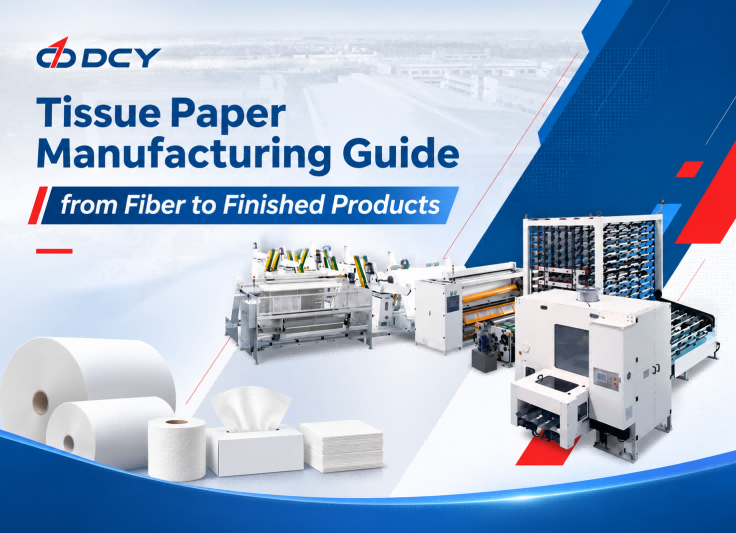
Tissue Paper Manufacturing Guide from Fiber to Finished Products
Tissue paper manufacturing connects fiber selection, sheet formation, drying, converting, and packaging. Each stage changes the properties that customers experience: how a sheet feels, how quickly it absorbs water, whether it tears during use, and how reliably it dispenses. A production decision made upstream can therefore determine both finished product quality and the operating efficiency of the converting line.
For factory owners, production managers, and equipment buyers, understanding these connections makes technical discussions more useful. A stronger parent reel may run more reliably but feel different to the consumer. More pronounced embossing may improve appearance while changing tensile strength. Faster rewinding may add little saleable output if packaging cannot keep pace.
Tissue Paper Manufacturing Guide from Fiber to Finished Products
This guide explains the main areas of tissue production, from raw materials and papermaking to finished product handling. It also shows how to use that knowledge when defining a product, selecting converting equipment, and improving an existing operation.
Tissue manufacturing at a glance: First define the product and its performance requirements. Select or purchase suitable base tissue, preserve its useful properties through converting, and validate the packed product against the customer's specification. Measure success through consistent quality, material yield, and accepted output across the whole line.
Start with the tissue product and its application
Toilet tissue, facial tissue, kitchen towels, hand towels, and napkins share a cellulose base, but their intended uses create different technical priorities. A premium facial tissue requires a different balance of surface feel, strength, and presentation from a hand towel used in a busy public washroom. The product specification should make those differences explicit before equipment is selected.
Product
Main performance priorities
Converting requirements to verify
Toilet tissue
Softness, perforation performance, roll consistency, appropriate dispersibility
Rewinding tension, perforation, roll diameter, tail sealing
Fold dimensions, overlap, stack compression, dispenser fit
Table napkin
Presentation, absorbency, fold accuracy
Folding format, embossing or printing, pack consistency
Build the specification around an approved physical sample and measurable limits. Include sheet dimensions, basis weight per ply, ply count, sheet count or roll length, package format, and critical performance tests. Describe how counts are expressed: an interfolded tissue sheet, a multi-ply finished sheet, and an individual ply are different counting units.
Hygiene depends on the product and the handling system
Tissue products support everyday cleaning and hygiene, but their benefits depend on appropriate use and clean handling. Hand towels also need a suitable dispenser, protected storage, and reliable refill practices. Manufacturing cleanliness, dust control, packaging integrity, and traceability help preserve the product through distribution.
Health claims require particular care. The CDC guidance on hand drying emphasizes drying hands completely and states that evidence is insufficient to determine whether a clean towel or an air hand dryer is more effective at reducing germs in community settings. Buyers should assess tissue performance and dispenser usability against the actual application rather than relying on broad claims about every drying method.
Understand the difference between papermaking and convertin
Primary tissue manufacturing produces the continuous base sheet. The process generally starts with prepared fiber stock and ends with large parent reels, also called jumbo reels. Converting takes those reels and turns them into retail or institutional products through operations such as embossing, rewinding, folding, cutting, and packing.
An integrated producer may operate both stages. An independent converter may purchase parent reels and focus entirely on finished products. This distinction has major implications for capital investment, utilities, staffing, and technical responsibility. A converting factory needs robust incoming paper control even though it does not operate a paper machine.
The expression complete tissue paper production line can refer to either project scope. Specify where the supply begins and ends: prepared pulp, purchased parent reels, cut products, wrapped packs, or palletized goods. Our guide to what a complete tissue paper production line includes explains the equipment boundaries and downstream interfaces buyers should clarify.
For a converter, the practical process route is usually parent reel receipt, unwinding, optional surface treatment and ply bonding, rewinding or folding, cutting, packaging, and dispatch. Not every product requires every operation, and the sequence depends on the selected machine design.
Choose fibers and base tissue for the required performance
Fiber furnish establishes much of the sheet's potential. Softwood fibers are generally longer and contribute to strength, while shorter hardwood fibers are commonly used to support a smooth surface and softness. The result depends on the fiber species, blend, treatment, and sheet structure; a furnish description alone does not predict finished product performance.
Recycled fibers can also be suitable for tissue applications when the recovered paper stream and preparation process meet the required cleanliness and performance standards. Their condition reflects prior use and processing. Screening, cleaning, and, where applicable, deinking affect both process economics and the resulting tissue grade.
Non-wood fibers, including bamboo, introduce further choices. Evaluate their actual properties and supply consistency using samples and test data. A material name does not establish superior softness, lower environmental impact, or compatibility with every converting configuration.
Fiber treatment changes the strength and bulk balance
Refining develops fiber bonding and can improve strength, but excessive treatment may reduce bulk and absorbency. Fines content, fiber length distribution, moisture, and the conditions used to form and dry the sheet all influence performance. The papermaker must balance these variables for the intended product and converting route.
Converters should translate this into an incoming paper specification. Alongside basis weight and ply count, record reel width, maximum diameter and weight, core dimensions, winding quality, moisture, and tensile properties in the machine and cross directions. Set expectations for splices, edge damage, and reel identification.
Incoming inspection should also include a converting trial when changing suppliers or grades. Two reels with the same nominal GSM can stretch, release dust, emboss, and fold differently. A lower purchase price can be offset by additional breaks, reduced speed, or higher reject levels.
Learn how the tissue machine builds sheet structure
The paper machine distributes fibers, removes water, develops the sheet, and winds it into a parent reel. Understanding the main sections helps converters identify which product characteristics are inherited from the base paper and which can be adjusted later.
Forming and dewatering
The headbox distributes a dilute fiber suspension across the machine width. The forming section removes water while establishing the fiber network. Formation quality and cross-direction consistency affect appearance, local strength, and downstream web handling. Uneven zones can become repeated sources of breaks or inconsistent embossing.
A crescent former is a widely used tissue forming arrangement. Subsequent dewatering and pressing depend on the machine concept. The pressure applied while removing water influences sheet density and bulk, so moisture removal is also a product development decision.
Drying and creping
In conventional creped tissue production, a large heated Yankee cylinder and an air hood supply drying energy. The balance among steam, condensate removal, hood conditions, and production rate affects moisture control and operating stability. These systems require coordinated process control and appropriate inspection and maintenance.
Creping removes the sheet from the Yankee surface with a blade, introducing a fine structure that contributes to extensibility and perceived softness. Adhesion, coating chemistry, blade condition, and machine settings influence the outcome. Changes can affect dust, stretch, and converting behavior as well as the feel of the base sheet.
Conventional drying and structured tissue technologies
Through-air drying, commonly called TAD, uses heated air passing through the sheet to remove moisture while preserving a relatively open structure. Other structured and hybrid processes use different combinations of sheet molding, pressing, and drying to target particular performance and investment requirements.
These technologies should be compared using the required product, energy sources, operating costs, and commercial positioning. A technology label is not a complete quality specification. For a converter purchasing parent reels, the more useful question is whether the delivered paper consistently meets the agreed performance range and runs on the intended equipment.
Balance softness strength and liquid absorption
Tissue quality involves tradeoffs. A sheet must feel appropriate for its application while remaining strong enough for production and use. It must also handle liquids in a way that matches the product's purpose. Increasing one property can change another, making a single headline measure an unreliable buying criterion.
Softness includes surface feel and the way the sheet bends or compresses in the hand. Fiber selection, creping, calendering, embossing, and ply construction all influence perception. Instrument readings can support process control, but comparisons should use consistent conditioning and methods, with sensory assessment where relevant.
Strength includes dry tensile performance and, for some applications, wet strength. Machine-direction and cross-direction results serve different purposes and should be identified separately. Toilet tissue also needs suitable breakdown behavior for its intended sanitation system; kitchen towel wet strength should not be treated as a universal target for every tissue grade.
Absorbency includes how quickly a sheet takes up liquid and how much it can retain under a defined test. Results expressed per gram and results expressed per sheet answer different questions. A heavier sheet can hold more total liquid without necessarily performing better per unit of fiber. Use the same method, sample conditioning, and units when comparing products.
Evaluate these properties after converting and packaging. A soft base sheet can become firmer after excessive winding or compression. A promising absorbency result can change when embossing, ply bonding, or pack pressure changes the structure. Product approval should therefore include the finished pack rather than stopping at the parent reel.
Control chemistry and environmental performance with evidence
Papermaking chemistry supports fiber retention, drainage, microbial control, Yankee operation, and selected product properties. Depending on the grade, additives may also adjust strength or surface feel. Chemical choices interact with equipment conditions and the intended use of the product, so changes should follow controlled trials and supplier technical guidance.
Converting can add further materials through ply lamination, printing, lotion application, and tail sealing. Confirm material suitability for the intended market, application, and any relevant contact requirements. Changes in adhesive or lotion may also affect cleaning frequency, web handling, and product testing.
Sustainability extends beyond the fiber source
Assess environmental performance across fiber procurement, energy and water use, process chemicals, converting waste, packaging, and transport. Renewable feedstock is one part of that assessment. Product claims such as recyclable, compostable, or carbon neutral require evidence relevant to the actual product and destination market.
The FSC explanation of its product labels distinguishes FSC 100%, FSC Mix, and FSC Recycled. These describe material sourcing categories; they do not establish every aspect of a tissue product's environmental performance. Verify the applicable certification scope, supply records, and trademark permissions before making a packaging claim.
For converters, useful improvement projects include reducing start-up scrap, optimizing trim, limiting unnecessary compression, and matching packaging dimensions to the product. Record material yield and energy use against accepted output so a change is not credited merely because the machine produced more rejects at higher speed.
Preserve product properties through converting
Converting gives base tissue its final format and many of its visible features. It also exposes a lightweight web to tension, pressure, cutting, and transfer forces. The machine configuration and operating settings must preserve the useful properties of the paper while achieving the required dimensions and presentation.
Unwinding and web control
Stable unwinding starts with suitable reel support, controlled braking or drive torque, and a web path appropriate for the paper. Tension must remain controlled as reel diameter changes. Incorrect settings can stretch the web, cause wrinkles, or trigger breaks, particularly with lightweight or highly extensible grades.
Specify the full reel envelope, including maximum weight and core condition, rather than width alone. Reel loading, splice handling, edge alignment, and access for safe threading also affect practical productivity. These tasks deserve attention during layout planning and operator training.
Embossing and ply bonding
Embossing applies a pattern through pressure and changes the sheet structure. Pattern geometry, nip loading, roller condition, and the base paper influence the result. Mechanical or adhesive-based ply bonding can hold layers together, but the selected method must be validated for the required appearance, strength, and feel.
A BioResources review of tissue converting operations describes how these operations affect finished tissue properties, including tradeoffs involving embossing, bulk, absorbency, softness, and tensile strength. Embossing should therefore be evaluated through finished product tests rather than appearance alone. DCY's tissue embossing equipment provides a relevant starting point for discussing pattern and application requirements.
Rewinding for roll products
A roll converting route typically combines perforation, rewinding, log formation, tail sealing, cutting, and packing. Winding control determines roll tightness and diameter consistency. Perforation must allow convenient sheet separation while retaining enough strength for production and handling.
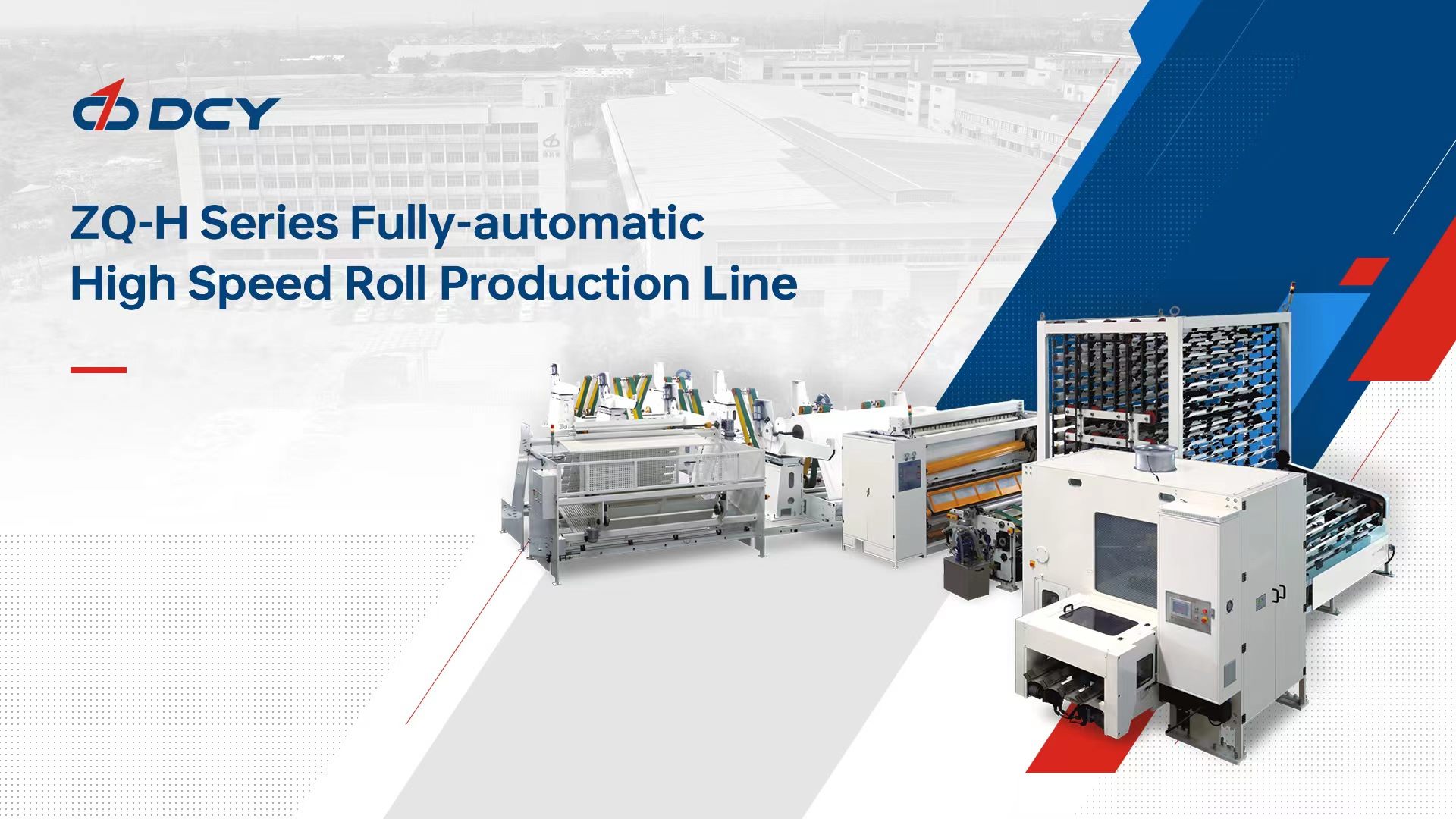
Match the configuration to the planned roll diameter, core dimensions, sheet length, roll length, and packaging format. The DCY ZQ-H roll production line is one example of equipment for roll converting applications. Confirm the proposed modules and trial conditions for each product; a published maximum speed does not establish the sustained packed output of every specification.
Folding for facial tissue and hand towels
Folded products require accurate sheet control, counting, stack formation, and transfer. For dispenser products, panel dimensions and interfold overlap influence how the next sheet presents. The required geometry should be documented with samples or drawings because suppliers may use fold terminology differently.
A V fold facial tissue production line illustrates a different equipment route from roll rewinding. Test the actual paper and final package, including first pull, dispensing near the end of the pack, stack recovery after compression, and performance in the intended dispenser where applicable.
Design packaging and logistics around the finished tissue
Packaging protects the product and establishes the dimensions handled by retailers, warehouses, and end users. It also affects tissue performance. Excessive compression can change stack recovery or roll shape, while insufficient containment can allow movement, deformation, and presentation problems.
Verify wrapper or cartoner compatibility with the full range of sizes, counts, materials, and orientations. Check seal integrity, print registration where required, date or batch coding, and pack stability during transfer. Product changeovers must include guides, film or board settings, and any downstream grouping equipment.
Line balancing requires consistent output units. A rewinder may be rated in meters per minute, a saw in cuts per minute, and a wrapper in packs per minute. Convert these into the same finished product basis before comparing capacities. Include trim, rejected units, planned stops, and the required product mix in the calculation.
For example, a line producing 240 acceptable rolls per minute needs a wrapper capable of at least 20 twelve-roll packs per minute before any additional operating margin. That simple conversion is only a starting point: roll orientation, grouping, transfer interruptions, and package changeovers also affect sustained output.
Pallet patterns and warehouse conditions complete the process. Validate pallet stability and product compression under the intended stacking load. Tissue is bulky relative to its mass, so package dimensions and transport utilization can materially affect delivered cost.
Use automation and quality data to control the whole line
Automation is most useful when it stabilizes a specific process or removes a measured source of loss. Servo coordination, tension control, recipe management, automatic counting, inspection, and synchronized transfers can support repeatable production. Their value depends on suitable sensors, maintained equipment, clear fault logic, and trained operators.
Data collection should link the parent reel, product recipe, operating conditions, and finished batch. This makes it possible to distinguish a material change from a machine setting problem. Timestamped stops and reject reasons also help identify whether losses arise at unwinding, converting, cutting, or packaging.
Track a small set of defined measures consistently. Saleable output per scheduled hour shows delivery capability. Material yield shows how effectively incoming tissue becomes accepted product. Changeover time, unplanned downtime, and first-pass quality reveal different opportunities for improvement.
Overall equipment effectiveness, or OEE, combines availability, performance, and quality. For illustration, 80% availability, 90% performance, and 97% quality produce 69.84% OEE. This is an arithmetic example, not an industry benchmark. Define the time base and reference rate for the same product and line boundary before comparing results across shifts or machines.
Move quality control upstream
Incoming inspection and process checks can prevent defects from reaching final packing. Use a control plan that specifies the property, method, frequency, limit, and response. Check dimensions and counts alongside functional properties such as perforation release, ply bonding, absorption, and dispensing behavior.
Online inspection can support detection, but it does not replace all laboratory or use tests. Samples should be traceable to material batches and operating conditions. Retain approved reference products and investigate trends before the process repeatedly crosses a rejection limit.
Troubleshoot through the process sequence
A visible defect is often the result of several interacting conditions. Start by locating where it first appears and comparing the current material and settings with the last stable run. Change one controlled variable at a time when practical, document the result, and use the machine supplier's procedures for adjustments.
Full and nearly empty packs in the intended dispenser
Dust or rough cut edges
Base paper lint, blade condition, cutting support, extraction
Cut samples and dust observations under matched conditions
Inconsistent roll diameter
Paper caliper, length control, winding tension, core variation
Diameter, roll length, and tightness across successive logs
Some problems require joint work between the papermaker and converter. If the incoming sheet has changed, adjusting downstream equipment alone may create further compromises. Share representative samples, batch records, and operating data so the investigation follows evidence.
Keep operator knowledge in the same system. Short fault reviews, documented settings, and handover notes help retain experience when shifts or personnel change. Include maintenance staff, quality personnel, and packaging operators in improvement discussions because each sees a different part of the process.
Turn manufacturing knowledge into an equipment specification
Use the process relationships above to prepare a project brief. Define the product first, then identify the paper envelope, the converting route, and the accepted output required from the complete system. This makes supplier proposals easier to compare and acceptance trials more meaningful.
Provide approved product samples, dimensions, counts, and packaging requirements.
Identify representative parent reel grades and their physical limits.
State required good output for each major product and the expected production mix.
Define interfaces among converting, cutting, wrapping, grouping, and palletizing.
Agree trial materials, test duration, quality criteria, waste measurement, and changeover expectations.
Confirm utilities, layout access, training, maintenance requirements, and service scope.
Acceptance should demonstrate a repeatable operating condition with the agreed materials and finished product specification. Record the product quality achieved at the measured output, including downstream packing performance. A brief high-speed run without those conditions provides limited evidence for routine production planning.
DCY supplies tissue converting equipment for roll and folded products. To discuss a new line or an upgrade, submit your samples, parent reel specifications, required output, packaging details, and available layout through our tissue machinery solution proposal service. Those details provide a practical basis for evaluating the process route and equipment configuration.
Frequently asked questions
Can a tissue converter operate without a paper machine
Yes. A converter can purchase parent reels and manufacture finished products through rewinding, folding, cutting, and packing. It still needs incoming paper specifications, supplier qualification, suitable storage, and material traceability.
Does more embossing always improve tissue quality
No. Embossing changes structure and appearance, but its effects depend on the pattern, pressure, base paper, and product design. Evaluate bulk, tensile strength, softness, absorbency, and ply integrity together on the finished product.
Is higher machine speed the best measure of productivity
Speed is useful only alongside accepted output, operating time, and waste. The relevant business measure is how much conforming product the complete line delivers over the planned production period, including changeovers and downstream interruptions.
What should be tested before changing the parent reel supplier
Compare incoming paper properties and run representative production trials. Check breaks, dust, web control, embossing or folding response, finished product quality, and packaging performance. Record the operating settings needed to achieve acceptable results.
How should sustainability claims be evaluated
Check the specific claim, supporting evidence, certification scope where applicable, and destination market requirements. Fiber source, manufacturing energy, material yield, packaging, and disposal conditions address different parts of environmental performance.
Further reading
The Wiki-Tissue reference collection from TissueStory offers further reading across tissue hygiene, environmental topics, papermaking technology, converting, and quality. For process-specific decisions, combine reference material with your paper specifications, equipment documentation, and controlled production trials.





 English
 Español
 العربية
 Português do Brasil
 Русский