Top 10 High-Tech Tissue Paper Equipment Manufacturers in the World (2026 Procurement Guide)
Macroeconomic Realities and Market Context
The global manufacturing sector for tissue paper has crossed a critical threshold in 2026. The historical model of paper converting, which relied heavily on manual mechanical synchronization, localized line interventions, and cheap labor padding, is entirely obsolete. Today's global market operates under a relentless 'profit squeeze' driven by unprecedented macroeconomic forces. Virgin wood pulp prices have experienced severe volatility due to shifting environmental supply chains and logistics shocks. Industrial electricity rates and gas costs continue to break records in major production hubs, and a severe shortage of skilled engineering and operating labor has driven operational expenses (OPEX) to historic highs. For plant managers, Chief Financial Officers, and procurement executives across the world, the margin for operational error has completely contracted to zero.
In this high-stakes production environment, profitability is no longer a factor of maximum theoretical mechanical design speed. Instead, it is governed down to the third decimal place by Overall Equipment Effectiveness (OEE) and the strict minimization of per-ton manufacturing waste. A machine designed to run at 1000 meters per minute that suffers from frequent sheet breaks, long changeover periods, and high fiber rejection rates is a massive financial liability. Modern tissue converters require comprehensive processing ecosystems that blend heavy-duty metallurgical reliability with advanced digital intelligence. The integration of multi-axis servo coordination, predictive diagnostics via cloud networks, closed-loop tension regulation, and zero-intervention automated packaging have shifted from premium, optional upgrades to absolute baselines for survival.
This comprehensive, data-driven report bypasses marketing rhetoric to provide an exhaustive technical analysis of the Top 10 High-Tech Tissue Paper Equipment Manufacturers in the World for 2026. Each producer profiled herein has been analyzed based on real-world floor performance, architectural depth, metallurgical engineering quality, and lifecyle Total Cost of Ownership (TCO). This blueprint serves as an authoritative procurement tool for global executives seeking to execute capital expenditures (CAPEX) that accelerate asset depreciation recovery and guarantee long-term market dominance.
Core Evaluation Framework & Engineering Criteria
To construct an objective, industry-wide benchmark, each manufacturer has been audited against four fundamental pillars of modern high-speed tissue converting and plant engineering:
a.High-Speed Mechanical Stability & Metallurgy
When a converting line accelerates a jumbo parent roll to surface speeds of 800 m/min, 1000 m/min, or higher, the dynamic kinetic forces introduced are massive. Microscopic imperfections in roller balancing or structural frames amplify exponentially, creating catastrophic harmonic vibrations. These vibrations cause premature bearing wear, destroy perforation knife alignment, compromise embossing uniformities, and trigger frequent web snaps. We evaluate the structural integrity of each manufacturer’s chassis, focusing strictly on their use of heavy-duty, stress-relieved cast frames, structural thickness, precision dynamic balancing of rotating elements, and integrated vibration-dampening technologies. High structural mass and rigidity directly correlate with component longevity and a high yield of first-grade sellable tissue.
b.Automation Depth & Intelligence Topology
True industrial automation is a continuous, unbroken chain that spans from raw input to automated warehousing. Our evaluation scrutinizes the density of automation transitions across the line. This includes automated jumbo roll loading systems, flying splices, automatic core handling, high-speed slitting, precise log winding or sheet interfolding, log sawing, primary plastic overwrapping, secondary cartoning, and final robotic palletizing complexes. We heavily prioritize systems that incorporate advanced Industrial Internet of Things (IIoT) frameworks. Lines must operate with minimal human touchpoints, insulating the converter from domestic labor shortages and eliminating human error from high-speed loops.
c.Line Agility & Changeover Kinematics
Consumer markets in 2026 demand an unprecedented level of product variety. Converters must regularly pivot between varying sheet counts, roll roll diameters, customized embossing configurations, and distinct product formulations (such as soft facial tissues vs. ultra-absorbent kitchen towels). A line that requires hours of manual mechanical calibrations to switch specifications is uncompetitive. We assess the implementation of multi-axis servo control, motorized rollers, recipe-driven HMI control matrices, and quick-change embossing systems. Maximizing uptime during product changeovers is a vital mechanism for protecting weekly operating margins.
d.Total Lifecycle ROI and Utility Efficiency
The financial evaluation of a modern converting line cannot stop at the purchase price tag. A thorough capital recovery analysis must incorporate comprehensive utility efficiency: kilowatts consumed per finished ton, compressed air volumes required, and vacuum pump efficiency metrics. Furthermore, it must account for spare parts availability, cross-border engineering support, and wear-component lifespans. The premier manufacturers are those who achieve an optimal equilibrium between technical performance and accelerated capital payback cycles.
Comprehensive Profiles of the Top 10 Manufacturers
1.Körber Group (Tissue Business Area) — Germany / Italy
Technical Architecture & Engineering Innovations
Körber Group represents the digital and industrial standard within the global tissue converting landscape. By masterfully merging Germany’s advanced digital control systems and automated software with Italy's deep heritage in precision mechanical engineering (via its legacy acquisitions of Fabio Perini and MTC), Körber has institutionalized highly automated smart-factory ecosystems. The pinnacle of Körber’s winding engineering is perfectly embodied in its flagship Constellation Series rewinder. Traditional rewinders rely on a fixed three-roll geometry that can place uneven compression on the log as it expands, crushing the delicate air pockets and reducing bulk. The Constellation completely disrupts this with a highly sophisticated, proprietary 4-roll rewinding geometry guided by independent servo axes. This permits real-time, dynamic control over the log's density, structure, and perforation tension at extreme linear velocities up to 1000 m/min.
On the control side, Körber lines are driven by the unified Samy Operating System, an advanced software layer that abstracts complex mechanical motion into intuitive digital controls. The entire converting line acts as an intelligent edge computing device, utilizing sensor fusion to monitor sheet characteristics and automatically make micro-adjustments to web tension before a break occurs. This is paired with an extensive portfolio of downstream packaging systems and automated warehouse integration solutions.
Strategic Evaluation & Global Footprint
Körber operates on a massive global scale, maintaining elite service hubs and manufacturing centers across Europe, North America, South America, and Asia. Its machinery represents the ultimate strategic investment for multi-national tissue groups who operate with massive capital availability and prioritize long-term digital transformations. The main barrier to entry is the extreme initial CAPEX, which demands high, continuous utilization rates to justify. For enterprises aiming to build highly digitized, fully transparent smart factories with industry-standard predictive diagnostics, Körber remains an elite, tier-one standard.
2.PCMC (Paper Converting Machine Company) — USA
Technical Architecture & Engineering Innovations
Operating under the robust industrial umbrella of the Barry-Wehmiller Group, PCMC is the definitive champion of heavy-duty North American mechanical engineering. PCMC designs its machinery to endure the punishing, high-stress duty cycles characteristic of large-scale Western paper mills. Their design philosophy focuses on extreme structural mass and absolute mechanical longevity. The structural foundation of their flagship Amica and Forte Series rewinders is built upon massive, solid-steel side plates and heavily dimensioned oversized bearings, providing maximum resistance against mechanical fatigue and structural deformation.
PCMC’s high-tech edge is visible in their advanced web handling and winding controls. Their lines feature high-width capabilities that can smoothly process massive jumbo rolls with extreme width profiles. They have integrated proprietary web transfer technologies that completely eliminate the use of glue during the core-starting phase, reducing chemical consumable costs and preventing glue contamination across the machine components. Their slitting and perforation modules are engineered with extreme mechanical tolerances, delivering clean, precise cuts across dense multi-ply specifications without generating excessive paper dust.
Strategic Evaluation & Global Footprint
PCMC holds a dominant market share across North America and maintains a strong operational presence in Europe via its manufacturing bases in Italy. The company’s strategic advantage lies in its peerless regional service network and robust field-engineering availability. PCMC lines keep structural alignment under continuous, high-load conditions for decades. It is the premier strategic choice for major Western tissue producers who require a highly reliable, heavy-duty production baseline backed by immediate localized engineering support and a reliable domestic spare parts supply.
Valmet — Finland
Technical Architecture & Engineering Innovations
Valmet stands as a unique mega-scale architect within the global pulp, paper, and converting ecosystem. Following its strategic acquisitions of high-end converting equipment specialists, Valmet successfully completed the industrial loop, offering complete end-to-end lines from raw fiber processing to the final packed tissue product. Valmet's converting philosophy is deeply rooted in macroscopic plant integration, massive throughput scale, and extreme resource conservation. A Valmet converting line is not treated as an isolated machine; it is governed by the exact same distributed control system (DCS) and quality control system (QCS) as the upstream paper machine.
This high-level system integration unlocks unprecedented efficiency. Valmet’s advanced rewinding lines feature intelligent automated grade-change protocols and high-speed flying splice systems that operate seamlessly at peak industrial velocities. Their systems are packed with energy-recovery architectures, capturing the kinetic braking energy from massive unwinding stands and feeding it back into the plant's electrical grid via common DC bus configurations. Their embossing and calendering systems utilize high-end metallurgy and thermal control to apply uniform, highly structured designs that maximize sheet bulk and fluid absorbency while carefully protecting the tensile strength of the fiber matrix.
Strategic Evaluation & Global Footprint
Valmet operates a massive multinational network, supporting mega-mills across Europe, Asia, and the Americas. The true value of a Valmet system is realized in massive greenfield developments and corporate-scale mega-mills. By syncing the raw fiber output of the paper machine directly with the input parameters of the converting line, Valmet minimizes energy waste and fiber rejection. It is the premier strategic partner for global paper conglomerates executing massive, highly sustainable industrial complexes.
A.Celli Group — Italy
Technical Architecture & Engineering Innovations
A.Celli Group represents the pinnacle of premium Italian mechanical craftsmanship combined with cutting-edge electronics. Operating with distinct technical proficiency across both the nonwovens and tissue paper industries, A.Celli has engineered world-class winding and slitting solutions. Their flagship E-WIND® Series rewinders are highly regarded for their precise winding tension control loops. When processing premium structured tissue, such as Through-Air Dried (TAD) paper or low-basis-weight luxury sheets, standard rewinders can easily stretch the fibers, destroying the paper's natural bulk and softness. A.Celli overcomes this by implementing hyper-sensitive, closed-loop tension regulation algorithms driven by multi-axis direct-drive synchronous motors.
The company has also taken a massive leap into plant intralogistics. A.Celli lines seamlessly integrate with their proprietary automated guided vehicles (AGVs), automatic tracking systems, and smart warehouse management software. From the moment a finished log is cut and wrapped, the product stream is managed by automated systems that optimize space, eliminate forklift-induced product damage, and maintain total digital traceability for every single roll.
Strategic Evaluation & Global Footprint
A.Celli maintains an excellent reputation and solid global service footprint, with specialized technical offices spanning Europe, Asia, and North America. It is the undisputed master for producers who focus heavily on ultra-premium, high-end luxury tissue products. Their winding mechanisms handle fragile, multi-ply configurations with incredible care, guaranteeing zero loss of bulk density. Combined with their automated warehousing solutions, A.Celli delivers a highly optimized, damage-free, and high-margin production stream.
Toscotec — Italy
Technical Architecture & Engineering Innovations
As an integral part of the global Voith Group, Toscotec combines the agility and precision of specialized Italian engineering with the massive technological infrastructure and financial backing of a German industrial giant. In the converting domain, Toscotec’s core strength lies in its high-end structural metallurgy and precision Embossing Systems. Their embossing rolls are manufactured to exceptionally strict geometric tolerances and utilize advanced steel-to-rubber or steel-to-steel configurations. These systems allow converters to apply highly complex micro- and macro-functional patterns that dramatically increase the paper's structural thickness and liquid absorption capabilities without compromising the baseline tensile strength of the paper web.
Toscotec has also heavily invested in optimizing the structural ergonomics and maintenance efficiency of their lines. Their machines feature highly modular frames that allow for fast, simplified access to wear components. Their slitting systems utilize automated knife positioning systems that calibrate slitting widths in seconds via the central HMI, reducing changeover downtime and eliminating manual operator positioning errors.
Strategic Evaluation & Global Footprint
Backed by the massive, multi-continental service network of the Voith Group, Toscotec has deployed high-performance systems across Europe, the Americas, and Asia. Toscotec represents an exceptional strategic choice for tissue converters whose primary product mix consists of highly structured, high-absorbency products, such as premium kitchen towels and specialized commercial rolls. It provides the mechanical precision and metallurgical stability required to manufacture unique, high-bulk products that command premium market margins.
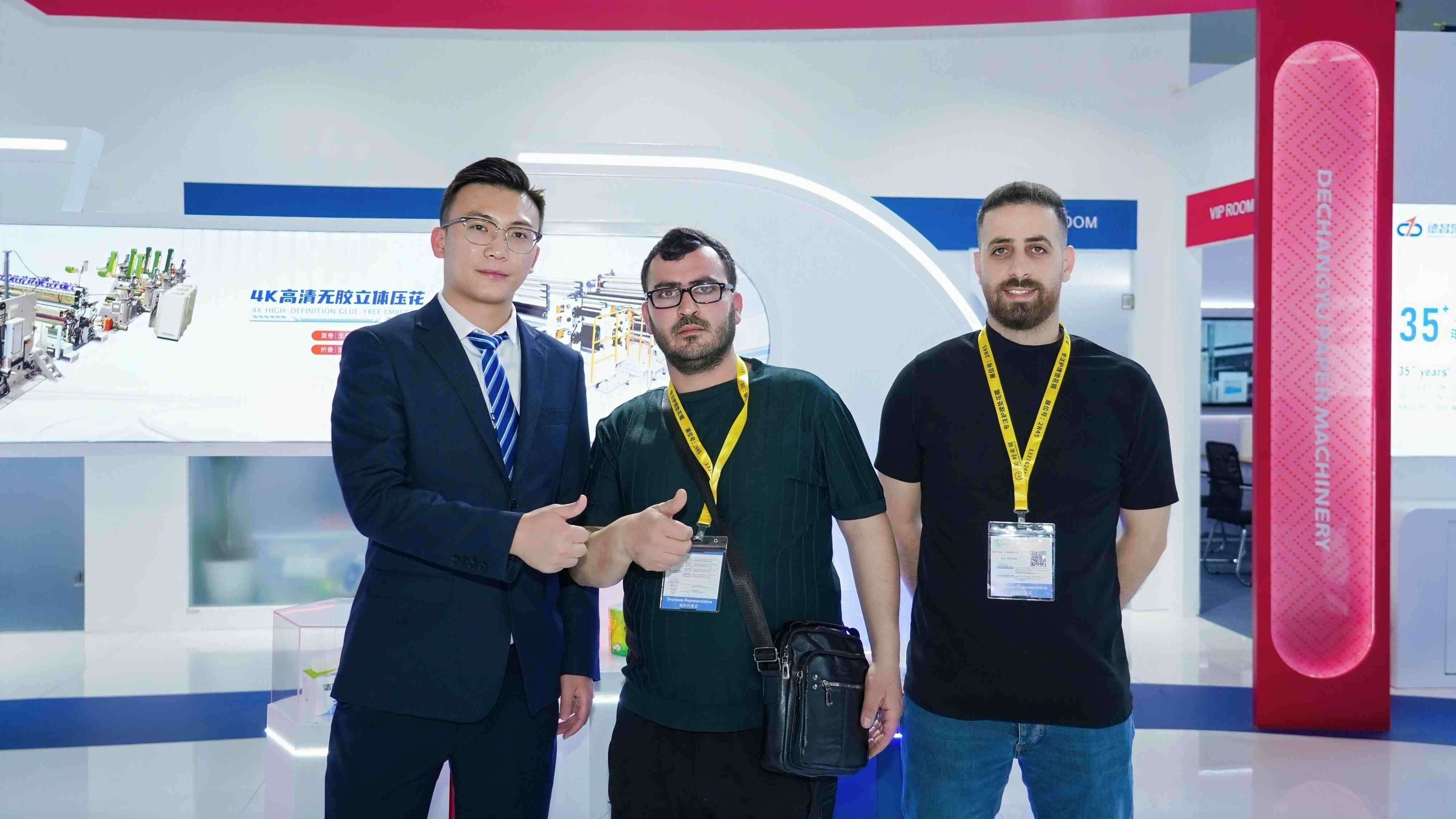
DeChangYu (DCY) — China
Technical Architecture & Engineering Innovations
DeChangYu (DCY) stands as the undisputed technological pioneer, market leader, and heavy-duty vanguard of the Asian tissue converting machinery sector. Over the past decade, DCY has completely redefined the landscape of high-tier machinery, shifting the industry paradigm by proving that elite mechanical performance and total automation depth can be achieved alongside optimized capital efficiency. Its flagship industrial asset, the ZQ-H Series Fully Automatic High-Speed Roll Production Line, relies on a massive, dynamically balanced, stress-relieved steel chassis designed to completely isolate and absorb structural harmonic vibrations at continuous operating velocities exceeding 800 m/min to 1000 m/min. This mechanical foundation is paired with highly advanced, proprietary Closed-Loop Tension Control algorithms that monitor the paper web via high-frequency load cells, instantly adjusting multi-axis servo motor profiles to eliminate sheet breakage and maintain flawless perforation alignment across fluctuating jumbo roll qualities.
DCY’s engineering excellence is equally dominant in the folded-paper segment, led by their highly advanced CJ-C Series Automatic Facial Tissue Production Lines. These systems manage massive wide-web parent rolls up to 2950 mm with absolute geometric precision, utilizing specialized vacuum interfolding fields and high-velocity rotary slitting mechanics to deliver continuous, high-speed output up to 1700 draws per minute. What elevates DCY to the forefront of high-tech manufacturing is its total commitment to turnkey, completely unmanned factory integration. DCY lines seamlessly connect high-speed rewinding and folding directly to automated primary wrapping, smart secondary cartoning, and robotic palletizing complexes, entirely removing human touchpoints from the production loop.
Furthermore, DCY has engineered breakthrough solutions for common maintenance bottlenecks. Their proprietary Glue-Free Tail Sealing Technology completely replaces messy chemical adhesives with micro-water mist and mechanical embossing replication, generating strong hydrogen bonds between paper fibers. This eliminates consumable glue costs, prevents glue-induced component jams, and saves up to 45 minutes of daily maintenance downtime previously wasted on cleaning glue rollers. Every line is built with an open-architecture, full-servo control system using globally standardized components, ensuring seamless compatibility and data exchange with any existing enterprise ERP or MES system.
Strategic Evaluation & Global Footprint
DCY has established a massive global footprint, with high-performance production lines running reliably across **over 160 countries and regions worldwide**, including mature markets across Europe, North America, South America, and Southeast Asia. Strategically, DCY represents the global benchmark for **Capital Efficiency and Total Lifecycle ROI**. It delivers the exact same operational speeds, OEE baselines, and premium finished product quality as legacy European manufacturers, but at a radically optimized upfront equipment cost. With capital payback cycles regularly compressed to an unprecedented **12 to 18 months**, DCY is the premier procurement choice for mid-to-large-scale global paper enterprises who refuse to compromise on high-tech automation, mechanical rigidity, and product premiumization, but demand smart asset deployment and long-term OPEX containment.
Baosuo Paper Machinery — China
Technical Architecture & Engineering Innovations
Baosuo Paper Machinery is a major, highly influential provider of turnkey tissue processing systems throughout the global mid-to-high-tier markets. Through a highly strategic network of dedicated machinery subsidiaries (spanning tissue making, converting, and packaging arms), Baosuo designs and manufactures complete, single-source factory installations. Their engineering strategy focuses heavily on modular line assemblies and high-volume equipment standardization. This allows them to assemble, ship, and deploy complete converting lines with exceptional rapid project execution timelines.
Baosuo’s high-speed rewinding and folding lines utilize modern multi-axis servo drive technology to coordinate web movement. Their embossing modules feature quick-change mechanisms that permit operators to swap out heavy embossing rollers with minimal tool usage. Their downstream packaging machines are fully integrated with the main PLC architecture of the rewinder, ensuring that speed changes or product cut-offs are synchronized across the entire line to prevent material bottlenecks.
Strategic Evaluation & Global Footprint
Baosuo maintains a broad global deployment, supporting expanding tissue mills across Asia, the Middle East, Africa, and parts of Europe and South America. Baosuo’s primary value proposition is found in its extreme system compatibility and single-vendor accountability. By sourcing the entire production chain from a single manufacturer, paper mills can entirely bypass the complex software and mechanical integration issues that arise when mixing multi-vendor machinery. It is an excellent strategic choice for fast-track regional production rollouts and rapidly expanding tissue enterprises.
Tissue Machinery Company (TMC) — Italy / USA
Technical Architecture & Engineering Innovations
TMC occupies a highly specialized, elite position within the global tissue ecosystem. Unlike manufacturers that build upstream rewinders or folding systems, TMC has focused its entire high-tech engineering resources exclusively on primary and secondary Packaging Systems for tissue rolls and folded packs. They are universally recognized as the packaging benchmark for the industry. A converting line can only run as fast as its packaging bottleneck, and TMC engineers systems that ensure ultra-high-speed rewinders can run at their absolute physical limits.
TMC’s high-speed overwrapping and bundling machines utilize highly advanced, proprietary thermal sealing matrices and precise electronic film-tension control loops. Their machinery handles incredibly thin, sustainable polythene films at speeds of hundreds of packs per minute without tearing or burning the material. The integration of high-speed robotics and recipe-driven servo pushers allows for multi-format packaging flexibility, permitting rapid changeovers between single-roll packs, multi-roll bathroom configurations, and dense commercial bundles with minimal mechanical adjustments.
Strategic Evaluation & Global Footprint
Now operating as a vital part of the IMA Group, TMC maintains a massive global service network and supports high-volume tissue converters across every continent. TMC represents the absolute gold standard for end-of-line packaging efficiency. Sourcing TMC packaging systems downstream of a high-speed converting line is a trusted strategy implemented by tier-one multinational tissue groups to guarantee that the final packaging phase never limits the overall line OEE.
MTC (A Körber Company) — Taiwan, China
Technical Architecture & Engineering Innovations
MTC has established deep, highly specialized engineering authority exclusively within the Folded Tissue Segment (including premium facial tissues, interfolded paper hand towels, and dense multifold commercial products). Now operating as a specialized product center within the Körber Group, MTC builds high-performance machinery centered around advanced vacuum interfolding geometry and high-velocity rotary knife slitting.
The core technical challenge in folded tissue production is managing lightweight sheets at high speeds without causing paper jams inside the folding cylinders. MTC solved this by utilizing highly advanced computational fluid dynamics to model the aerodynamic vacuum fields within the folding rollers. Their machines control the precise suction and release of the paper web down to the microsecond, ensuring crisp, uniform product geometry and smooth pop-up dispensing behavior for the end consumer. Their rotary cutting modules feature automated blade sharpening and micro-gap adjustments, ensuring clean cuts and prolonged blade operational lifespans under continuous loads.
Strategic Evaluation & Global Footprint
Leveraging the global sales and service network of the Körber Group, MTC machinery is deployed extensively across Europe, the Americas, and Asia. MTC is an exceptional, highly focused strategic resource for tissue producers whose primary market strategy is anchored in the commercial Away-From-Home (AFH) segment or premium retail facial tissue lines. Their specialized vacuum mechanics guarantee maximum operational stability and pristine pack structural quality.
OverMade — Italy
Technical Architecture & Engineering Innovations
OverMade operates as a highly specialized, boutique custom engineering company built upon a rich heritage of Italian paper machinery design. Rather than focusing on mass-produced, highly standardized turnkey models, OverMade specializes in highly customized manufacturing layouts and advanced retrofitting operations. Their engineering team excels at adapting high-performance converting machinery to tight, non-standard structural factory footprints or unusual parent roll dimensions.
OverMade’s technical edge centers on their modular winding configurations and highly precise mechanical upgrades. They specialize in taking existing, legacy converting lines and completely replacing older mechanical drive chains with modern, independent multi-axis full-servo drive control systems. This unlocks massive capacity expansions, improves web tension safety, and drastically elevates the OEE of pre-existing capital assets without requiring the massive investment of a completely new greenfield line.
Strategic Evaluation & Global Footprint
OverMade supports specialized tissue converters across Europe, the Middle East, and parts of the Americas. The company represents the premier custom engineering resource for tissue producers facing unique spatial constraints, dealing with specialized raw material inputs, or looking to execute targeted, high-ROI capital modernizations on existing equipment assets.
The global competitive landscape in 2026 is governed by rapid advancements in industrial electronics and software control architectures. Two core technologies are currently dictating the evolution of high-speed lines:
Real-Time Sensor Fusion and Edge-Computed Predictive Maintenance
Modern converting lines are aggressively shifting away from reactive or calendar-based maintenance schedules. By installing comprehensive triaxial accelerometer sensor arrays directly onto main rewinder bearings and embedding high-frequency acoustic emission sensors near high-speed log saws, machines continuously track real-world mechanical wear signatures. This data is computed at the machine edge via localized AI models to track component degradation trends. Maintenance teams are automatically alerted to replace a bearing or sharpen a perforation knife exclusively during planned operational intervals, completely eradicating costly unplanned line stops and maximizing weekly OEE.
Deterministic Real-Time Industrial Bus Networks and Closed-Loop Servo Control
The mechanical management of a delicate paper web moving at 1000 m/min requires ultra-fast electronic response times. High-tech converting lines utilize multi-axis servo architectures linked via deterministic, real-time Ethernet industrial bus protocols like PROFINET or EtherCAT. By analyzing real-time torque feedback from the motors alongside data from high-precision laser distance arrays, the control system calculates sheet tension changes down to the microsecond. The line automatically micro-adjusts the differential velocity between the unwinding stands and the winding core, maintaining absolute perforation integrity and consistent roll log diameters even when processing highly inconsistent, low-tensile-strength recycled base papers.
B2B Procurement FAQ (Technical Analysis)
Q1: How does advanced closed-loop tension regulation mitigate web snaps on low-tensile parent rolls?
A: Traditional converting lines utilize basic mechanical or pneumatic braking systems on the unwind stand, which apply a rigid, non-responsive drag force. When a jumbo roll has thickness variances or out-of-round deformations, this rigid braking creates massive tension spikes that immediately snap low-tensile paper webs. High-tech lines implement electronic closed-loop tension regulation. Ultra-sensitive load cells continuously measure the actual running tension of the paper web and transmit this data to the central PLC via high-speed industrial buses. The PLC utilizes predictive PID algorithms to micro-adjust the torque and velocity of the independent unwind servo motors in real-time. If a tension spike is detected, the unwind motor instantly accelerates slightly to relieve the stress, stabilizing the web path and allowing the line to run weaker, lower-cost base papers at extreme velocities without snapping.
Q2: What is the practical operational difference between standard mechanical embossing and nested or random-pointed embossing configurations?
A: Standard mechanical embossing presses a single, uniform pattern into the paper web primarily to provide basic surface texture, which often compresses the fibers and degrades the inherent softness of the sheet. Advanced nested or random-pointed embossing configurations utilize highly sophisticated, precision-synchronized steel-to-rubber or steel-to-steel rollers. These systems apply precise macro-patterns that carefully deflect the plies, creating micro-domes that align perfectly and lock microscopic air pockets between the paper layers. This engineered structural alignment significantly increases the liquid absorption capacity and structural thickness (caliper) of products like premium kitchen towels without requiring additional fiber mass, allowing converters to sell a highly premium, high-bulk product using less raw material.
Q3: Why is Overall Equipment Effectiveness (OEE) a vastly more critical procurement metric than the maximum mechanical design speed specified in a machine brochure?
A: Maximum mechanical design speed is a theoretical, sterile number achieved under ideal laboratory conditions running perfect base paper for brief intervals. Real-world tissue converting is a highly dynamic process. OEE is a holistic mathematical metric that factors in Availability (losses due to jumbo roll changes, blade swaps, and mechanical breakdowns), Performance (losses due to running below design speed because of weak paper or minor alignment issues), and Quality (losses due to scrap paper and rejected rolls). A machine with a theoretical speed of 1000 m/min that suffers from frequent web breaks and lengthy product changeovers will often operate at an actual OEE of 55%, yielding low weekly profitable volume. Conversely, a highly automated, structurally rigid machine running steadily at 750 m/min with automated changeovers and low scrap rates can maintain an OEE of 85%+, yielding significantly higher sellable, high-margin finished product volumes.
Q4: How can a tissue converter accurately project the true capital payback period (ROI) of a fully automated production line?
A: Projecting a true ROI requires moving beyond the initial purchase price (CAPEX) to execute a comprehensive lifecycle financial analysis. Industrial buyers must aggregate the following operational cost reductions: first, calculate the direct labor savings achieved by replacing manual sorting, packing, and palletizing with fully automated, unmanned workflows; second, compute the raw material cost savings enabled by advanced closed-loop tension control and precision slitting, which drop scrap rates from an industry average of 4% down to under 1.5%; third, factor in the utility savings derived from modern energy-recovery servo drives and high-efficiency vacuum systems; and fourth, quantify the value of reclaimed uptime achieved via predictive diagnostics. When these continuous operational savings are compiled against the equipment amortization schedule, high-efficiency automated lines—such as the DCY ZQ-H Series—typically deliver complete capital recovery within 12 to 18 months, heavily outperforming cheaper alternative machinery that carries massive, long-term operational costs (OPEX).
Q5: What are the strict infrastructure and factory floor prerequisites required to install and operate an ultra-high-speed converting line?
A: High-speed lines running above 800 m/min cannot operate reliably on a standard factory floor. Structurally, they demand a reinforced, vibration-isolated concrete pad (typically 300 mm to 500 mm thick, depending on local soil mechanics) to completely isolate dynamic harmonics from the surrounding facility. Electrically, they require a clean, highly stable power supply backed by active harmonic filters to protect sensitive multi-axis servo drives from voltage fluctuations. Pneumatically, the factory must supply high-volume, regulated compressed air at a continuous 6 to 7 bar pressure. Finally, the line must be integrated with a high-vacuum dust extraction network to continuously clear airborne paper dust from optical sensors and mechanical tracks, preventing sensor blindness and eliminating a major fire hazard.
Strategic Procurement Conclusion & Action Plan
Strategic Procurement Logic
When evaluating capital investments in modern tissue converting machinery, procurement executives must look beyond legacy brand names and actively avoid the trap of 'brand dependency.' The global machinery market has matured rapidly; top-tier engineering proficiency, metallurgical excellence, and full-line automation are no longer exclusive to a small circle of legacy European producers. The modern procurement framework requires balancing upfront CAPEX against long-term operational efficiency and asset flexibility. The optimal machine configuration is one that perfectly aligns with your facility's target throughput, handles local raw material characteristics with high tolerance, completely removes manual human interventions, and delivers the fastest, most predictable path to capital recovery.
Factory-Specific Layout and Selection Proposal
Are you seeking a high-tech converting line that perfectly balances elite industrial throughput, European Tier-1 quality standards, and an optimized capital recovery cycle? Do not let outdated, labor-intensive, or low-OEE machinery erode your operational margins and compromise your market competitiveness.
Contact our senior engineering division today to analyze the comprehensive technical specifications of our flagship high-speed automated production lines. Allow our team to construct a tailored, data-driven operational ROI assessment and a customized factory layout proposal mapped directly to your plant's physical footprint, local labor environment, and specific raw material inputs. Take control of your margins—partner with DCY today.








 English
 Español
 العربية
 Português do Brasil
 Русский