The worldwide manufacturing sector for tissue paper products is facing an unprecedented era of structural transformation. In a market historically characterized by stable overheads and simple mechanical adjustments, 2026 presents a hyper-competitive operational matrix. Global tissue mills and independent converters are encountering a relentless profit squeeze. Virgin wood pulp costs fluctuate dynamically based on macroeconomic shocks and ecological supply chain reconfigurations. Concurrently, localized industrial energy costs continue to break historic records, and a severe deficit in skilled factory labor has escalated variable operational expenses (OPEX) to all-time highs. For corporate executives, plant directors, and Chief Financial Officers (CFOs), legacy machinery is no longer an asset—it is a clear operational liability.
To protect manufacturing margins under these severe constraints, capital expenditure (CAPEX) procurement strategies must abandon short-sighted focus on upfront invoice pricing. True long-term financial survival is governed down to the third decimal place by maximizing Overall Equipment Effectiveness (OEE) and crushing per-ton material scrap rates. Modern tissue converting lines must transition from standalone units into fully integrated, data-driven production ecosystems. This whitepaper systematically addresses the top 20 technical, financial, and mechanical questions that corporate procurement leads and plant managers face when auditing and upgrading their tissue paper machinery portfolios for global market dominance.
Top 20 Technical & Operational Questions Answered
Q1: What is the fundamental mechanical distinction between V-Fold, Z-Fold, and W-Fold interfolding technologies?
A: The core engineering distinction across interfolding lines resides in the mechanical geometry of the folding cylinders and the vacuum distribution arrays that guide the paper webs. V-Fold (2-panel) systems interlock two continuous webs by crossing them and executing a single alternating half-fold, creating a classic 'V' profile that yields a smooth, low-resistance pop-up dispensing experience perfect for retail boxed facial tissue lines. Z-Fold (3-panel) and W-Fold (4-panel) architectures pass single or multiple paper webs across multi-stage guide plates and articulating folding arms that divide each sheet into thirds or fourths. This tight, multi-layered nesting pattern is highly compact, vastly increasing the stack density of the finished pack. Z-Fold and W-Fold methods are engineered specifically to provide higher friction resistance during extraction, which prevents continuous 'chaining' (pulling multiple sheets out at once), making them the absolute standard for commercial Away-From-Home (AFH) hand towel lines where minimizing paper waste is a primary operational objective. For high-output flexible folding solutions, converters rely on multi-panel platforms like DeChangYu (DCY) Facial Tissue Production Lines.
Q2: How does a fully automatic toilet paper rewinder differ from a semi-automatic machine in terms of long-term plant OEE?
A: While semi-automatic rewinders feature a lower initial entry CAPEX, they represent a continuous financial drag on long-term plant مؤشر فعالية المعدات الإجمالية. Semi-automatic setups require manual operator intervention to insert cardboard cores, guide the initial web wrap around the core, and physical transfer finished tissue logs to separate, secondary tail sealers and log saws. This introduces severe availability and performance losses due to human speed variations, shift changes, and frequent micro-stops. Conversely, a flagship Fully Automatic ZQ-H Series Production Line integrates the entire conversion loop into an unbroken, high-speed closed-loop kinematic sequence. The system automatically feeds cores, executes high-velocity slitting, rewinds the log under full-servo tension control, transfers the log, seals the tail, and cuts it with an orbital log saw without a single manual human touchpoint. This fully automated architecture pushes baseline OEE from a human-limited 60% up to a highly predictable, sustained 85% to 90%, completely insulating the manufacturer from local labor shortages and wage inflation.
Q3: What is Glue-Free Tail Sealing technology, and why is it replacing traditional chemical adhesives?
A: Traditional converting lines rely on liquid chemical glues to secure the final outer sheet tail of a rewound tissue log to the roll body before it enters the log saw. However, chemical adhesives introduce severe operational overhead. Glue lines suffer from continuous overspray, coating delicate optical sensors, timing belts, and mechanical tracks in a sticky residue. This forces operators to shut down the entire production line for up to 30 to 45 minutes every single day for manual cleaning. Furthermore, glue contributes to a recurring consumable expense and frequently triggers 'first-sheet tearing' that degrades the consumer experience. Breakthrough innovations, detailed in the DCY Glue-Free Tail Sealing Technical Whitepaper, entirely solve this bottleneck. This system applies a micro-water mist alongside microsecond mechanical embossing replication directly onto the final tissue ply. the water temporarily weakens the hydrogen bonds within the cellulose matrix, and as the specialized embossing wheel applies precise compression, the paper fibers physically interlock. As the moisture quickly dissipates, a clean, secure physical bond is formed. This completely eradicates adhesive chemical costs, eliminates glue-induced component jams, restores 45 minutes of daily production uptime, and delivers a pristine, easily peelable first sheet for the end consumer.
Q4: How does advanced closed-loop web tension control prevent web snapping on low-tensile jumbo rolls?
A: Legacy tissue machinery utilizes basic mechanical or pneumatic surface brakes on the unwind stand that apply a fixed, non-responsive resistance torque to the jumbo roll. When processing lower-cost recycled fibers or alternative agricultural pulps with high structural inconsistency and out-of-round deformations, this rigid resistance creates massive, sudden tension spikes that instantly snap the fragile paper web. Advanced high-tech lines utilize a completely electronic, closed-loop tension regulation architecture. High-frequency load cells continuously measure the real-world micro-resistance of the moving web and feed this structural data back to a central PLC in microseconds. The PLC runs specialized predictive PID algorithms that instantly micro-adjust the velocity and torque profiles of independent, direct-drive AC servo motors on the unwind stands. If a tension spike is detected, the unwind motor accelerates slightly to relieve the web stress, completely stabilizing the web path and allowing the line to run weaker, lower-grade base papers at extreme linear velocities without web snaps.
Q5: What are the strict infrastructure and factory floor prerequisites for running a tissue converting line above 800 m/min?
A: Operating an ultra-high-speed converting line running at surface velocities of 800 m/min, 1000 m/min, or higher requires a highly engineered foundation. First, structurally, the massive rotating masses of jumbo parent rolls generate severe dynamic harmonics that can warp equipment alignment and ruin perforation tolerances. The machine must be anchored to a heavy, reinforced concrete pad between 300 mm to 500 mm thick, completely isolated from the main factory floor via specialized dampening expansion joints. Second, electrically, multi-axis servo networks demand pristine power stability; facilities must integrate active harmonic filters to insulate the electronic drives from voltage surges. Third, pneumatically, lines require high-volume, regulated compressed air at a constant 6 to 7 bar. Finally, due to the high volume of microscopic paper dust generated during rapid slitting, the line must be integrated with a high-vacuum dust extraction system to prevent sensor blindness and eliminate severe explosive fire hazards.
Q6: What is the operational difference between nested, point-to-point, and random-pointed embossing configurations?
A: Embossing is a critical metallurgical process that modifies the structural properties of the tissue web. Standard random-pointed configurations press a single uniform pattern into the paper to provide basic texture, but the heavy mechanical force often compresses the cellulose fibers, degrading the paper's natural softness. Advanced nested and point-to-point embossing configurations utilize highly synchronized, matched steel-to-rubber or steel-to-steel rollers manufactured to micro-level geometric tolerances. In point-to-point setups, the raised micro-protrusions of the top and bottom rollers meet exactly, locking air pockets between the plies. In nested configurations, the protrusions of one roller intermesh between the protrusions of the opposing roller. These advanced configurations carefully deform the paper matrix to create miniature structural domes that trap air pockets between the sheets. This engineered alignment increases the total thickness (caliper) of the roll by 15% to 20% without requiring additional fiber mass, enabling converters to manufacture high-bulk, premium kitchen towels using less raw material pulp.
Q7: Why is the metallurgy and dynamic balancing of perforation cylinders critical for high-speed converting lines?
A: The clean, reliable tearing characteristic of premium retail tissue rolls is executed within the high-speed perforation module, consisting of a rotating anvil knife cylinder intermeshing with fixed or highly controlled counter-blades. At high linear speeds, the perforation cylinder rotates at thousands of RPMs. If the cylinder lacks precision dynamic balancing or is fabricated from low-grade steel prone to thermal expansion, it introduces high-frequency harmonic vibrations. These vibrations cause the microscopic gap between the perforation blades to drift, leading to incomplete cuts, ragged edges, or premature log separation inside the winding nest. High-end equipment utilizes specialized, heat-treated high-alloy tool steels that undergo strict dynamic balancing audits, ensuring the blade gap remains constant down to the micron across continuous high-velocity production runs, prolonging blade operational life and guaranteeing product consistency.
Q8: How do multi-axis full-servo drive architectures outperform traditional centralized mechanical drive shafts?
A: Older generations of tissue machinery utilize a single, massive centralized AC motor connected to a complex network of mechanical drive shafts, chains, open gears, and timing belts to distribute motion across the unwind stands, embossing stations, and winding nests. This physical setup suffers from mechanical backlash, component wear, high friction losses, and immense maintenance complexity. Modern high-tech lines adopt a completely decentralized multi-axis full-servo drive control system linked via real-time deterministic Ethernet networks, such as PROFINET or EtherCAT. Every critical movement axis is powered by its own independent synchronous AC servo motor governed by an electronic cam matrix inside the central PLC. This eliminates hundreds of wearing mechanical components, eliminates friction-induced energy waste, enables microsecond-level synchronization, and permits operators to instantly alter sheet counts or perforation lengths directly from the software HMI without halting the line.
Q9: What role does the Industrial Internet of Things (IIoT) play in predictive maintenance for modern tissue machinery?
A: The integration of Industrial Internet of Things (IIoT) frameworks completely shifts factory operations away from reactive or calendar-based maintenance schedules. High-tech converting lines are equipped with arrays of triaxial accelerometers installed on primary rewinder bearings and high-frequency acoustic emission sensors near orbital log saws. These sensors continuously monitor mechanical vibration frequencies, ultrasonic sound signatures, and thermal profiles. This structural data is captured and computed at the machine edge via localized AI models. When a bearing begins to degrade or a log saw blade dulls, the system identifies the precise microscopic wear signature long before an actual breakdown occurs. The line automatically alerts the maintenance team, scheduling part replacement exclusively during planned operational intervals, eliminating costly unplanned downtime and maximizing weekly throughput.
Q10: How do you accurately calculate the true Total Cost of Ownership (TCO) for a converting line investment?
A: Projecting a true financial lifecycle model requires looking past the initial machine invoice cost (CAPEX) to execute a rigorous Total Cost of Ownership (TCO) calculation across a standard 10-year asset lifespan. Financial executives must aggregate four critical operational cost vectors: first, direct labor expenditures (fully automated lines eliminate manual packing labor, saving hundreds of thousands of dollars annually); second, raw material yield (advanced closed-loop tension control drops pulp scrap rates from a typical 4.5% down to under 1.5%); third, energy and utility draw (full-servo lines with regenerative braking reduce power consumption by 15% to 20%); and fourth, micro-stop downtime losses. When these continuous variable operational expenses (OPEX) are modeled, a higher-quality automated line consistently proves to be significantly more profitable, achieving complete capital payback far quicker than a cheaper machine that carries high long-term operational overhead.
Q11: What are the primary engineering causes of log telescoping, and how can automated systems correct them?
A: Log telescoping—a severe defect where the inner layers of a tissue roll slide laterally out of alignment, creating a cone-shaped edge—is driven by an improper winding density profile. If the web tension is too high at the start of the wind and drops sharply as the roll expands, the loose outer layers compress the tightly wound inner layers, causing structural buckling. To eliminate this defect, modern winding nests utilize real-time rider roll profiling algorithms. The top rider roll is mounted on high-precision pneumatic or servo actuators linked to the central PLC. As the tissue log grows in diameter and mass inside the winding nest, the system reads continuous feedback and dynamically relieves the downward force applied by the rider roll according to a precise mathematical curve. This maintains a perfectly uniform winding density from the first sheet around the core to the final outer ply, completely eradicating telescoping and core-crushing defects.
Q12: How does a flying splice unwind stand maximize production availability during jumbo roll transitions?
A: In traditional start-stop converting configurations, when a massive jumbo parent roll is depleted, the entire line must be decelerated to a complete standstill. Operators must manually cut the paper tail, remove the empty mandrel, hoist a fresh multi-ton jumbo roll onto the stand, manually thread the new web through the machine, and ramp the line back up to speed. This sequence introduces massive availability losses and strains the electrical drive system. Advanced lines utilize continuous unwind stands equipped with automated flying splice systems. As the primary jumbo roll approaches depletion, a secondary, fully loaded unwind stand accelerates its fresh jumbo roll until its surface velocity perfectly matches the running line speed. At the precise millisecond of depletion, a servo-driven mechanical arm slashes the old web while an integrated tape matrix instantly welds the new web to the moving sheet on the fly. The transition occurs at full production speed without a single second of line deceleration, maximizing uptime.
Q13: What is the optimal infrastructure layout for a turnkey, unmanned tissue packaging line?
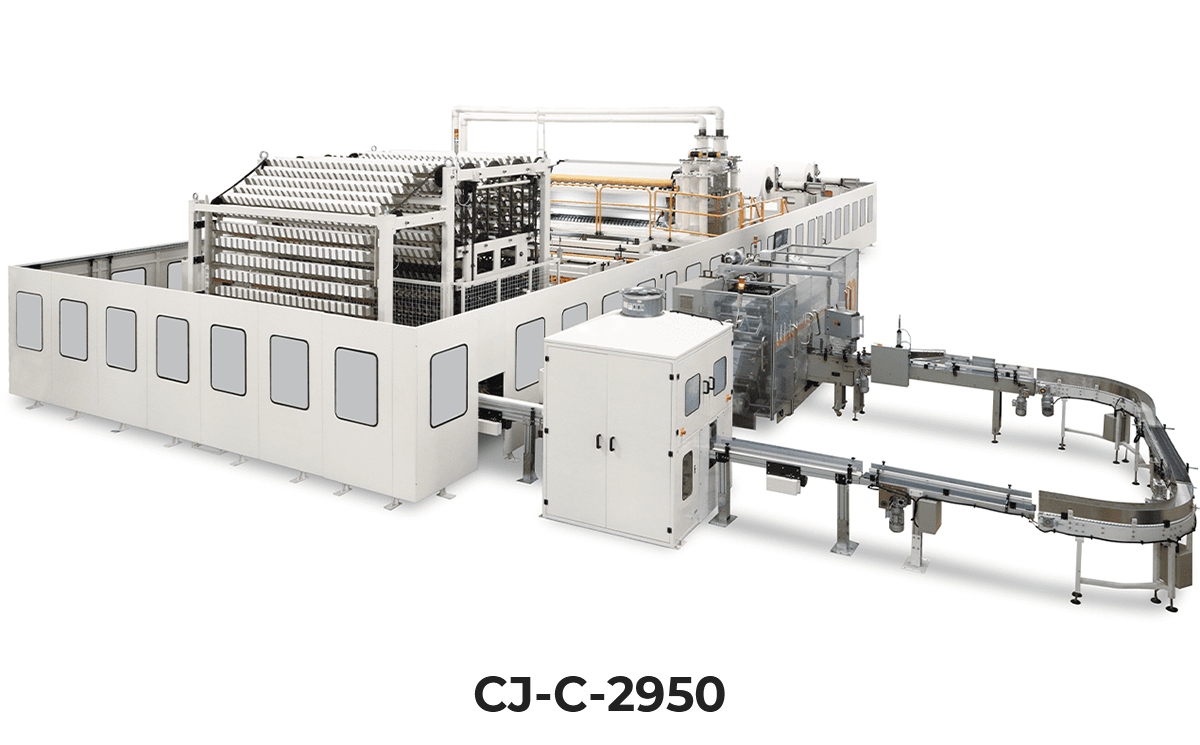
A: An optimized, fully automated downstream packaging line must be configured as a continuous, linear flow that perfectly balances the maximum throughput capacity of the upstream rewinder or folder. The optimal layout directly links the output of the high-speed log saw or folding machine to automated primary overwrappers via synchronized multi-belt conveyor systems equipped with electronic speed-matching sensors. Primary wrapped packs flow immediately into automated secondary cartoning or bundling machines that arrange the packs into commercial configurations without human touchpoints. The final stage incorporates a heavy-duty robotic palletizing cell equipped with customized vacuum or mechanical grippers that stack boxes onto pallets according to pre-programmed layer profiles, passing the finished pallets to automated stretch wrappers. By maintaining absolute kinematic continuity and utilizing independent servo speed-matching between each machine, the layout ensures that the packaging phase never acts as a bottleneck, maximizing entire-line OEE.
Q14: How do alternative agricultural pulps like bamboo or bagasse impact converting machine performance compared to virgin wood pulp?
A: Alternative non-wood fibers, such as bamboo and bagasse, possess fundamentally different physical properties than standard virgin softwood or hardwood pulps. Bamboo fibers typically exhibit a higher stiffness index and lower cross-directional tensile strength, meaning the paper web is significantly more brittle and highly sensitive to sudden directional alterations. When running alternative pulps, a standard converting line will suffer from continuous web snaps and severe perforation defects. To handle alternative fibers successfully, the machinery must be configured with highly tolerant web path geometries that minimize sharp bending angles. Furthermore, alternative pulps generate a significantly higher volume of abrasive micro-dust during slitting and folding operations. This requires the converting line to feature reinforced dust extraction shrouds, hardened tungsten carbide slitting knives, and robust vacuum pumps with specialized filtration matrices to prevent premature mechanical wear and sensor failures.
Q15: Why is integrated paper dust extraction essential for sensor accuracy and fire prevention in tissue mills?
A: High-speed tissue slitting, perforating, and embossing processes act as massive generators of fine, airborne cellulose dust. If a converting facility lacks a robust, integrated high-vacuum dust extraction network, this fine dust quickly settles across the entire machine environment. From an automation standpoint, paper dust accumulates on the lenses of high-precision optical registration sensors, color-mark readers, and safety light curtains, causing sensor blindness, false error faults, and frequent micro-stops that devastate performance efficiency. From a plant safety standpoint, accumulated cellulose dust is highly flammable and can easily be ignited by static electricity or mechanical friction from high-speed bearings. A high-velocity line must feature customized suction hoods positioned directly at the slitting knives and perforation cylinders, drawing dust away continuously into centralized filtration units to maintain a clean, safe, and highly efficient production floor.
Q16: What distinct technical parameters govern the engineering selection of automated log saw cutting systems?
A: The log saw is the high-velocity gatekeeper of the toilet roll production line, and its selection is governed by four critical engineering parameters: first, the diameter and metallurgy of the orbital circular blade (typically fabricated from premium high-speed steel or chrome-vanadium alloys to maintain edge sharpness); second, the orbital speed profile (advanced saws utilize independent servo-driven planetary gears that match the blade's downward plunge velocity exactly to the continuous advance speed of the tissue log, ensuring a perfectly perpendicular, deformation-free cut); third, the automation depth of the sharpening system (integrated grinding wheels must execute automated micro-sharpening at programmed cut-intervals without halting the blade rotation); and fourth, the design of the log clamping system (pneumatic or servo-driven polyurethane clamps must secure the log firmly without crushing the delicate embossed bulk).
Q17: How do multi-ply laminating systems synchronize adhesive distribution at high linear velocities without fluid slinging?
A: In premium multi-ply toilet paper and kitchen towel manufacturing, laminating units must apply a micro-layer of adhesive to bond the sheets together. At high linear speeds exceeding 800 m/min, centrifugal force threatens to fling the liquid adhesive out of the distribution fountain, creating catastrophic misting that ruins product quality and coats the machine in glue. Advanced laminating systems eliminate this issue through high-precision, enclosed Anilox roller architectures. The laser-engraved ceramic Anilox roller features millions of micro-cells that hold a precise, mathematically calculated volume of adhesive. A specialized doctor blade system seals the fluid fountain and strips away excess glue before it leaves the nip, ensuring that adhesive is transferred to the embossed paper plies strictly via micro-contact printing, guaranteeing a flawless bond with zero fluid slinging or mechanical contamination.
Q18: What is the mathematically projected capital payback period (ROI) for a modern full-servo converting line?
A: While a fully automated, full-servo converting line carries a premium initial CAPEX, a comprehensive lifecycle financial audit reveals that high-efficiency equipment delivers an exceptionally compressed capital payback window, typically ranging between **12 to 18 months**. This rapid asset recovery is driven by dramatic reductions in variable operating expenses: first, labor insulation (replacing manual downstream handling with an unmanned turnkey line slashes payroll costs); second, fiber yield protection (dropping material scrap from 4.5% to under 1.5% saves tens of thousands of dollars in raw pulp costs); and third, OEE optimization (minimizing micro-stops and changeover downtime allows the factory to output significantly higher sellable volumes per week). For mid-to-large-scale global paper enterprises, investing in advanced platforms like those engineered by DeChangYu (DCY) represents the fastest path to long-term cost containment and high-margin profitability.
Q19: How do regional climate variations, specifically humidity and temperature, affect converting precision?
A: Cellulose fibers are highly hygroscopic, meaning they naturally absorb moisture from the surrounding environment. In regions with high ambient humidity (such as tropical Southeast Asian markets), the raw tissue paper web absorbs water vapor, which causes the fibers to expand, lowers the dry tensile strength of the sheet, and increases its elasticity. If a converting line lacks intelligent adaptability, this climate factor leads to severe web elongation, loose log winding, and ragged perforation cuts. To combat regional climate variations, modern high-tech machinery integrates advanced ultrasonic web guiding systems and hyper-sensitive closed-loop tension regulation. The system continuously measures real-world web resistance, automatically lowering the baseline tension profiles in humid environments to match the weakened state of the paper matrix, ensuring perfect log geometry and exact cutting precision regardless of seasonal or geographic climate shifts.
Q20: What critical criteria should corporate executives use to evaluate cross-border engineering support and spare parts logistics?
A: When purchasing high-tech machinery across international borders, corporate buyers must look past standard warranty claims to evaluate three operational criteria: first, **Component Standardization** (the machine builder must utilize globally recognized electrical and pneumatic brands, such as Siemens PLCs and SKF bearings, allowing the factory to source off-the-shelf replacements from domestic local distributors the same day); second, **Cloud-Based Remote Access** (the equipment must feature secure, built-in Industrial IoT gateways, allowing the manufacturer's senior software engineers to remotely log into the PLC from anywhere in the world to diagnose code-level logic faults and optimize tension profiles in real-time); and third, **Structured Spare Parts Packages** (the machinery should ship with an exhaustive, data-calculated wear-parts kit to protect the plant from international logistics delays during critical production runs). International buyers can explore customized global service frameworks via the DCY Global Partnership & Support Channel.
Strategic Conclusion and Procurement Blueprint
Navigating capital investments in modern tissue paper machinery requires a fundamental shift in procurement logic. Corporate executives and plant directors must break free from the trap of legacy brand dependency and look past the initial machinery invoice price to strictly evaluate long-term TCO, automation depth, and material yield efficiency. The global tissue market in 2026 offers no cushion for mechanical inefficiency, high scrap paper rates, or labor-intensive workflows. The optimal converting asset is a heavy-duty, full-servo, highly automated line that perfectly balances top-tier industrial throughput, flawless output quality, and an optimized, rapid path to capital recovery.
Are you ready to eliminate mechanical inefficiency, drop your material scrap rates, and insulate your factory from rising labor costs? Stop leaving your operating margins to chance. Connect with our senior industrial engineering division today to receive a comprehensive, data-driven operational ROI audit and a customized factory footprint layout customized explicitly to your plant's physical boundaries, local labor environment, and target capacity goals. Take command of your manufacturing margins—partner with DeChangYu (DCY) today.





 English
 Español
 العربية
 Português do Brasil
 Русский