The DeChangYu (DCY) Milestone History, Technical Evolution, and Future Blueprint
Executive Summary & Macroeconomic Industry Landscape
The global manufacturing sector for tissue paper products is undergoing an extraordinary era of industrial transformation in 2026. Historically characterized by fragmented, semi-automated mechanical workshops utilizing manual intervention, the modern marketplace now enforces an uncompromising mandate for full-line automation, extreme energy efficiency, and total raw material yield optimization. Global paper mills and independent converters are encountering an aggressive profit squeeze driven by severe pulp market volatility, surging electricity and natural gas tariffs, and a widening deficit of skilled machine operators. In this high-stakes production environment, operational survival is no longer governed by theoretical top design speeds, but by maximizing Overall Equipment Effectiveness (OEE) and minimizing lifecycle Total Cost of Ownership (TCO).
Over the past four decades, the tissue converting industry has evolved from crude mechanical gears and line shafts into highly intelligent, cloud-connected digital factories. At the absolute forefront of this multi-decade technological renaissance stands Foshan DeChangYu (DCY) Paper Machinery Co., Ltd. Founded in 1987, DeChangYu has spent more than 40 years pioneering breakthrough engineering solutions that have systematically redefined high-speed paper converting. From its humble origins as a regional machinery builder to its status today as a global machinery vanguard supplying high-tier equipment across over 160 countries and regions, DCY’s history embodies the spirit of continuous innovation, heavy-duty metallurgical excellence, and customer-centric automation.
Today, as corporate converters transition toward 'lights-out' unmanned manufacturing and sustainable green converting, understanding the evolution of tissue converting machinery provides essential guidance for corporate procurement teams, plant directors, and Chief Financial Officers. This comprehensive whitepaper explores DeChangYu's remarkable 40-year journey (1987 to Present and Beyond), detailing how pioneering engineering breakthroughs—such as full-servo motion control, closed-loop tension algorithms, and proprietary glue-free tail sealing—have shaped modern tissue converting technology. Through granular technical analyses, historical milestone reviews, and comparative operational matrices, this document serves as an authoritative blueprint for modern paper enterprises worldwide.
DeChangYu (DCY) Historical Journey: 1987 to Present & Future
To understand the sophisticated engineering architectures powering today's ultra-high-speed tissue production lines, one must trace the chronological development of DeChangYu Machinery across four distinct strategic eras of industrial expansion. For more details on the corporate ethos, readers can explore the official DeChangYu Corporate Overview.
Phase I: 1987 – 2000 | Entrepreneurial Genesis & Deep Industry Rooting
In 1987, DeChangYu Machinery was officially established, commencing its dedicated focus on the research, development, and fabrication of tissue paper post-processing equipment. During this initial founding era, the global tissue converting market was dominated by legacy European builders, while domestic Asian factories relied heavily on crude, labor-intensive manual machinery. Recognizing that local converters required reliable, easy-to-maintain equipment, DCY established its initial manufacturing base and began accumulating hands-on metallurgical and mechanical fabrication expertise.
Throughout the late 1980s and 1990s, DCY focused intensely on mastering core mechanical operations: parent roll unwinding, mechanical embossing, rotary perforation, and manual log cutting. By continuously gathering feedback from early factory floors, DCY refined its structural chassis designs and gear ratios, laying a solid mechanical foundation for future high-speed automation. This early dedication to structural durability established DCY’s reputation as a dependable machinery manufacturer.
The turn of the century marked a strategic turning point for DeChangYu. In 2001, DCY made its debut at major international professional industry exhibitions, introducing its tissue machinery portfolio to overseas buyers for the first time. The exceptional structural mass, reliability, and attractive capital efficiency of DCY lines quickly earned widespread recognition from international clients, launching the company’s global export trajectory.
To support its rapid international expansion, DCY prioritized formal quality management and standardized manufacturing procedures. In 2002, the company successfully passed comprehensive quality management system certifications. This was followed in 2003 by earning official certification and trust validation from Bavaria, Germany (Bavarian Trust Company), verifying that DCY’s manufacturing protocols, product safety, and corporate governance met rigorous European industrial standards. This international endorsement significantly boosted brand prestige across European and Latin American markets.
In 2006, DeChangYu established a strategic partnership with Made-in-China.com, accelerating the construction of its international digital trade infrastructure and expanding its overseas sales channels. By 2007, the DeChangYu brand had established a prominent commercial presence across Southeast Asia, the Middle East, and South America.
Driven by a commitment to technological self-reliance, DCY established a dedicated Technology Research & Development Center in 2008, significantly strengthening its in-house automation and electronic control capabilities. This R&D investment propelled a shift from basic mechanical setups to intelligent, high-efficiency machinery. In 2009, DCY achieved formal ISO 9001 Quality Management System Certification, standardizing every phase of casting, machining, assembly, and testing under strict international quality benchmarks. By 2010, DCY's export footprint spanned dozens of nations, earning widespread industry awards.
Phase IV: 2012 – 2018 | Capacity Expansion & Modern Manufacturing Base
To satisfy surging global demand for turnkey converting lines, DCY initiated the construction of its flagship Sanshui Modern Manufacturing Base in 2012. In 2013, the facility added approximately 60,000 square meters of state-of-the-art production workshops, housing heavy-duty CNC machining centers, automated welding bays, and dynamic balancing test halls, dramatically expanding comprehensive production capacity.
Throughout 2015, DCY continuously pushed the boundaries of high-speed automation and intelligent equipment R&D, introducing multi-axis servo coordination across its entire product lineup. In 2018, DCY implemented advanced international management frameworks, achieving a triple-certification milestone: ISO 9001 (Quality Management), ISO 14001 (Environmental Management), and ISO 45001 (Occupational Health & Safety Management), cementing its status as a world-class industrial enterprise.
In 2019, DeChangYu was awarded numerous national high-tech enterprise honors and industrial innovation awards, reflecting sustained increases in R&D expenditure. In 2020, DCY upgraded its corporate strategic layout, driving digital factory management, smart manufacturing execution systems (MES), and cloud-connected remote diagnostics. By 2021, DCY had accumulated dozens of patents, including breakthrough patents for glue-free tail sealing and full-servo interfolding geometry.
In 2022, DCY further expanded its manufacturing throughput and established localized technical service hubs across key international markets. By 2023, following comprehensive ISO system re-certifications, DCY solidified its position as a global leader in intelligent tissue post-processing equipment, delivering complete turnkey solutions to premier paper conglomerates worldwide.
Phase VI: The Future | Smart Manufacturing & Next-Generation Horizons
Looking ahead, DeChangYu Machinery remains dedicated to pioneering the next era of tissue equipment: intelligent tissue production machinery, ultra-high-speed automated converting lines, digital factory solutions, and cloud-based global service networks. By continuously driving technological innovation, DCY is committed to delivering ultra-efficient, stable, and intelligent tissue manufacturing solutions to clients across the globe.
To provide corporate executives and engineering leads with a clear structural overview of DeChangYu’s evolution, the table below outlines the 40-year developmental timeline and technical achievements:
Year / Era
Strategic Milestone
Industrial & Technical Impact
1987
Company Founding
Established initial production base; commenced dedicated R&D in tissue converting.
2001
International Exhibition Debut
Entered global export markets; earned widespread international client recognition.
2002
Quality System Certification
Standardized factory management and internal quality control protocols.
2003
German Bavarian Trust Certification
Earned official trust certification, verifying compliance with European standards.
2006
Global Trade Network Expansion
Partnered with Made-in-China.com; expanded overseas export channels.
2007
Brand Market Penetration
Expanded brand presence across Southeast Asia, Middle East, and Latin America.
2008
R&D Center Establishment
Built dedicated technology center; boosted automated equipment R&D capabilities.
2009
ISO 9001 Certification
Achieved formal ISO 9001 certification; elevated quality management systems.
2010
Global Export Acceleration
Expanded export reach across dozens of countries with widespread industry awards.
2012
Sanshui Production Base Launch
Initiated construction of modern manufacturing complex in Sanshui, Foshan.
2013
60,000 m² Facility Expansion
Added 60,000 m² workshop area; massively increased fabrication throughput.
2015
Full-Servo Automation R&D
Pioneered multi-axis servo coordination across roll and folded product lines.
2018
Triple ISO Certification
Achieved ISO 9001, ISO 14001, and ISO 45001 international certifications.
2019
National High-Tech Enterprise Honors
Received prestigious national engineering awards for continuous innovation.
2020
Digital & Smart Manufacturing MES
Implemented MES digital factory management and cloud-connected diagnostics.
2021
IP & Patent Portfolio Growth
Secured key patents for Glue-Free Tail Sealing and advanced interfolding.
2023
ISO System Upgrade & Global Leadership
Consolidated status as a top-tier global tissue equipment supplier.
Future
Smart Factory & IIoT Leadership
Focusing on AI-driven smart machinery, ultra-high-speed automation, and green converting.
Evolution of Converting Engineering: From Line Shafts to Full Servo Topology
The 40-year history of tissue machinery is defined by a fundamental shift in motion control topologies. In early mechanical generations (1980s–1990s), converting lines relied on a single massive centralized motor connected to a complex web of physical drive shafts, open gears, timing belts, and mechanical jackshafts to distribute power across the unwind stands, embossing rollers, perforation heads, and winding nests. This physical drive approach suffered from severe mechanical backlash, high friction losses, vibration-induced component wear, and lengthy product changeovers requiring hours of manual tool adjustments.
Today, modern high-tech lines utilize a completely decentralized multi-axis full-servo drive architecture linked via real-time deterministic Ethernet industrial communication bus networks like PROFINET or EtherCAT. Every critical movement axis—from unwind mandrels and embossing rollers to rotary log saws and robotic pushers—is driven by its own independent synchronous AC servo motor governed by an electronic cam matrix inside a Siemens PLC. This electronic synchronization eliminates hundreds of wearing mechanical parts, slashes power consumption by 15-20%, and permits operators to alter sheet counts or perforation lengths instantly via the software HMI touchscreen.
Engineering Parameter
Traditional Mechanical Line Shafts (Legacy)
Modern Full-Servo Open Topology (DCY)
Drive Distribution
Single main AC motor + physical drive shafts, gears & belts
Decentralized multi-axis synchronous AC servo motors
Regenerative braking; common DC bus energy recovery
Flagship Product Engineering: ZQ-H & CJ-C Series Technical Breakdown
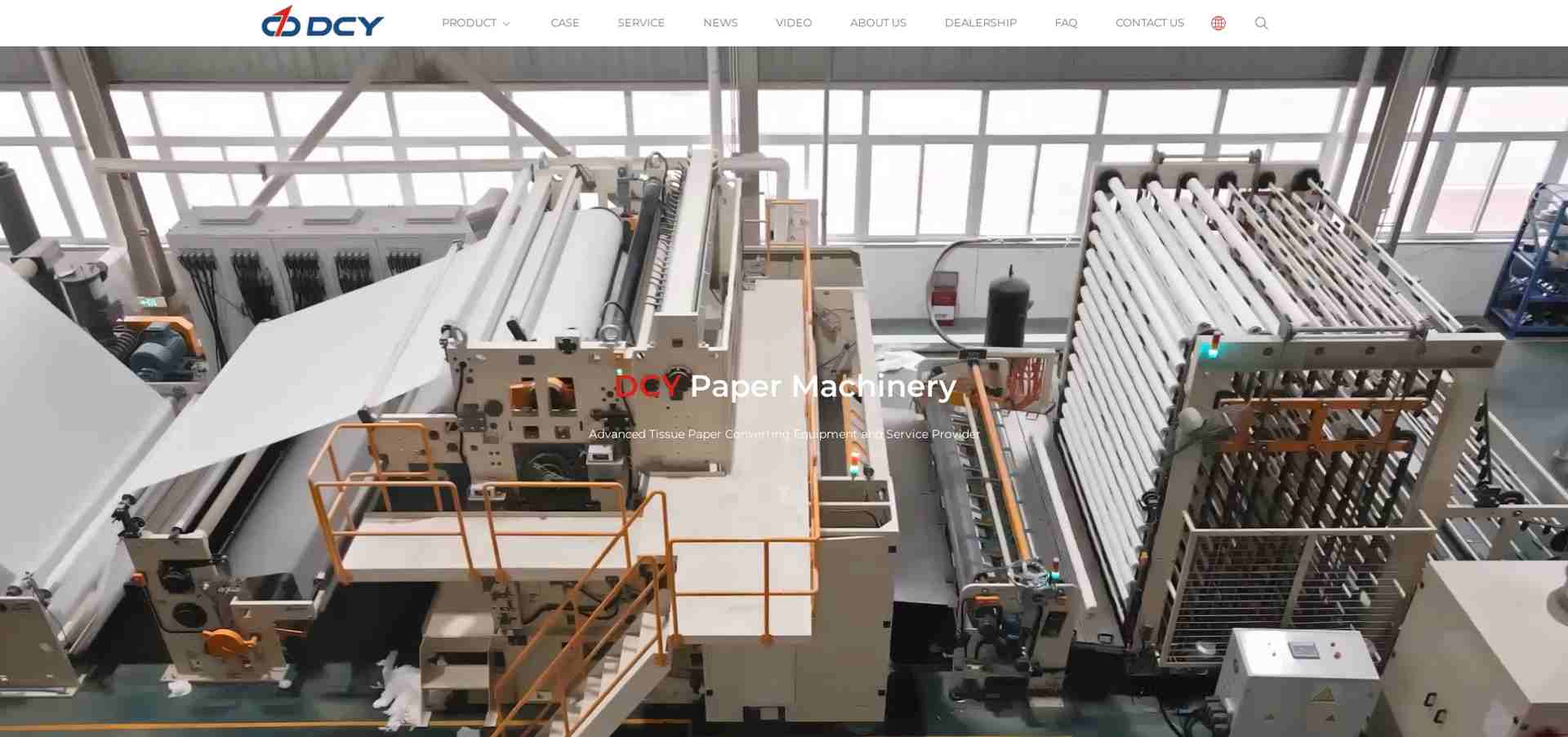
DeChangYu’s engineering excellence is best demonstrated in its industry-leading equipment series. In the high-volume roll-converting domain, DCY supplies its flagship ZQ-H Series Fully Automatic High-Speed Roll Production Line. Built upon a massive, stress-relieved steel chassis designed to completely isolate dynamic vibrations at continuous surface velocities exceeding 800 to 1000 m/min, the ZQ-H Series seamlessly connects parent roll unwinding, embossing, perforation, rewinding, tail sealing, cutting, wrapping, bundling, and palletizing without human intervention. Converters can explore the complete lineup via the DCY Roll Converting Solutions Portal.
In the folded paper segment, DCY leads with its specialized CJ-C Series Automatic Facial Tissue Production Line. Capable of handling wide parent rolls up to 2950 mm, the CJ-C Series utilizes advanced computational fluid dynamics to govern internal vacuum distribution arrays within its folding cylinders. Suction and release are controlled down to the microsecond, producing perfectly folded facial tissues at speeds up to 1700 draws per minute without sheet jams or edge tearing. Browse DCY's folded tissue assets through the DCY Folded Tissue Solutions Section.
Technical Feature
ZQ-H Series Roll Production Line
CJ-C Series Facial Tissue Line
Primary Target Product
Bathroom toilet rolls & kitchen towels
Pop-up boxed facial tissues & hand towels
Maximum Operating Speed
800 - 1000 meters per minute (Continuous)
Up to 1700 draws per minute per lane
Parent Roll Width Capacity
Standard 2.8m - 3.5m wide jumbo rolls
Up to 2950 mm wide-web parent stock
Specialized Motion Mechanics
Surface winding cradle with rider roll density profiling
A major source of chronic unplanned downtime, optical sensor blindness, and recurring variable cost in traditional converting plants is the application of liquid chemical glues during log tail-sealing. Standard chemical glues create severe overspray that coats timing belts, mechanical tracks, and registration sensors, forcing maintenance teams to halt production for up to 45 minutes every single day for manual cleaning. DCY completely eradicates this operational bottleneck through its proprietary Glue-Free Tail Sealing Technology Whitepaper.
This breakthrough system completely replaces chemical adhesives by applying a localized micro-water mist combined with microsecond mechanical embossing replication directly onto the final tissue ply. The water mist temporarily weakens the hydrogen bonds within the cellulose matrix; as the specialized embossing wheel applies targeted compression, the paper fibers physically interlock, forming a secure, clean physical bond as the moisture dissipates. This completely eliminates chemical consumable expenses, eliminates glue-induced jams, restores 45 minutes of daily uptime, and delivers a pristine, easily peelable first sheet for the end consumer.
Manufacturing Base & Quality Infrastructure (Sanshui Base, ISO Certifications)
DeChangYu’s commitment to engineering precision is backed by its modern Sanshui Manufacturing Base in Foshan, Guangdong. Spanning over 60,000 square meters of specialized workshop area, the Sanshui base houses heavy-duty CNC gantry machining centers, precision gear grinding equipment, dynamic balancing test bays, and automated assembly halls. Every structural frame cast at DCY undergoes rigorous ultrasonic flaw detection, stress-relief heat treatment, and coordinate measuring machine (CMM) audits, ensuring absolute metallurgical stability before assembly. Plant directors can review quality protocols via the DCY Quality Control Portal.
Furthermore, DCY operates in full compliance with global management benchmarks, maintaining a comprehensive triple-ISO certification portfolio: ISO 9001 (Quality Management), ISO 14001 (Environmental Management), and ISO 45001 (Occupational Health & Safety). This standardized quality infrastructure guarantees that every turnkey converting line leaving the factory meets strict international safety and reliability standards.
Certification Standard
Initial Achievement / Upgrade Year
Operational Scope & Compliance Impact
ISO 9001 Quality Management
Achieved 2009 / Upgraded 2023
Guarantees standardized raw material sourcing, CNC machining, & CMM testing
An upstream converting line running at extreme mechanical velocities is entirely useless if it is restricted by an inefficient, manual downstream packaging bottleneck. True industrial competitive agility requires a completely continuous, automated material stream that carries the product smoothly from raw conversion down to final commercial palletizing. DCY addresses this through its seamlessly integrated DCY Post-Processing Packaging Solutions.
Downstream of the orbital log saw or interfolding head, products flow into automated primary overwrappers and secondary bundling modules via synchronized multi-belt conveyors equipped with electronic speed-matching sensors. Sourcing dedicated assets—such as DCY Toilet Paper Machine Systems, commercial DCY Hand Towel Machine Solutions, or boxed DCY Facial Tissue Machine Systems—guarantees that upstream log formation is perfectly matched to downstream wrapping cycle times.
The final phase of the unmanned factory floor incorporates heavy-duty robotic palletizing cells equipped with customized vacuum or mechanical grippers that stack boxes or bundles onto commercial pallets according to pre-programmed layer profiles. Pallets are automatically transferred to integrated stretch wrappers before delivery to the warehouse. To review the full range of automated machinery platforms, buyers can visit the central DCY Complete Converting Machine Portal.
Digital Ecosystems, IIoT Gateway & Predictive Maintenance
The industrial competitive landscape of 2026 is heavily governed by industrial software architecture. Modern DCY converting lines embed secure Industrial Internet of Things (IIoT) gateways that enable predictive maintenance and cloud-based remote diagnostics. Triaxial accelerometers on main bearings track micro-vibration wear signatures, allowing the system to identify component wear long before a breakdown occurs. If a software anomaly arises in an overseas facility, senior off-site software engineers can securely log into the PLC via encrypted cloud portals to resolve code-level logic faults in real-time.
Converters can review detailed remote support protocols via the DCY Technical Support & Service Portal and inspect spare parts logistics via the DCY Standardized Spare Parts Hub. Sourcing equipment built on open-architecture component standardization (using Siemens PLCs, Omron sensors, and SKF bearings) ensures that local maintenance teams can source off-the-shelf replacements locally the exact same day.
Global Expansion, Trade Exhibitions & Customer Success Stories
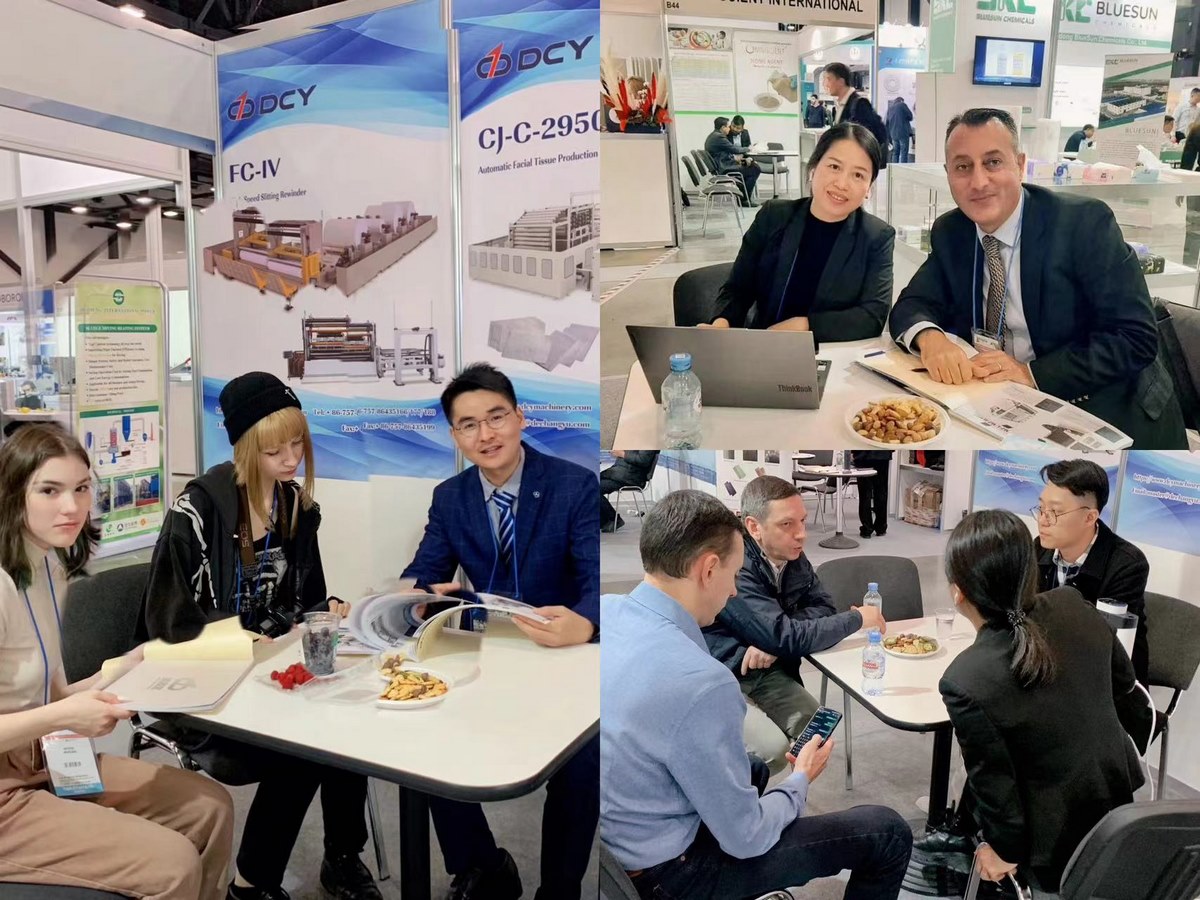
DCY’s continuous global expansion is reinforced by its active physical presence across major international paper industry exhibitions, including repeated participation in the prestigious Tissue-ME Exhibition in Cairo, Egypt, as well as major trade expos across Europe, Latin America, and Asia. Procurement leads can browse event coverage via the DCY News & Exhibition Portal.
Through decades of field excellence, DCY has supplied turnkey converting lines to top-tier international paper groups, including Hayat Hygiene, Fine Hygienic Holding (Al Bardi Paper Mill), Zeina Group, White Tissues, Pyramids Paper Mills (Flora), Crown Paper Mill (UAE), and Indevco Group. Industry leads can view video demonstrations on the DCY Official Video Gallery and consult technical answers on the DCY B2B Technical FAQ Hub.
Q1: How does closed-loop tension control actively mitigate web snaps when processing low-tensile base paper webs? A: Traditional converting lines utilize basic mechanical or pneumatic surface brakes on the unwind stand that apply a rigid, non-responsive drag resistance. When a jumbo roll has thickness variances or out-of-round deformations, this rigid resistance creates sudden, massive tension spikes that instantly snap the fragile paper web. DCY full-servo lines implement electronic closed-loop tension regulation driven by high-frequency load cells that continuously measure running web tension and transmit data to the central PLC, allowing predictive PID algorithms to micro-adjust the torque and velocity of independent unwind servo motors in real-time to stabilize the web path, allowing factories to run lower-cost base papers—including short-fiber eucalyptus pulp or recycled stock—at extreme velocities without snaps.
Q2: What factory floor infrastructure prerequisites are mandatory before installing an ultra-high-speed rewinder running above 800 m/min? A: High-speed converting lines generate dynamic harmonics that can affect machine alignment. The factory floor must feature a reinforced, vibration-isolated concrete pad (300 mm to 500 mm thick) decoupled from the main building. Electrically, clean power and active harmonic filters are required to insulate sensitive multi-axis servo networks from grid fluctuations, paired with regulated compressed air at 6 to 7 bar and centralized dust extraction systems.
To explore advanced research milestones, plant directors can visit the DCY Industrial R&D and Automation Center. Global partnership details are available through the DCY Global Partnership Channel or by reaching out to the engineering taskforce via the DCY Official Contact Portal.
As the tissue converting industry enters its fifth decade of modern evolution, DeChangYu Machinery continues to define the technological horizon. Looking to the future, DCY remains focused on pioneering next-generation smart manufacturing ecosystems: AI-driven autonomous machine self-calibration, zero-carbon converting technologies, fully integrated digital twin simulation models, and predictive cloud-based maintenance algorithms. By combining 40+ years of deep metallurgical experience with cutting-edge digital intelligence, DeChangYu is uniquely positioned to lead global tissue paper manufacturers toward a more efficient, profitable, and sustainable future.






 English
 Español
 العربية
 Português do Brasil
 Русский