In the 2026 global tissue manufacturing landscape, operating margins are under unprecedented pressure. Volatile wood pulp prices, rising industrial electricity rates, and a shrinking pool of skilled manual labor have rendered traditional, labor-intensive converting processes financially unsustainable.
For plant directors and Chief Financial Officers (CFOs), the decision to upgrade to Fully Automated Tissue Rewinders is no longer a debate about mere mechanical speed. It is a strict financial calculation centered on Total Cost of Ownership (TCO), Operating Expenses (OPEX) reduction, and precise Return on Investment (ROI).
This guide deconstructs the financial mechanics of modern rewinding architectures and incorporates a real-world operational video case study to provide a data-driven framework for evaluating how automation directly impacts your factory’s bottom line.
1. Deconstructing the OPEX Leaks in Traditional Systems
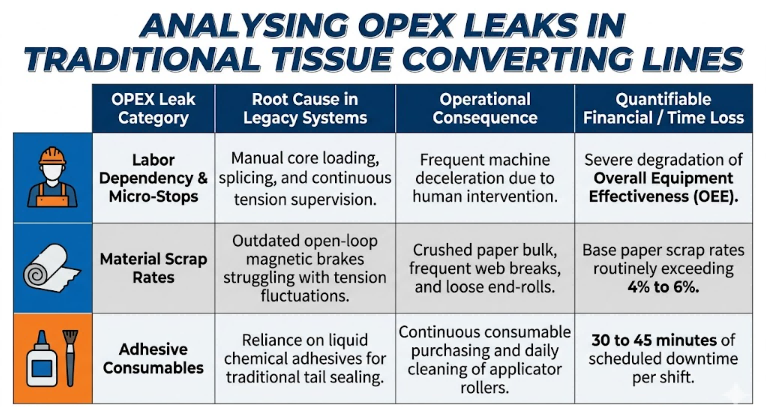
Before calculating the ROI of new equipment, procurement teams must identify the hidden financial leaks within their existing semi-automated or legacy rewinding lines. These operational inefficiencies typically fall into three categories:
Labor Dependency and Micro-Stops: Semi-automated lines require manual core loading, manual splicing, and continuous operator supervision to manage web tension. Every time a human operator must intervene, the machine decelerates. These frequent micro-stops severely degrade Overall Equipment Effectiveness (OEE).
Material Scrap Rates: Older machines utilizing open-loop magnetic brakes struggle to handle tension fluctuations. This results in crushed paper bulk, frequent web breaks, and loose end-rolls. In many legacy facilities, base paper scrap rates routinely exceed 4% to 6%.
Adhesive Consumables: Traditional tail sealing requires liquid chemical adhesives. Beyond the recurring cost of the glue itself, the applicator rollers require daily cleaning, resulting in 30 to 45 minutes of scheduled downtime per shift.
2. Real-World Case Study: DeChangYu (DCY) ZQ-H Fully Automated Rewinder
To visualize how fully automated architectures translate theoretical concepts into actual factory profits, we can examine a live operational case study from an industry-leading equipment manufacturer, DeChangYu (DCY) Paper Machinery.
▶️ Watch the Field Operation Video: Customer Cases | ZQ-H Fully Automated Rewinder
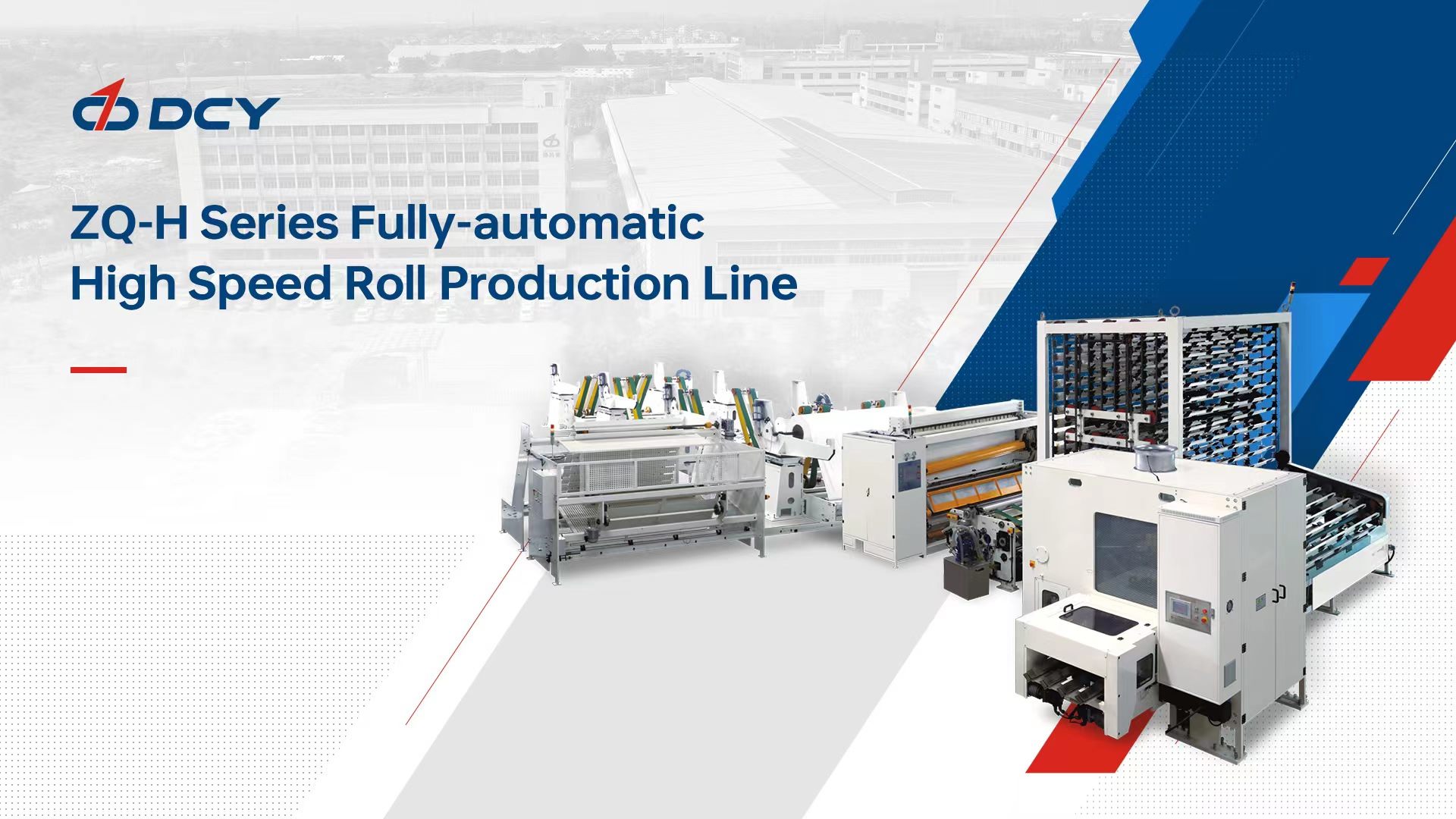
In this customer case video, DCY's ZQ-H Series Fully Automatic High-Speed Roll Production Line perfectly demonstrates the core automation metrics required by modern manufacturing enterprises, showcasing outstanding performance in a real factory environment:
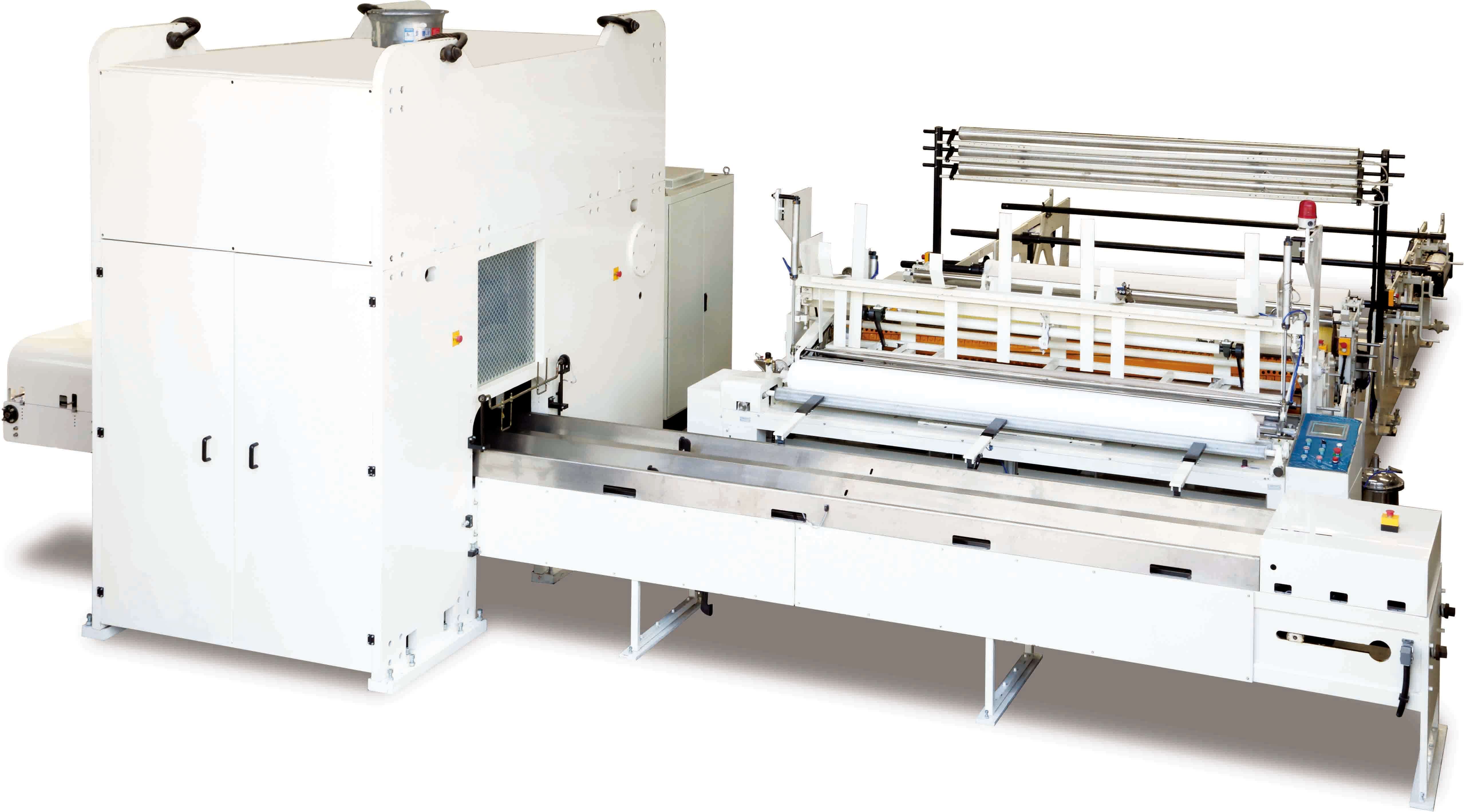
Non-Stop Continuous Rewinding: The equipment features a non-stop design, meaning the rewinding process of the paper log is entirely continuous. This completely eliminates the deceleration and pauses during roll changes common in traditional equipment, ensuring maximum OEE utilization.
Independent Servo Motor Drive: Abandoning complex traditional mechanical transmissions, every operational unit of the machine is driven by independent servo motors. This highly simplified mechanical structure drastically reduces the equipment's failure rate and maintenance requirements.
Precise Perforation & Web Breaking [00:00:23 - 00:00:30]: Utilizing the advanced Siemens SIMOTION motion control system and a high-precision CNC-machined large-diameter blade shaft, the servo-controlled mechanical arm severs the paper web at the exact perforation line with extreme stability. It is even equipped with an automatic axial sliding function for the blade shaft, which not only guarantees perforation clarity but also ensures the final consumer roll has excellent tightness and a perfectly uniform diameter.
By integrating this level of high-end automation, the client successfully achieved significant cost reductions and efficiency gains, validating the massive ROI generated by fully automated upgrades.
3. The 3 Financial Vectors of Fully Automated Tissue Rewinders
Building on the case study above, modern fully automated systems elevate ROI through three quantifiable vectors:
Vector A: Labor Displacement and OEE Maximization
A fully automated line integrates automatic core feeding, unbroken log transfers, and synchronized log saws. By transitioning to a closed-loop continuous operation, a facility can reduce the required headcount per shift from 3–4 operators down to a single monitoring technician. Furthermore, eliminating manual micro-stops typically increases baseline OEE from 65% up to 85% or higher.
Vector B: Waste Reduction via Precision Control
As demonstrated by the servo control systems in the video, high-end automated rewinders utilize closed-loop PID servo tension control. Load cells communicate with the central PLC in milliseconds to adjust torque, maintaining perfectly uniform tension across the entire jumbo roll. This prevents web breaks and systematically reduces raw material scrap rates to under 1.5%.
Vector C: Glue-Free Tail Sealing
Industry-leading equipment integrates mechanical crimping and hydrogen bonding (water mist) technologies, entirely eliminating the need for chemical adhesives. Read our complete guide on Why Glue-Free Tail Sealing Technology Matters to see how this removes a continuous consumable expense from the balance sheet and reclaims the daily production time previously lost to cleaning glue applicators.
4. A Data-Driven ROI Comparison: Legacy vs. Fully Automated
To visualize the financial impact, we have modeled a standard 24-month production scenario.
Simulation Baseline Parameters:
Production Target: 2-ply, 15gsm standard toilet rolls.
Operation Schedule: 24 hours/day, 300 days/year.
Pulp Cost: Estimated at $800 / Ton.
Labor Cost: Estimated at $25,000 / Operator / Year (Emerging Market Baseline).
The ROI Conclusion: As the simulation data demonstrates, a fully automated rewinder can directly generate over $250,000 in OPEX savings annually (not factoring in the additional revenue generated by the OEE increase). For a standard regional factory, this level of cost reduction typically yields a complete capital amortization (ROI) within 18 to 24 months.
5. Protecting Your Investment: IoT and Mean Time To Repair (MTTR)
Calculating ROI assumes the machine is running. In 2026, mechanical reliability must be supported by digital infrastructure.
When evaluating fully automated tissue rewinders, procurement teams must ensure the equipment features secure Internet of Things (IoT) connectivity. Modern architectures employ centralized SCADA (Supervisory Control and Data Acquisition) control. If an anomaly occurs, the exact fault node is highlighted on the HMI touchscreen. Furthermore, this connectivity allows the Original Equipment Manufacturer's (OEM) software engineers to securely remote into the PLC, run code-level diagnostics, and push parameter adjustments within minutes. By drastically reducing the Mean Time To Repair (MTTR), IoT capability serves as the ultimate insurance policy for your calculated ROI.
Conclusion: Shifting from CAPEX to Total Cost of Ownership (TCO)
The procurement of tissue converting machinery is undergoing a fundamental paradigm shift. Approaching equipment acquisition by merely looking for the lowest initial CAPEX is a mathematically flawed strategy that locks a facility into years of high OPEX and stagnant productivity.
Fully Automated Tissue Rewinders require a higher initial capital investment. However, through aggressive labor reduction, the total elimination of chemical consumables, and the minimization of raw material waste, they offer a mathematically verifiable path to profitability.
When planning your next facility upgrade, demand hard data, run the Total Cost of Ownership formulas, and invest in intelligent Turnkey Solutions for Tissue Converting designed for structural stability and continuous high-yield production. Ready to discuss your ROI potential? Visit the DeChangYu Dealership & Contact Page to consult with our engineering team today.





 English
 Español
 العربية
 Português do Brasil
 Русский