In the capital-intensive industry of tissue converting, upgrading plant machinery is often viewed strictly through the lens of Capital Expenditure (CAPEX). When Chief Financial Officers (CFOs) and plant directors evaluate the price tag of modern High-Speed Folding Machines, the initial sticker shock can sometimes delay critical modernization. However, evaluating machinery solely on its acquisition cost is a severe miscalculation of industrial economics.
In 2026, the true metric of success is the Total Cost of Ownership (TCO) and the speed of the Return on Investment (ROI). Due to exponential advancements in servo-driven kinematics, aerodynamic vacuum folding, and digital automation, modern High-Speed Folding Machines are no longer just capacity upgrades—they are aggressive cost-reduction engines.
This comprehensive financial and engineering whitepaper provides a granular breakdown of how transitioning from legacy mechanical folders to advanced High-Speed Folding Machines (such as the CJ-C-A Series engineered by DeChangYu) effectively pays for itself within an 18-month operational window.
1. The Core Financial Mechanics of High-Speed Folding Machines
The fundamental premise of achieving a rapid ROI with High-Speed Folding Machines lies in the drastic reduction of Operating Expenditure (OPEX) coupled with a massive increase in sellable throughput.
Legacy folding machines typically operate at speeds of 500 to 600 cuts per minute. They are mechanically limited by physical tucker blades that physically strike the paper to create a fold. Pushing these older machines beyond their mechanical limits results in catastrophic web breaks, destroying your Overall Equipment Effectiveness (OEE).
In contrast, modern High-Speed Folding Machines utilize aerodynamic vacuum suction. Operating at stable speeds of 1000 to 1200 cuts per minute (or 130-160 meters per minute), they effectively double the output of a standard line using the exact same factory floor footprint. By doubling throughput without doubling the overhead (rent, baseline electricity, administrative costs), the cost-per-unit plummets, immediately accelerating the amortization schedule.
2. How High-Speed Folding Machines Slash Labor Costs
One of the largest continuous drains on a tissue converting facility's profitability is manual labor. Legacy equipment requires constant human intervention: operators must manually splice webs, clear paper jams caused by mechanical friction, and physically transfer folded logs to the packaging unit. A typical legacy line requires 4 to 5 operators per shift.
State-of-the-art High-Speed Folding Machines operate as fully automated, "lights-out" ecosystems.
Automated Web Splicing: Systems are equipped with automated jumbo roll unwinding and splicing, eliminating the need to stop the machine for roll changes.
Seamless Transfer: Through precise servo-motor synchronization, the folded tissue logs are automatically conveyed directly into the Toilet Paper Wrapping Machine or cartoner without human touch.
By utilizing the digital architecture of High-Speed Folding Machines, a factory can reduce its labor requirement to just 1 or 2 monitoring technicians per shift. Over three shifts a day, 300 days a year, this labor reduction alone can recoup up to 30% of the machine's initial CAPEX in the first year.
3. Waste Reduction Capabilities of High-Speed Folding Machines
In the tissue industry, raw tissue paper pulp accounts for up to 60% of the final product's cost. Wasting base paper is akin to shredding raw currency.
Legacy machines utilizing mechanical friction create immense amounts of paper dust and frequent web breaks. Every time the web snaps, the machine must be re-threaded, leading to hundreds of meters of ruined paper that must be scrapped or recycled at a massive loss. A 4% to 5% waste rate is common in outdated facilities.
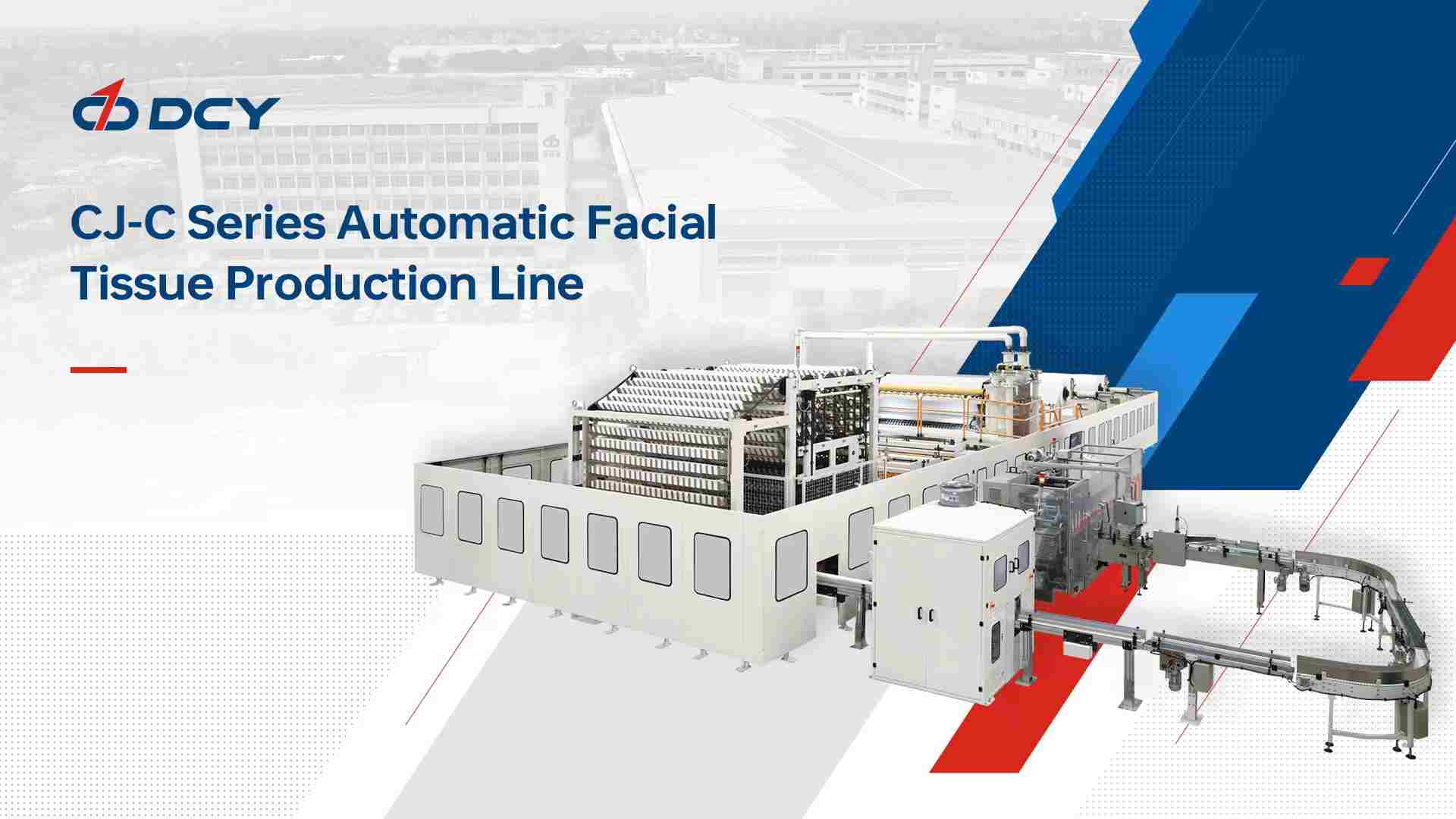
Modern High-Speed Folding Machines eliminate this through Vacuum Suction Folding Technology. As seen in the CJ-C Series Automatic Facial Tissue Production Line, high-capacity vacuum pumps physically pull the tissue web into the interfolding geometry using Bernoulli's principle. Because there is zero hard metal scraping against the paper surface:
Paper dust is virtually eliminated, reducing fire hazards and cleaning downtime.
Web breaks are reduced by 90%, as the paper is handled with aerodynamic care.
Scrap rates plummet from 4.5% to under 0.8%.
4. The ROI Data: How High-Speed Folding Machines Break Even in 18 Months
To move beyond theory, let us examine the hard mathematical reality. Below is a comparative 18-month financial model for a mid-to-large scale tissue facility producing V-fold facial tissues.
Table 1: 18-Month Financial Impact (Legacy Line vs. DCY High-Speed Folding Machine)
Baseline Assumptions: Operation runs 3 shifts (24 hours/day), 300 days/year. Base paper cost is $1,000/Ton. Labor rate is $20/hour.
The Conclusion: As the data clearly illustrates, the savings generated strictly from reduced paper waste and eliminated labor redundancy amount to $909,000 over 18 months. Subtracting the initial estimated $250,000 capital investment for the new machinery leaves the factory with a Net Positive Cash Flow of $739,000. The machine literally pays for itself in less than half the calculated 18-month window.
5. Energy Efficiency and Kinematic Optimization
While older machines were built during an era of cheap electricity, modern High-Speed Folding Machines are engineered for rigorous energy conservation.
Advanced systems utilize closed-loop Siemens PLCs and Mitsubishi Servo motors equipped with regenerative braking. When the massive unwinding stands or folding cylinders decelerate, the kinetic energy is not wasted as heat; it is captured and fed back into the factory's electrical grid.
Furthermore, optimizing tension control via digital PID algorithms ensures the motors only draw the exact amperage required to maintain the web tension, resulting in a 20% to 30% reduction in overall energy consumption compared to legacy clutch-and-brake systems. For a deeper understanding of this tension technology, see our Tissue Converting Line Guide.
6. Maximizing OEE with IoT and Remote Diagnostics
An often-overlooked factor in the ROI calculation of High-Speed Folding Machines is the drastic improvement in Mean Time To Repair (MTTR).
When a 20-year-old machine breaks down, diagnosing the fault is a manual, trial-and-error process. Modern High-Speed Folding Machines manufactured by DeChangYu are integrated with secure IoT (Internet of Things) gateways.
If a sensor faults or a servo drive registers an anomaly, the SCADA system instantly highlights the exact node on the HMI touchscreen. Furthermore, our engineers at the DCY headquarters can remotely log into the machine's PLC via a secure cloud connection to troubleshoot code-level faults, adjust timing parameters, or push software updates in real-time. This eliminates the need to fly technicians across the globe, turning days of catastrophic downtime into mere minutes of digital resolution. Read more about this in our After-Sale Warranty commitments.
To guarantee the 18-month ROI, High-Speed Folding Machines cannot operate in a vacuum. They must be part of a synchronized digital ecosystem.
When you source Turnkey Solutions for Tissue Converting Lines, you ensure that the folding unit communicates flawlessly with the downstream cartoner or film wrapper. If the packaging machine runs out of film, the folding machine does not perform a hard emergency stop (which snaps the paper web). Instead, the entire line executes a coordinated soft-deceleration. This holistic approach to factory integration is the ultimate safeguard for your investment.
Conclusion: Stop Paying the "Invisible Tax" of Old Equipment
Refusing to upgrade to modern High-Speed Folding Machines under the guise of "saving money" is a fatal industrial fallacy. By clinging to obsolete equipment, you are paying a massive, invisible tax every single day in the form of wasted raw materials, excessive labor costs, and lost production capacity.
The transition to high-speed, vacuum-suction, servo-driven automation is not just an operational upgrade; it is a proven financial strategy that guarantees a rapid Return on Investment.
At DeChangYu, we have spent 40 years engineering the most reliable and financially viable converting equipment in the global market. Whether you require the ultra-high throughput of the CJ-C-A Series or a complete facility Solution Proposal, our technology is built to protect your bottom line.
Ready to calculate the exact ROI for your specific facility? Stop losing money to inefficiency. Visit our Dealership and Contact page today to consult directly with our senior engineering team and begin your transition to highly profitable, automated manufacturing.





 English
 Español
 العربية
 Português do Brasil
 Русский