Tissue Log Saw Machine Buying Guide: Cutting Accuracy, Speed, and Automation
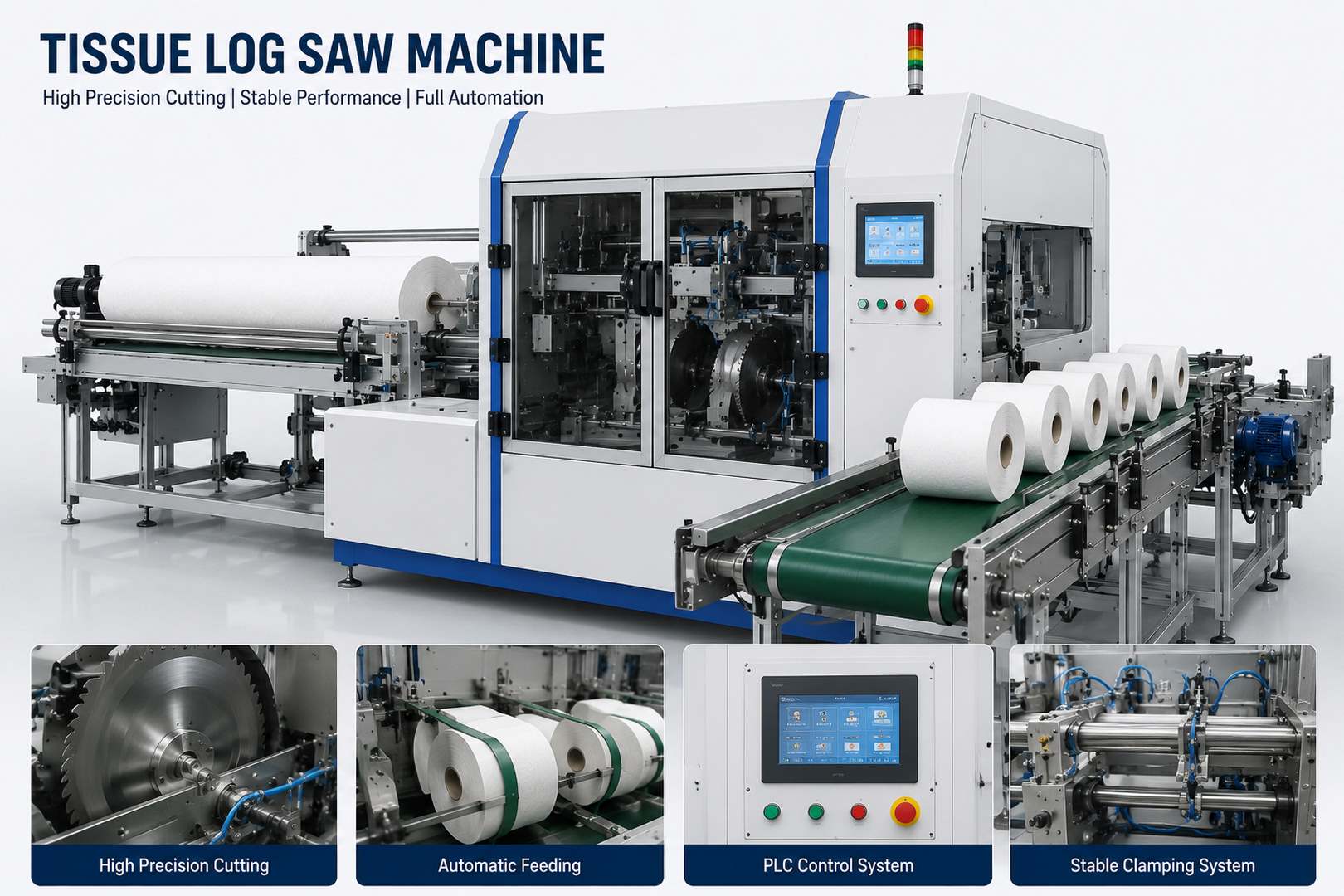
When you’re in the market for a tissue log saw machine, understanding its function is essential. This equipment cuts long tissue logs or folded tissue bundles into finished-size products, preparing them for packaging. Typical applications include toilet rolls, kitchen towels, and facial tissues, among other converted tissue products. However, machines may boast similar specifications but perform differently based on factors like product size, tissue density, log diameter, blade system, and line configuration. To make an informed decision, you should evaluate three main areas: cutting accuracy and finished-product quality, stable production speed, and automation and production-line integration. This guide will clarify which specifications truly matter when comparing tissue log saws and automatic tissue cutting machines. Additionally, investing in a high-quality tissue converting line can significantly enhance production efficiency and quality, ensuring that your products meet market demands.
Key Takeaways
- Assess cutting accuracy by checking the machine’s tolerance levels, ideally around ±1 mm, for consistent finished product width.
- Evaluate the machine’s stable production speed rather than just maximum speed to ensure consistent cutting quality and efficiency.
- Look for automation features like servo-controlled positioning and automatic lubrication to enhance productivity and reduce downtime.
- Consider the machine’s flexibility for product changeovers, ensuring easy adjustments through HMI for different cutting lengths.
- Ensure integration capabilities with the production line, including a log accumulator, to maintain a smooth workflow and minimize waste.
What Is a Tissue Log Saw Machine?
A tissue log saw machine is an essential piece of equipment in the tissue converting process, positioned between the converting and packaging stages. This machine, often referred to as a tissue log cutting machine or automatic log saw machine, performs several critical functions in producing various tissue products, including:
- Toilet paper
- Kitchen towels
- Facial tissue
The basic operating sequence involves log feeding, positioning, clamping, cutting, trim removal, and finished-product discharge. While the term “log saw” can refer to machines used for different tissue products, selecting the correct log saw should focus on the finished product type rather than solely on machine speed. This guarantees maximum performance and quality in your tissue manufacturing operations.
Where Does a Log Saw Fit in a Tissue Production Line?
In a typical toilet paper converting line, the log saw serves as the essential link between the converting and packaging sections. Positioned after the tail sealing and log accumulation steps, the facial tissue log saw prepares the logs for transfer to the packaging area. Its efficiency hinges on upstream factors like rewinder speed, log length, and diameter, as well as the number of logs produced and accumulator capacity. Downstream, roll transfer speed, wrapper capacity, bundling speed, and case packing capacity play significant roles. If the log saw’s capacity outpaces these factors, it can become a bottleneck, preventing efficient factory output. Ultimately, a faster toilet roll cutting machine won’t enhance productivity unless the entire system supports that speed. Moreover, the tissue manufacturing process is crucial in ensuring that the logs produced meet quality standards before they reach the packaging stage.
What Specifications Matter Most When Buying a Tissue Log Saw Machine?
When you’re choosing a tissue log saw machine, focus on how the specifications align with your product requirements and desired output. Consider factors like product type, log diameter and dimensions, cutting length range, and the number of cutting channels. These aspects will guarantee you select a machine that meets your operational needs effectively.
Product Type
Understanding the cutting characteristics of various tissue products is essential for selecting the right tissue log saw machine. Different products, such as toilet rolls, kitchen towels, and jumbo rolls, have unique specifications that affect cutting performance. When choosing a machine, consider:
- Density and softness of the tissue
- Diameter and core structure
- Finished dimensions and compressibility
These factors determine if a toilet paper log saw machine or a tissue paper cutting machine can reliably cut the exact tissue product you manufacture. Ensuring compatibility with your specific products will enhance efficiency and accuracy, preventing waste and ensuring quality. Additionally, modern machines incorporate advanced technologies that improve performance and sustainability, making it crucial to evaluate these characteristics before making your purchase to achieve ideal results.
Log Diameter and Dimensions
Choosing the right log diameter and dimensions is essential for optimizing the performance of your tissue log saw machine. You must check the minimum and maximum log diameters to guarantee compatibility with your orbital log saw or kitchen towel log saw. The incoming log length, finished roll width, and core diameter are also critical specifications to contemplate. If you’re working with larger diameter logs, be aware that they may necessitate different blade sizes and cutting geometries, which can impact efficiency and quality. Additionally, knowing the maximum product height or width is important to confirm that your machine can handle the finished product effectively. All these factors will considerably influence your production capabilities and machine performance.
Cutting Length Range
The cutting length range is an essential specification to evaluate when purchasing a tissue log saw machine, especially since factories often produce several SKUs with varying roll widths. You’ll want to take into account the following factors:
- Minimum cutting length: Verify it meets your product requirements.
- Maximum cutting length: This provides the ability to handle larger rolls.
- Cutting length adjustment: Look for servo-controlled positioning for precise settings.
An effective human-machine interface (HMI) with parameter setting and saved production recipes enhances usability. Wider adjustment ranges offer greater flexibility for future product lines. By focusing on these specifications, you can confirm that your tissue log saw machine meets current and upcoming production needs efficiently.
Number of Cutting Channels
How many cutting channels does your operation need? A single-channel log saw is suitable for smaller production runs, while a double-channel log saw can greatly enhance throughput. If you’re aiming for high-volume output, consider a multi-channel cutting system, which can maximize efficiency but demands compatible feeding, cutting, discharge, and packaging systems.
Keep in mind that while multiple channels can increase output, they don’t automatically translate to higher finished rolls per minute. Cuts per minute and finished rolls per minute are distinct figures, so assess your operational needs carefully. A well-matched system guarantees you get the most out of your investment without bottlenecks in production, enhancing both speed and accuracy in your tissue log processing. Additionally, investing in advanced machinery can further improve operational efficiency and product quality, aligning with current market trends.
Cutting Speed: Why Cuts per Minute Can Be Misleading
When evaluating tissue log saw machines, advertised speeds like 100 to 250 cuts per minute can be misleading. Actual cutting speed hinges on various factors, including finished roll width, log diameter, and blade condition. It’s crucial to focus on stable production speed and calculate output based on the specific characteristics of your operation to guarantee efficiency. Additionally, understanding production capacity is essential to ensure that the machine can meet your operational goals effectively.
Maximum Speed vs Stable Production Speed
While many buyers focus on a machine’s maximum speed, understanding the difference between maximum speed and stable operating speed is crucial for effective production. Maximum speed refers to the highest machine speed under specified operating conditions, while stable operating speed is where the machine maintains acceptable cutting quality consistently.
To make informed decisions, consider these factors:
- Cutting Quality: Stable speeds guarantee precision cuts without compromising material integrity.
- Production Efficiency: Operating at stable speeds can optimize throughput and reduce downtime.
- Supplier Insights: Always ask suppliers for the expected stable operating speed based on your actual product specifications. Additionally, evaluating material compatibility is essential to ensure that the machine aligns with your tissue substrate and product specifications.
Calculate Output Based on Finished Products
Understanding the output from your tissue log saw machine isn’t just about calculating cuts per minute; it requires a more nuanced approach. To approximate finished units per minute, you need to take into account effective cutting cycles multiplied by the finished products produced per cycle. However, the actual output isn’t that straightforward. Factors like trim cuts, machine efficiency, log changes, product length, downtime, and upstream and downstream limitations all play vital roles. For instance, if you’re frequently changing logs or experiencing downtime, your overall output will drop appreciably. Consequently, while calculating cuts per minute provides a baseline, it’s essential to factor in these variables for a realistic assessment of your machine’s performance and potential output. Additionally, integrating fully integrated production lines can significantly enhance overall efficiency and output consistency.
Cutting Accuracy: What Should Buyers Look For?
How can you guarantee that your tissue log saw machine delivers the precision you need? Look closely at the cutting tolerances, which modern servo-controlled machines can achieve around ±1 mm, depending on the design and product conditions. However, remember that dimensional accuracy is just one aspect of cutting quality.
To ensure precision, focus on cutting tolerances and remember that dimensional accuracy is only one factor in cutting quality.
You should also inspect:
- Finished roll width consistency
- Square cutting surface
- Edge smoothness
A perfectly measured roll can still be subpar if the edges are rough or if the roll is crushed. Pay attention to core condition, roll deformation, loose outer sheets, paper dust, and trim consistency to confirm that your final product meets the highest standards. Additionally, consider the importance of high-speed operation, as it can significantly enhance production efficiency and ensure consistent quality across wrapped units.
What Does a Good Tissue Roll Cut Look Like?
A good tissue roll cut exhibits several key characteristics that guarantee both quality and functionality. These elements enhance product integrity and streamline packaging processes.
| Characteristic | Description | Importance |
|---|
| Flat Cutting Face | Smooth and even surface | Secures consistent stacking |
| Clean Edge | No roughness or tears | Improves retail presentation |
| Consistent Width | Uniformity across rolls | Facilitates packaging reliability |
| Round Roll Profile | Evenly shaped rolls | Aids in automated handling |
| Minimal Fraying | Reduced fiber loss | Enhances product appearance |
Good cutting quality not only elevates product appearance but also secures carton consistency and supports downstream automation, leading to reliable packaging solutions. Additionally, maintaining blade precision is crucial for achieving these cutting qualities effectively.
What Causes Rough Edges, Crushed Rolls, and Uneven Cuts?
Rough edges, crushed rolls, and uneven cuts can stem from several factors, both related to the log saw and the conditions of upstream converting. A dull or poorly sharpened blade, incorrect log clamping, and improper feed positioning can all contribute to these defects. Additionally, poor incoming log quality can exacerbate the problem, leading to subpar cutting results.
Dull or Poorly Sharpened Blade
When blades become dull or poorly sharpened, they considerably increase cutting resistance, leading to several operational issues. You may notice rough edges on your cuts, which can compromise the quality of your tissue products. Additionally, the operational strain can result in:
- Crushed tissue rolls due to excessive pressure during cutting
- Increased dust levels, creating a mess and affecting air quality
- Core damage from uneven cuts, potentially jeopardizing machine integrity
These problems not only affect the final product but can also lead to increased maintenance costs and downtime. Keeping your blades sharp and well-maintained is vital for ensuring efficient operation and high-quality output in your tissue log saw machine. Additionally, technological innovations in blade manufacturing can greatly enhance cutting performance. Make sharpening a priority to avoid these complications.
Incorrect Log Clamping
Improper log clamping can greatly impact the quality of your cuts in a tissue log saw machine. If you clamp too loosely, the log can shift during cutting, leading to inaccurate angles and rough edges. Conversely, over-clamping can deform the tissue, resulting in flattened rolls and crushed cores.
| Clamping Type | Effects | Resulting Issues |
|---|
| Too Little Clamping | Log movement, inaccurate cut | Rough edges, angled cuts |
| Too Much Clamping | Tissue deformation, flattened rolls | Crushed cores, uneven cuts |
| Ideal Clamping | Stabilizes log during cutting | Precise, clean cuts |
Finding the right balance in clamping will guarantee high-quality tissue production and minimize waste. Additionally, fully automated control systems can enhance the precision of cuts by providing real-time monitoring during the cutting process.
Incorrect Feed Positioning
Inadequate feed positioning can lead to significant issues in tissue log saw operations, resulting in rough edges, crushed rolls, and uneven cuts. A few key factors contribute to these problems:
- Servo Positioning: Inaccurate servo adjustments can cause the feed to misalign, leading to inconsistent cuts.
- Feed Synchronization: If the feed isn’t properly synchronized with the saw blade, it can create uneven tension and pressure on the material.
- Inaccurate Cutting Length: Miscalculations in cutting length can result in dimensions that don’t meet specifications, impacting product quality.
Each of these issues highlights the importance of precise feed positioning to guarantee ideal performance and high-quality output in your tissue log saw operations. Additionally, investing in automatic high-speed log saws can further enhance cutting precision and reduce the likelihood of these feed positioning issues.
Poor Incoming Log Quality
While a well-calibrated tissue log saw can enhance cutting efficiency, it cannot rectify the inherent issues caused by poor incoming log quality. Problems such as loose rewinding, inconsistent log diameter, and damaged cores lead to rough edges and crushed rolls. Uneven density affects the cutting consistency, resulting in uneven cuts, while poor tail sealing introduces weaknesses. Additionally, unstable embossing can create further complications, hindering the saw’s performance. Each of these factors contributes to subpar log quality that a log saw simply can’t compensate for. As a result, ensuring high-quality logs produced by upstream equipment is vital for achieving ideal cutting results and maintaining operational efficiency. Prioritize log quality to maximize your tissue log saw’s effectiveness. Furthermore, enhancing tissue embossing techniques can improve the overall quality and texture of the log, providing better cutting outcomes.
Why Blade Technology Matters
Blade technology plays an essential role in your tissue log saw machine’s performance. Factors like circular blade diameter, automatic blade sharpening, and effective lubrication directly impact cutting quality, machine uptime, and overall operating costs. Understanding these elements will help you make informed decisions for maximum efficiency and longevity. Additionally, the integration of advanced PLC-based control systems enhances the overall reliability and precision of your cutting processes.
Circular Blade Diameter
Choosing the right circular blade diameter is vital for enhancing your tissue log saw machine’s performance. The diameter must align with various factors to guarantee effective cutting. Here are key considerations:
- Log diameter: A blade too small may struggle with larger logs, while an oversized blade can reduce cutting efficiency.
- Tissue product: Different tissue products require specific blade sizes to achieve the desired finish and minimize waste.
- Cutting geometry: The design of your machine affects how blade diameter influences cutting speed and accuracy.
Selecting the appropriate diameter is fundamental; it directly impacts your machine’s performance and product quality. Hence, avoid universal size recommendations, and focus on your specific operational needs for peak results.
Automatic Blade Sharpening
Maintaining ideal cutting performance goes beyond selecting the right circular blade diameter; automatic blade sharpening plays a significant role in overall efficiency. With programmable sharpening intervals, you can guarantee blades are sharpened at the best times, preventing degradation in cutting quality. PLC-controlled sharpening systems automate the process, reducing manual intervention and minimizing downtime. These systems utilize precision grinding wheels to produce a consistent edge quality, which is essential for maintaining accuracy during operation. By implementing automatic blade sharpening, you’re not just enhancing cutting performance; you’re also extending the life of your blades. This technology allows for continuous operation, guaranteeing that your tissue log saw machine remains at peak performance, ultimately maximizing productivity and reducing operational costs.
Blade Lubrication
Effective blade lubrication is essential for optimizing the performance of your tissue log saw machine. Controlled lubrication greatly enhances operational efficiency by:
- Reducing friction, which minimizes wear and tear on the blade.
- Improving cutting performance, leading to smoother and faster cuts.
- Reducing blade contamination, ensuring cleaner cuts and minimal downtime.
Additionally, it’s crucial to take into account adhesive contamination in some tissue converting processes, as it can affect overall output quality. By implementing proper lubrication techniques, you’ll maintain your blade’s integrity and extend its lifespan. Remember, well-lubricated blades not only perform better but also contribute to a more reliable and efficient production process. Prioritizing blade lubrication is a smart investment for your tissue log saw machine. Furthermore, understanding material compatibility is essential for selecting appropriate slitting techniques to ensure optimal cutting results.
Blade Wear Compensation
As blades undergo repeated sharpening, their diameter gradually diminishes, which can impact cutting accuracy over time. Advanced tissue log saw machines are designed to compensate for this blade wear, guaranteeing that the cutting position remains precise throughout the blade’s usable life. By integrating automated sensors and feedback systems, these machines can detect the blade’s current diameter and adjust the cutting parameters accordingly. This technology allows the machine to maintain ideal cutting depth and alignment, preventing inconsistencies in the finished product. When you’re selecting a tissue log saw machine, consider models with robust blade wear compensation features to enhance operational efficiency and prolong blade life. This will guarantee your cutting processes remain accurate and reliable, even as the blade ages. Additionally, features such as automatic rewinding shaft feeding can further streamline the cutting process and improve overall productivity.
Servo Control and PLC Automation
Servo control and PLC automation are essential features that greatly enhance the performance of tissue log saw machines. Implementing these technologies allows for improved precision, efficiency, and adaptability during operation. With servo control, you can achieve accurate positioning and speed adjustments, ensuring ideal cutting performance. PLC automation streamlines the machine’s operations, reducing manual intervention and allowing for complex programming capabilities.
Servo control and PLC automation significantly boost the efficiency and precision of tissue log saw machines, transforming operational capabilities.
Key benefits include:
- Enhanced Precision: Achieve tighter tolerances and consistent cuts.
- Increased Efficiency: Reduce cycle times and maximize material usage.
- Flexibility: Easily reprogram for different cutting tasks and log sizes.
Automation Features Worth Comparing
How can you enhance the performance of your tissue log saw machine? Start by examining automation features like automatic log feeding, which guarantees continuous transfer from accumulators or upstream equipment, enhancing productivity. Consider automatic positioning, utilizing servo-controlled cutting lengths for precise cuts. Automatic blade sharpening at programmed intervals reduces downtime, while automatic blade lubrication minimizes manual maintenance. Automatic trim removal efficiently separates head and tail waste, keeping your workspace clean. Product detection sensors help identify abnormal feeding or positioning, preventing errors. Automatic discharge systems streamline the transfer of finished products toward wrapping or packaging equipment. Finally, a PLC and HMI control system allows you to adjust parameters like product length, cutting speed, and sharpening frequency for ideal operation. Additionally, integrating a high-speed interfolder machine into your production line can significantly boost overall efficiency.
Semi-Automatic vs Fully Automatic Tissue Log Saw Machine
The difference between a semi-automatic and fully automatic tissue log saw machine is not only the cutting mechanism itself, but also how much manual handling is required before and after cutting. For factories comparing equipment, the automation level should therefore be evaluated across the complete production flow rather than as an isolated machine feature.
| Factor | Semi-Automatic Log Saw | Fully Automatic Log Saw |
|---|
| Production volume | Low to medium | Medium to high |
| Manual handling | Higher | Lower |
| Automatic feeding | Limited or optional | Typically included |
| Labor requirement | Higher | Lower |
| Line integration | Limited | High |
| Changeover automation | Lower | Higher |
| Suitable for | Smaller or flexible operations | Continuous industrial production |
Semi-automatic log saws may require operators to load tissue logs, position products, remove finished rolls, or transfer them to the next production stage. This can be suitable for smaller factories, lower production volumes, or operations where flexibility is more important than continuous high-speed output.
Fully automatic log saw machines are generally designed to work as part of an integrated tissue converting line. Logs can be transferred automatically from the rewinder or log accumulator into the cutting machine, while finished rolls are discharged onto conveyors and sent directly to wrapping or bundling equipment. Servo controls, sensors, PLC systems, and automatic blade management can further reduce operator intervention.
However, installing a highly automated log saw does not automatically create a fully automated tissue production line. If operators still need to manually load logs into the saw or move cut rolls to the packaging machine, manual handling remains a bottleneck.
For this reason, buyers should evaluate automation at the production-line level. The log saw, rewinder, accumulator, conveyors, and packaging equipment should have compatible capacities and be designed to transfer products smoothly between each stage. The most effective automation investment is one that improves the continuous flow of the entire line rather than simply increasing the automation level of a single machine.
Why Production Line Integration Matters
Integrating your tissue log saw machine with other essential components in the production line is imperative for maximizing efficiency and output. Effective communication and synchronization among machines guarantee smooth operations, preventing downstream congestion and optimizing product flow. Consider these key elements:
Integrating your tissue log saw with production line components is essential for maximizing efficiency and ensuring smooth operations.
- Automatic start/stop features enhance coordination.
- Line speed balancing maintains consistent output.
- Sensor communication facilitates real-time adjustments.
The correct question isn’t just “How fast is the log saw? but rather, “How much stable finished-product output can the complete line achieve?" A well-integrated system with a rewinder, tail sealer, conveying system, and additional machines guarantees that every part works harmoniously, resulting in higher productivity and reduced waste. Additionally, the high-speed operation of the entire production line is crucial for achieving optimal results. Prioritize integration to elevate your production capabilities.
Why a Log Accumulator Can Improve Line Efficiency
While the production line operates at high speeds, a log accumulator plays an important role in enhancing efficiency between rewinding and cutting processes. It temporarily stores tissue logs, allowing the line to buffer speed differences between the two operations. This reduces interruptions at the rewinder, ensuring smooth material flow and improved line continuity. By providing a buffer, the accumulator allows for short downstream interruptions without immediately stopping upstream production, which minimizes downtime and optimizes overall efficiency. It’s vital to match the accumulator’s capacity with your line speed and production requirements to maximize its effectiveness. This alignment helps maintain a consistent workflow, ultimately leading to higher productivity and reduced operational disruptions. Additionally, utilizing advanced tissue converting equipment can further enhance the overall efficiency of your production line.
Product Changeover and Multi-SKU Production
In today’s competitive tissue production landscape, the ability to quickly changeover between different products is a significant factor in maintaining productivity. Flexibility in changeovers is essential, especially when producing varied roll widths, diameters, private-label products, pack sizes, and kitchen towel versus toilet tissue products. You’ll want to guarantee your machine can handle these variations effectively.
Flexibility in product changeovers is crucial for productivity in today's diverse tissue production environment.
Consider these key questions:
- Can cutting length be changed through the HMI?
- How long does changeover take?
- Can several roll diameters be processed?
A slightly slower machine with fast changeovers can sometimes provide better overall productivity for factories focused on many short production runs. Prioritizing changeover flexibility can enhance your operations and meet diverse customer demands efficiently. Additionally, investing in advanced converting machines can improve production efficiency and reduce downtime.
Tissue Log Saw Safety Features to Check
When selecting a tissue log saw machine, it is crucial to prioritize safety features due to the high-speed blades and automated moving equipment involved in operation. Look for enclosed blade guards to minimize exposure to cutting edges, and interlocked safety doors that prevent operation when accessed. Emergency stops should be easily accessible for quick shutdowns in critical situations. Abnormal-product detection can help identify issues before they escalate, while automatic machine stopping enhances overall safety. Guarantee safe blade maintenance access and electrical isolation to protect operators during servicing. Additionally, check for protection around conveyors and pinch points to reduce injury risks. Finally, confirm that all machine safety features comply with the regulations applicable in your destination market for superior safety standards.
Tissue Log Saw Maintenance Requirements
Consistent cutting quality in tissue log saw machines hinges on regular preventive maintenance. You should conduct frequent inspections to guarantee all components are functioning at their best. Focus on these critical areas:
- Circular blade and sharpening wheels
- Lubrication system and clamping mechanism
- Sensors and pneumatic components
Additionally, keeping the machine free of paper dust is essential. Dust accumulation can interfere with sensitive components, leading to malfunctions or decreased performance. Regularly cleaning these areas helps maintain precision and prolongs the life of your equipment. By adhering to these maintenance requirements, you’ll enhance your machine’s efficiency and cutting accuracy, guaranteeing your operations run smoothly and reliably. Furthermore, consider utilizing 24-hour online technical support for instant access to guidance and troubleshooting assistance.
Spare Parts Buyers Should Discuss Before Ordering
To guarantee ideal performance and minimal downtime for your tissue log saw machine, it’s crucial to discuss essential spare and wear parts with your supplier before placing an order. Key components to address include cutting blades, grinding wheels, drive belts, bearings, sensors, pneumatic components, lubrication components, and servo-related electrical parts.
Make sure to request a recommended spare-parts list, which will help you understand what you need for peak operation. Additionally, inquire about expected wear intervals for each part and the lead time for sourcing these components. It’s also wise to discuss the recommended stock levels for one to two years of operation, ensuring you have adequate supplies on hand to prevent interruptions in your production process.
15 Questions to Ask Before Buying a Tissue Log Saw Machine
Before purchasing a tissue log saw machine, buyers should go beyond basic specifications such as cutting speed and machine dimensions. The right questions help confirm whether the machine can handle your actual tissue products, integrate with your existing production line, and maintain stable performance over time.
- What tissue products can the machine cut?
Confirm whether the machine is suitable for toilet paper, kitchen towel, facial tissue, hand towels, coreless rolls, or other tissue formats you plan to produce.
- What log diameter range does it support?
Check both the minimum and maximum supported log diameter to make sure the machine can handle your current products and any planned future sizes.
- What cutting length range is available?
Different SKUs may require different finished widths. Confirm the minimum and maximum cutting length and how easily this setting can be adjusted.
- What cutting accuracy can be achieved with my product?
Ask for the expected dimensional tolerance under your actual product conditions, including tissue density, roll diameter, and cutting length.
- What is the expected stable operating speed for my product?
Do not rely only on the maximum advertised cuts per minute. Ask for realistic continuous output based on your product specifications.
- How many logs or products can be processed simultaneously?
Single-channel, double-channel, and multi-channel systems can produce very different outputs. Confirm how the machine's channel configuration affects finished-product capacity.
- Is log feeding servo controlled?
Servo-controlled feeding can improve positioning accuracy, synchronization, and repeatability, especially when producing multiple product sizes.
- How does the clamping system prevent product deformation?
The log needs to remain stable during cutting without being compressed excessively. Ask how the clamping pressure is controlled for softer or larger tissue products.
- Is blade sharpening automatic?
Automatic sharpening can help maintain consistent cutting quality and reduce manual intervention during continuous production.
- Is blade lubrication automatic?
A controlled lubrication system can help reduce friction, support cleaner cuts, and reduce the need for manual blade maintenance.
- How does the machine compensate for blade wear?
Repeated sharpening gradually reduces blade diameter. Ask whether the machine automatically compensates for this change to maintain the correct cutting position.
- How is head and tail trim removed?
Confirm whether trim waste is automatically separated from saleable products and how it is discharged without interrupting product flow.
- How long does product changeover normally take?
For factories producing multiple SKUs, changeover time can significantly affect daily productivity. Ask which settings are automatic and which require manual adjustment.
- Can the machine integrate with my existing rewinder and packaging equipment?
Check whether the log saw can synchronize with upstream rewinding, accumulation, conveying, wrapping, and bundling equipment.
- What installation, training, spare parts, and technical support are provided?
Clarify what support is included after purchase, including machine installation, operator training, recommended spare parts, troubleshooting, and ongoing technical service.
These questions help buyers compare tissue log saw machines based on real production requirements rather than headline specifications alone. A suitable machine should not only cut accurately and quickly, but also fit smoothly into the complete converting and packaging process.
How to Choose the Right Tissue Log Saw Machine
When choosing the right tissue log saw machine, focus on your specific product requirements and the finished output you need. Evaluate the cut quality to guarantee it meets your standards and select the appropriate level of automation for your operation. Additionally, check for compatibility with your existing production line to optimize efficiency.
Choose According to Product
Choosing the right tissue log saw machine hinges on several critical factors that directly impact your production efficiency and product quality. To make an informed decision, consider the following aspects of your product:
- Product Type: Identify if you’re cutting toilet paper, paper towels, or other tissue products.
- Log Diameter: Verify the machine accommodates the diameter of your logs to avoid operational issues.
- Finished Width: Determine the width required for your end products to optimize material use.
Additionally, assess the core size and tissue density, as these factors influence cutting precision and machine performance. By understanding these elements, you can select a machine tailored to your specific production needs. Furthermore, investing in a machine with advanced folding technology can significantly enhance your production efficiency and output quality.
Determine Required Finished Output
How can you guarantee that your tissue log saw machine meets your production needs? Start by defining your daily production target. Break this down into rolls per minute and packs per minute. For instance, if your goal is 10,000 rolls daily, calculate how many rolls your machine needs to produce each minute to stay on track.
Don’t just choose a machine based on the maximum cuts per minute. Consider the machine’s efficiency and how it integrates with your workflow. Evaluate the machine’s ability to maintain consistent output throughout your production hours. By working backward from your targets, you’ll confirm the machine you select aligns perfectly with your operational goals, thereby optimizing your tissue production process. Additionally, ensure the machine supports high-speed folding to enhance overall productivity and efficiency.
Evaluate Cut Quality
To guarantee the tissue log saw machine delivers the quality you need, it’s essential to evaluate the cut quality before making a purchase. Focus on the following aspects to ascertain precision and reliability:
- Review machine test videos to observe the cutting process and results.
- Analyze actual samples from the machine to assess the finish and consistency.
- Consider factory acceptance testing to verify performance against specified standards.
Additionally, comparing similar customer product specifications can provide insight into how well the machine meets industry requirements. By diligently evaluating these factors, you’ll make an informed decision that aligns with your quality expectations and operational needs, ultimately enhancing your production efficiency. Investing in high-quality machines ensures consistent product quality and reduces downtime, further benefiting your operations.
Select the Right Automation Level
What level of automation is right for your tissue log saw machine? Begin by evaluating labor availability—if skilled operators are scarce, higher automation may be beneficial. Next, analyze your production volume. High-output environments often require automated solutions to maintain efficiency and consistency. Consider your line configuration, as certain setups may necessitate specific automation features to optimize workflow. Finally, think about future expansion; investing in a machine with scalable automation options allows for easy upgrades as your business grows. By considering these factors, you’ll make an informed decision that aligns with your operational needs, enhancing productivity while ensuring precision in cutting. Balancing automation and manual control is key to maximizing your investment.
Check Line Compatibility
When evaluating line compatibility for your tissue log saw machine, consider how well it integrates with existing equipment. A seamless connection enhances efficiency and minimizes downtime. To guarantee compatibility, match the saw to specific components in your production line:
- Rewinder: Confirm that the saw’s output aligns with the rewinder’s specifications.
- Conveyors: Ascertain the saw’s discharge fits with your conveyor system to maintain smooth material flow.
- Bundler: Check that the saw’s cutting dimensions work with the bundler’s requirements. Additionally, ensure that the saw supports high-precision slitting as this feature is critical for maintaining consistent cut quality.
Plan for Future Products
Considering future product lines is essential for selecting the right tissue log saw machine. You need to guarantee the machine offers sufficient flexibility to accommodate realistic projections for product dimensions, additional SKUs, and potential capacity increases. Evaluate machines that allow for automation upgrades, as this adaptability can greatly enhance efficiency and productivity over time. Look for features like adjustable cutting widths and depths, which will enable you to easily switch between different product specifications. Additionally, consider the machine’s compatibility with future technologies, as this can streamline integration and reduce the need for costly replacements. By planning for future needs, you’ll guarantee your investment remains viable and continues to meet your operational demands as your product lines evolve. Moreover, the rising demand for eco-friendly products in the tissue paper market indicates that machines capable of processing recycled fibers may become increasingly important.
Conclusion: Choose Based on Stable Line Output, Not Maximum Saw Speed
Choosing the right tissue log saw machine requires more than comparing maximum cutting speeds. A machine may offer a high cuts-per-minute rating, but the real measure of performance is how consistently it can produce accurate, cleanly cut tissue products under normal factory conditions.
Buyers should consider cutting accuracy, finished-product quality, stable operating speed, blade management, automation, product flexibility, maintenance requirements, safety, and integration with other equipment. These factors determine whether the log saw can maintain reliable output without creating unnecessary waste, downtime, or downstream handling problems.
Most importantly, the log saw should be evaluated as part of the complete tissue converting line. Its capacity needs to match the rewinder, accumulator, conveying system, and packaging equipment. A balanced production line with consistent product flow will usually deliver more practical value than maximizing the theoretical speed of one individual machine.
Configure a Tissue Log Saw for Your Production Requirements
Every tissue production line has different product sizes, capacities, and automation requirements. DeChangYu can help configure a tissue log saw around your actual manufacturing needs and integrate it with rewinding, accumulation, conveying, and packaging equipment.
To discuss a suitable configuration, provide DeChangYu with your:
- tissue product type
- log diameter
- finished roll dimensions
- core diameter
- required production capacity
- current or planned rewinder
- packaging configuration
Contact DeChangYu with your production specifications to discuss a tissue log saw solution designed around the performance of your complete converting line.




 English
 Español
 العربية
 Português do Brasil
 Русский